India bowl out New Zealand for 157 in first ODI
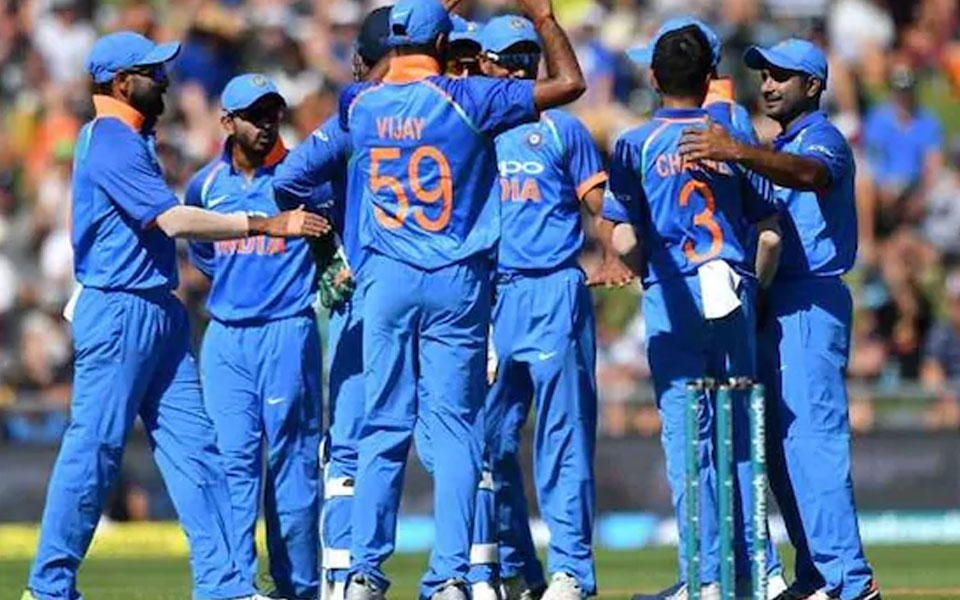
Napier, Jan 23 : India bowled with clinical precision to bundle out New Zealand for a paltry 157 in the first One-day International here Wednesday.
Wrist spinner Kuldeep Yadav was the most successful bowler for India, returning figures of 4/39 in 10 overs, while seamer Mohammed Shami finished with an excellent 3/19 in six overs. There were also two wickets for leg-spinner Yuzvendra Chahal.
Captain Kane Williamson top-scored for the hosts with 64 off 81 balls at the McLean Park.
Opting to bat, the New Zealanders were off to an inauspicious start, losing both openers Martin Guptill and Colin Munro within the first five overs with just 18 runs on the board.
Shami was the successful bowler on both occasions as he went through Munro with an indipper from round the wicket, moments after he forced Guptill to play one, which moved in on landing, onto his stumps.
By sending back Guptill in his 56th match, the 28-year-old Shami became the fastest Indian to reach 100 wickets in ODIs.
Entering the series after a hugely successful 2018, Ross Taylor looked good in his 41-ball 24, but he was brilliantly caught and bowled by Chahal, who lured the batsman to dance down the pitch a tad too early with his change of pace.
Till Taylor was there alongside Williamson, things looked good for New Zealand, as the duo played a few delightful shots, especially the skipper whose trademark backfoot punch through the covers stood out.
Tom Latham was dismissed in similar fashion, with leg-spinner Chahal being the bowler.
Henry Nicholls and Mitchell Santner came, swung their willows for a six and a couple of boundaries, got out to Jadhav and Shami respectively as New Zealand stuttered at 133 for six in the 30th over.
By that time, Williamson too have had enough, and got out while trying to hoick Yadav over long-on.
Let the Truth be known. If you read VB and like VB, please be a VB Supporter and Help us deliver the Truth to one and all.
IMEC momentum to boost Karnataka exports amid global trade disruptions
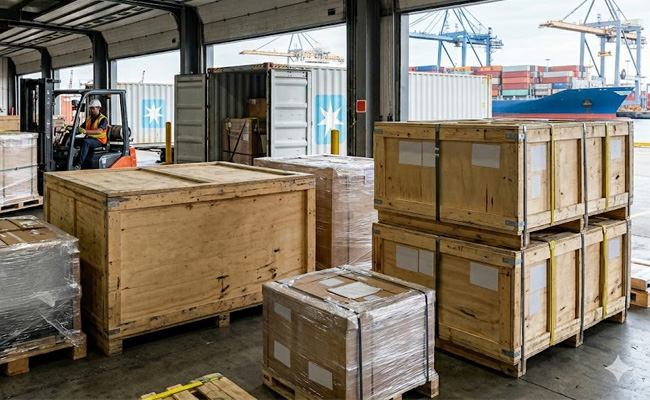
Bengaluru (PTI): Karnataka’s exporters are set to benefit as the India-Middle East-Europe Economic Corridor (IMEC) gathers momentum as an alternative to traditional maritime choke points, a senior tax official said, pointing to shifting global trade routes amid ongoing geopolitical tensions.
Addressing a seminar on “Navigating Geo-Political Challenges: Policy Measures and Preparedness to Build Resilience,” Kotraswamy M, Commissioner of Central Tax, Bengaluru North, said disruptions around key routes such as the Strait of Hormuz and the Suez Canal had underscored the need for more reliable corridors.
The event was organised by the Bangalore Chamber of Industry and Commerce (BCIC) in association with the Indian Institute of Materials Management.
"Owing to geopolitical tensions in West Asia, connectivity was hindered with Strait of Hormuz and Suez Canal as the choke points. Now with India-Middle East-Europe Economic Corridor (IMEC) gaining momentum as alternatives to the choke points, exporters from Karnataka and other states in India stand to gain in the global trade market," Kotraswamy said.
With this development, several critical choke points, especially fuel-related disruptions are expected to increase, he said adding IMEC is now gaining momentum as a more efficient and more reliable pathway, instead of depending on routes like the Suez Canal, the Strait of Hormuz, or even the Cape route, which are costly in terms of freight and sailing time, Kotraswamy said.
He added that exporters were also seeing gains from policy measures under the Goods and Services Tax (GST) regime.
“As exports are treated as zero-rated supplies under GST, the effective tax incidence on exports is zero per cent, allowing businesses to claim refunds on input taxes paid,” he said.
Kotraswamy noted that over 90 per cent of refund claims were now processed within seven days, compared to 15 to 30 days earlier.
He further said recent recommendations had enabled automatic refund processing and reduced documentation, cutting compliance costs by 20 to 25 per cent and easing working capital pressures.
Highlighting the state’s export performance, Prince Mehra of EXIM Bank said Karnataka is the fourth-largest exporter in India, contributing around seven per cent to the country’s merchandise exports and recording a compound annual growth rate of 7.8 per cent from FY19 to FY25.
“In FY25, Karnataka’s exports stood at USD 30.5 billion, driven by telecom instruments (17.3 per cent) and petroleum (14 per cent), followed by electrical equipment (five per cent), RMG/apparel (4.7 per cent), electronics (4.2 per cent), coffee (4.1 per cent) and pharmaceuticals (3.8 per cent),” Mehra said.
He added that the state ranked sixth in NITI Aayog’s Export Preparedness Index 2024 with an untapped export potential of USD 24.4 billion.
Emphasising the need for adaptability, K Ravi, senior vice president of BCIC, said in today’s volatile global landscape, resilience is no longer optional as it is a strategic imperative. Geopolitical challenges are reshaping trade dynamics and compelling businesses to rethink risk, cost, and continuity.
Sivasankari Murugan of ECGC highlighted support mechanisms available to exporters, including insurance products and policy interventions such as the RELIEF Scheme and the Export Promotion Mission.
She said such measures reflected a strong commitment to safeguarding industry competitiveness, and added that platforms like the seminar help stakeholders build the collaborative mindset required to navigate uncertainty.