India chase Billie Jean King Cup play-offs spot; Shrivalli pull out due to back spasm
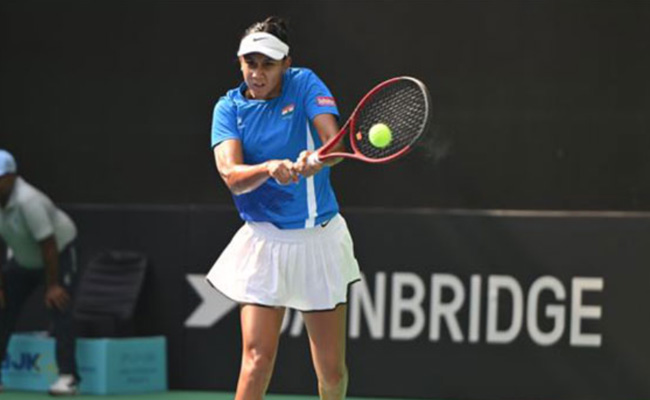
New Delhi (PTI): India will look to make the most of familiar conditions and home support when the Asia-Oceania Group I ties of the Billie Jean King Cup begin at the DLTA Complex on Tuesday, with promotion to the 2026 play-offs firmly on their radar.
However, the home challenge has suffered a dent with the withdrawal of talented Shrivalli Bhamidipaty.
Placed alongside Indonesia, Korea, Mongolia, New Zealand and Thailand, the hosts face a stiff challenge in a tightly-contested field where only the top two teams will progress, while the bottom two sides will be relegated to Group II for 2027.
India return to the regional competition after a disappointing outing in the 2025 play-offs held in Bengaluru, where they finished third in a three-team Group G.
The hosts suffered a 1-2 defeat to Slovenia and a 0-3 loss to the Netherlands, despite spirited efforts from debutant Shrivalli and Sahaja Yamalapalli.
That campaign marked a transition phase for the team, and the responsibility in singles now firmly rests on Sahaja and top-ranked Vaishnavi Adkar, who lead India's charge in the format.
Experienced campaigner Ankita Raina, meanwhile, is expected to focus on doubles duties, where her experience alongside Rutuja Bhosale remains a key asset. It won't be a surprise if skipper Vishal Uppal asks Ankita to play singles also during the tournament.
Sahaja, India's number two player at number 384, has been a consistent performer on the ITF circuit, reaching multiple semifinals over the past year and breaking into the top-300, underlining her role as the team's lead singles option.
She also gained valuable exposure at the WTA level, including a main-draw win on debut at the Chennai Open, reflecting her ability to compete against higher-ranked opposition.
Shrivalli has shown her big-match temperament in national colours, having gone unbeaten in singles during India's strong run in the 2025 Asia-Oceania Group I event, defeating multiple higher-ranked players.
She faced early exits in recent events such as the Mumbai Open, but her fighting displays continue to underline her potential at this level.
Her withdrawal is a setback for the hosts.
"Shrivalli withdrew from the team due to back spasm. Vaidehee Chaudhari (India number 3) would have replaced her but she twisted her ankle on Thursday while practising with the team. She hasn't fully recovered so we can't risk her. Zeel Desai has replaced her," Uppal told PTI.
"We have to work with and make the best of the cards dealt to us. I am focusing on what we have and how we make the most of it," he said.
The rise of Vaishnavi Adkar has added depth to India's singles line-up. The youngster, now the country's number one singles player at number 383, earned her maiden national call-up after a breakthrough run to the final of a W100 event in Bengaluru -- the first by an Indian woman in over a decade -- and also clinched an ITF title earlier this season, highlighting her rapid progress.
However, the absence of top-200 players remains a concern, with India's singles contingent still outside the top 300, reflecting the gap at the highest level.
Indonesia head into the tournament as favourites, led by the highest-ranked player in the field Janice Tjen, who has rapidly risen into the top 50 of the WTA rankings. Her recent performances underline why she is a major threat.
The world number 41 Tjen made global headlines last year by winning a match on her Grand Slam debut at the US Open, becoming the first Indonesian woman in over two decades to register a victory at that level.
She has carried that momentum into 2026, defeating top-30 player Leylah Fernandez at the Australian Open before reaching the second round. She has the ability to trouble higher-ranked opponents.
On the WTA Tour, she has already shown consistency against quality fields, including wins over established names and a run to the third round in a tour event earlier this season.
Though she suffered an early exit at the Miami Open, her competitive three-set loss against Kazakhstan's Yulia Putintseva further illustrated her fighting ability.
Having also clinched titles across WTA and WTA 125 events in 2025 and broken into the top 50 -- a rare feat for an Indonesian player -- Tjen arrives as the most accomplished singles player in the competition.
Backed by Priska Madelyn Nugroho and doubles specialist Aldila Sutjiadi, Indonesia present a well-rounded challenge.
Korea's line-up, featuring Sohyun Park and Eunhye Lee, offers depth, while New Zealand could prove dangerous with doubles specialist Erin Routliffe in their ranks even though they will miss experienced Lulu Sun, ranked 106.
Thailand, led by Patcharin Cheapchandej and Peangtarn Plipuech, also have the ability to trouble fancied sides, while Mongolia remains the least experienced but unpredictable unit.
For India, the key will be to capitalise on home conditions and deliver under pressure -- an area that cost them in Bengaluru.
If Sahaja and Vaishnavi can deliver in singles and the experienced doubles combination holds firm, the hosts stand a realistic chance of finishing in the top two and earning a return to the play-offs.
Squads:
India: Sahaja Yamalapalli, Vaishnavi Adkar, Zeel Desai, Ankita Raina, Rutuja Bhosale.
Indonesia: Janice Tjen, Priska Madelyn Nugroho, Anjali Kirana Junarto, Meydiana Laviola Reinnamah and Aldila Sutjiadi.
Korea: Sohyun Park, Eunhye Lee, Dayeon Back, BoYoung Jeong, Gaeul Jang.
Mongolia: Jargal Altansarnai, Khongorzul Aldarkhishig, Anu-Vjin Gantor, Oyungerel Khasbaatar.
New Zealand: Monique Barry, Valentina Ivanov, Aishi Das and Erin Routliffe.
Thailand: Patcharin Cheapchandej, Anchisa Chanta, Thasaporn Naklo, Peangtarn Plipuech and Kamonwan Yodpetch.
Let the Truth be known. If you read VB and like VB, please be a VB Supporter and Help us deliver the Truth to one and all.
Rajnath to top commanders: Outmaneuver adversaries with strategic surprise
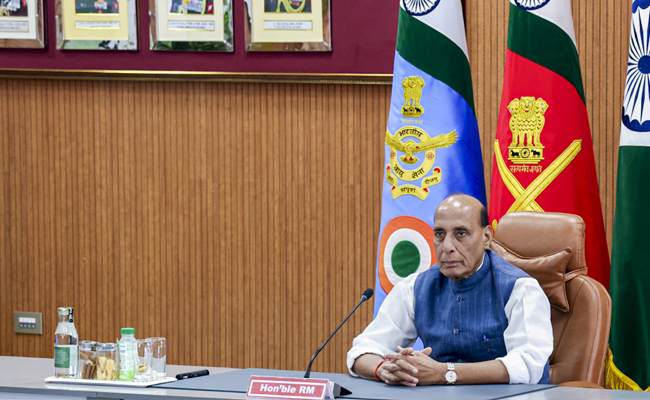
Jaipur/New Delhi (PTI): Defence Minister Rajnath Singh on Friday directed the top military commanders of the three services to integrate an "element of surprise" into modern warfare to outmaneuver India's adversaries and bolster strategic posture.
In his address at the joint commanders conference in Jaipur, Singh also described the Operation Sindoor as a testament to the "swift, precise, and joint response" of the Indian armed forces to safeguard national interests and called upon the military to remain ready to deal with any security challenges.
In their two-day deliberations, the commanders carried out a comprehensive review of the combat preparedness of the military in the wake of the evolving regional security situation.
Operation Sindoor was a demonstration of India's growing capabilities and a symbol of the nation's collective resolve and new military ethos, Singh said, a day after the first anniversary of Operation Sindoor.
He also unveiled a 'Joint Doctrine for Integrated Communication Architecture' that is aimed at strengthening doctrinal clarity, interoperability and integrated communications across the armed forces in future multidomain operations.
The joint commanders' conference, themed 'Military Capability in New Domains', brought together the top leadership of the defence ministry and the three services to deliberate on emerging security challenges and future readiness.
Comprehensive deliberations were held on future warfare, multidomain operations, technological transformation and joint capability development.
The conference witnessed extensive discussions on cognitive warfare, cyber resilience against evolving quantum and AI-enabled threats, military capability development in emerging domains, indigenous innovation and AI-enabled warfighting concepts.
It was attended by Chief of Defence Staff Gen Anil Chauhan, Chief of the Naval Staff Admiral Dinesh Kumar Tripathi, Chief of the Army Staff Gen Upendra Dwivedi, Chief of the Air Staff Air Chief Marshal AP Singh and Defence Secretary Rajesh Kumar Singh among others.
In his remarks, Singh asked the commanders to remain "future-ready" by learning from the operation as well as the current global security landscape.
He underscored the need to strengthen capabilities in artificial intelligence, autonomous systems, data analytics and secure communication networks to stay prepared in the rapidly evolving geopolitical security scenario. He emphasised that future conflicts will increasingly be shaped by hybrid threats, information dominance and operations conducted simultaneously across cyber, space, electromagnetic and cognitive domains, according to an official readout.
Highlighting the transformative impact of emerging technologies, Singh stressed on the importance of ensuring integrated national preparedness across all spectrums of conflict, it said.
Singh's remarks at the conference came a day after the first anniversary of Operation Sindoor.
The defence minister appreciated the progress achieved in enhancing jointness, integration and technological adoption across the three services, the readout noted.
Singh said that jointness constitutes a pivotal dimension within the transformative changes sweeping across the global defence sector.
"Future wars will not be won solely through weaponry, but through innovative thinking and enhanced synergy," he said.
The defence minister exhorted the commanders to cultivate the "element of surprise" to remain unpredictable to the nation's adversaries and secure a strategic edge in any given situation.
He, however, urged them to remain vigilant of the element of surprise of the enemy and always stay two steps ahead.
Singh also reiterated the Narendra Modi government's commitment to enhancing the capabilities of the defence forces through state-of-the-art weapons and platforms. He added that special focus is being laid on research in niche domains.
During the conference, he released a documentary film on Operation Sindoor.
The film reaffirms the nation's and defence forces' commitment to operational preparedness and decisive national response capabilities.
Demonstrations of advanced systems and platforms developed for intelligence fusion, operational planning and information management were also showcased during the conference reflecting growing integration of cutting-edge technologies into joint operational structures, according to the defence ministry.
The discussions will contribute significantly towards shaping India's future military transformation and integrated operational preparedness, it said.