India eye series-levelling win in 4th T20I, runs from openers
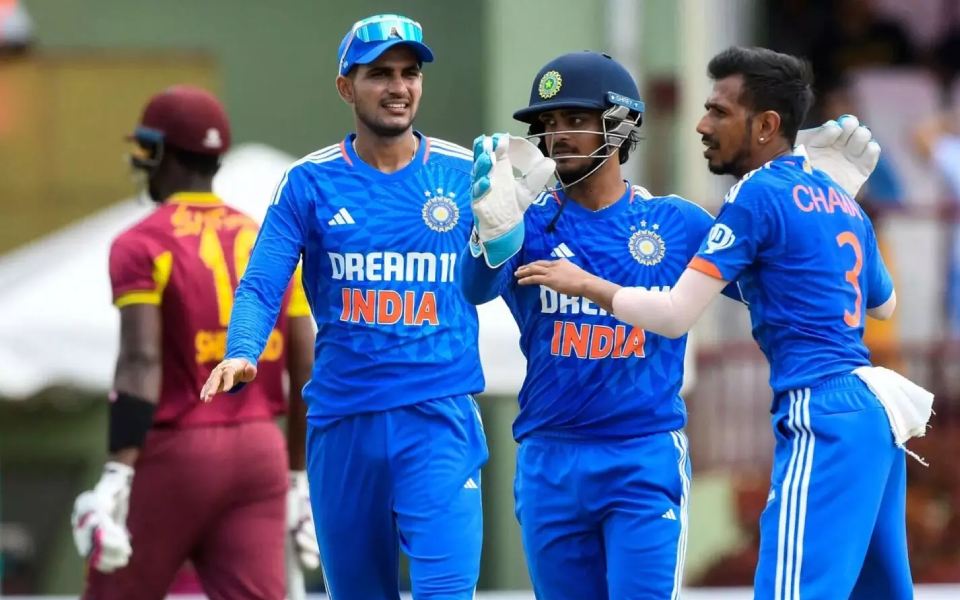
Lauderhill (USA), Aug 11: India will hope that batsmen will helm their march towards a series-levelling victory over the West Indies with another impact effort in the fourth T20 International here on Saturday.
India might have stayed afloat with a win in the third T20I but Windies still lead the series 2-1, a quick reminder to the fact that the visitors still have concerns surrounding the batting unit.
It was a comforting sight indeed to see Suryakumar Yadav flicking on his beast mode and Tilak Varma chipping in with crucial runs. But India's opening combination continued to falter.
India had handed T20I debut to Yashasvi Jaiswal, resting Ishan Kishan. But for the third successive match, the pair at the totem pole position failed to impress, making just six runs. Jaiswal got out to pacer Obed McCoy in the first over itself.
In the previous two matches, Kishan and Shubman Gill had managed to score just five and 16 for the first wicket to place some amount of pressure on the middle-order.
Whether India will bring back Kishan for this match remains to be seen, but the management will hope for a more potent outing from the openers in a must-win match.
That India do not have a handy bat lower down the order, makes it mandatory for batsmen at the top to deliver. India have deployed Axar Patel at No. 7 to maintain the balance and they might continue to adopt the five-bowler policy.
Having said that, the way Tilak carried the burden on his young shoulders has been remarkable.
The sequence of 39 (22 balls), 51 (41 balls) and 49 (37 balls) might be a presage that the Hyderabad left-hander is ready for bigger stages in his career.
He is currently the leading run-scorer in the series with 139 runs while averaging 69.50.
Suryakumar hinted at a possible broadening of role for Tilak, his teammate at Mumbai Indians.
"We've batted (together) for a long time now. We both understand each other. It was his day to bat with maturity. He is batting with a lot of confidence and he helped me bat well too," Suryakumar had said.
Kuldeep Yadav returned to the side for the third T20I and his performance will certainly add to India's confidence. He had missed the second T20I with a sore thumb.
The left-arm wrist spinner bagged three wickets, conceding 28 runs from four overs.
West Indies batsman Nicholas Pooran has been a thorn in India's flesh the whole series, but Kuldeep snaffled him before the left-hander blossomed.
Overall, three spinners -- Kuldeep, Axar, Yuzvendra Chahal -- gave a good account of themselves in the last match, and India will need an encore from them at the Central Broward Stadium.
In the initial part, the pitch here assists the batsmen but it often slips into sluggishness as the match progresses, evidenced by the 11 wins out of 13 matches registered by the team batting first.
As for the West Indies, they will not want to miss a chance to score their first series win over India after 2016 and will look for a far more cohesive display.
Teams:
India: Hardik Pandya (Captain), Ishan Kishan, Shubman Gill, Yashasvi Jaiswal, Tilak Varma, Surya Kumar Yadav, Sanju Samson, Axar Patel, Yuzvendra Chahal, Kuldeep Yadav, Ravi Bishnoi, Arshdeep Singh, Umran Malik, Avesh Khan, Mukesh Kumar.
West Indies: Rovman Powell (Captain), Kyle Mayers, Johnson Charles, Shai Hope, Roston Chase, Shimron Hetmyer, Jason Holder, Akeal Hosein, Alzarri Joseph, Brandon King, Obed McCoy, Nicholas Pooran, Romario Shepherd, Oshane Thomas, Odean Smith.
Match starts at 8 PM IST.
Let the Truth be known. If you read VB and like VB, please be a VB Supporter and Help us deliver the Truth to one and all.
T'gana RTC strike: Talks between govt, employees successful

Hyderabad (PTI): Talks between employees of Telangana State Road Transport Corporation (RTC) who were on strike and the state government concluded successfully on Friday as the government agreed to the key demands of the workmen.
Following a day-long marathon of talks between the leaders of the employees' Joint Action Committee (JAC) and the cabinet sub-committee, the government announced after midnight that it acceded to the demands, including a merger of RTC with the government, 11 per cent pay revision and elections to the employees' unions.
A committee comprising officials and employee leaders would be appointed over the merger of RTC with the government, it said.
The RTC management has also agreed to address the remaining issues as well, an official release said.
The employees would call off their strike and the RTC buses would hit the roads shortly, it said.
The employees had been on an indefinite strike since April 22 over a series of demands, including the merger of RTC with the government.
Earlier in the day, a driver of the RTC, who attempted suicide on April 23 during the strike, died at a hospital here in the early hours of Friday.
Shankar Goud, a 55-year-old driver, set himself ablaze by pouring petrol at Narsampet in Warangal district when the employees were staging a protest on Thursday in support of their demands.
Goud suffered serious burns, was initially admitted to a state-run hospital in Warangal, and later shifted to a super-speciality hospital in Hyderabad for advanced treatment.
"He succumbed (to injuries) at about 1.30 am on Friday," a senior official said.
The driver’s body was taken to his relative’s village, Muttojipet in Warangal district, for funeral rites.
Tension prevailed in Muttojipet as his family members and RTC employees attempted to take the body to the Narsampet bus station, where he worked, to enable his colleagues to pay their last respects. However, police did not permit this, citing law-and-order concerns.
This led to a deadlock before the funeral could proceed.
Union Minister Bandi Sanjay Kumar criticised the Telangana government for not allowing the body to be taken to the Narsampet bus station.
Kumar, Minister of State (Home), visited Muttojipet village in Warangal district, where the funeral was held, and paid homage to Goud.
“They (family members) want to take the body to the bus depot for five minutes. Is the RTC bus depot in Pakistan or Bangladesh? They are emotionally attached to taking the body there. The government is hurting sentiments and creating fear among RTC employees,” Kumar told reporters.
He also expressed anger at the police for not allowing the body to be taken to the bus station and staged a protest, according to a release from his office.
RTC employees and BJP workers attempted to take the mortal remains in an ambulance to Narsampet, but were stopped by the police.
Later, after discussions with the police, the family members and RTC employees agreed to conduct the funeral in the village.
Sanjay Kumar, stating he would abide by the family’s decision, left the village after the funeral was conducted there.
Transport Minister Ponnam Prabhakar said an ex gratia of Rs 10 lakh, a house, and a government job would be provided to the kin of Goud.
Chief Minister A Revanth Reddy expressed shock over the employee’s death and conveyed deep condolences to the grieving family, according to the release.
The RTC employees’ JAC had earlier announced an agitation programme from April 24 to 29, including silent marches and submission of memorandums to MLAs and other leaders.