India head coach Stimac to serve just one-match ban, to return at helm against Kuwait in SAFF c'ship
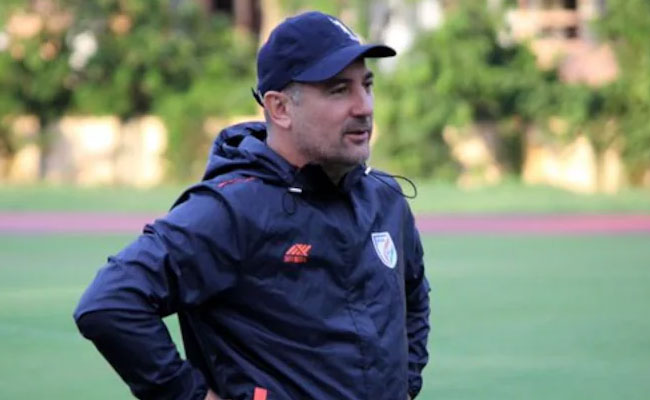
Bengaluru (PTI): Head coach Igor Stimac will return to the India dug out in the game against Kuwait on Tuesday after serving one-match ban for his red-card offence against Pakistan in the home side's SAFF Championships opener here.
South Asian Football Federation (SAFF) General Secretary Anwarul Huq told PTI that Stimac's offence was not serious enough to attract a ban of more than one match and as such it will not be referred to the SAFF Disciplinary Committee for further action.
"He (Stimac) will serve a one-match ban, not more than that," he said from Dhaka on Thursday.
He said the report of the referee and match commissioner mentioned the scuffle during the match which had led to Stimac's expulsion from the field of play but it would not be sent to the SAFF Disciplinary Committee.
"It (the offence) was not so serious that it would merit referring the matter to the Disciplinary Committee (for a harsher punishment)."
Stimac, a vastly experienced coach and 1998 World Cup bronze medallist for Croatia, interfered when Pakistan player Abdullah Iqbal was ready to make a throw-in. He tried to pull back the ball from the player, sparking wild reactions from some Pakistani players as well as some coaching staff.
The referee Prajwal Chhetri and other match officials had to intervene to separate the intensely sparring individuals.
As the scuffle was brought under control referee Chhetri showed red card to Stimac, as per the football rules, for interrupting with the actions of an opposition player deliberately.
Stimac could not stand on the sideline for the rest of the match, with former India defending Mahesh Gawli doing the duty on the touchline.
Gawli will also take charge of the Indian team against Nepal on Saturday before Stimac returns for the last group match against Kuwait.
A red card (direct or indirect) generally attracts one-match ban for a player or coach but the punishment can be increased up to suspension of four matches if the offence is grave.
Let the Truth be known. If you read VB and like VB, please be a VB Supporter and Help us deliver the Truth to one and all.
Choose faith or future: BJP alleges 'second-class treatment' of Hindus in K'natka CET row
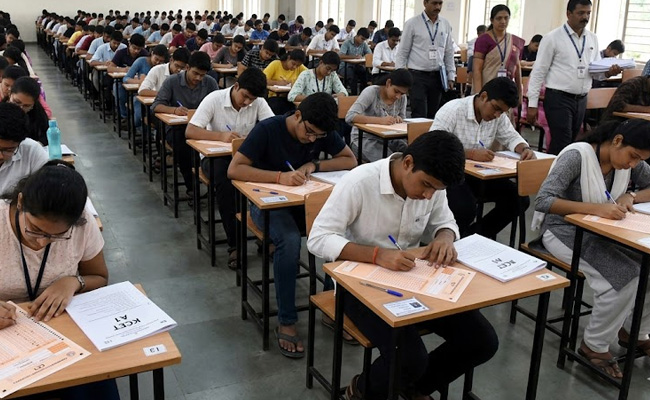
New Delhi (PTI): The BJP on Saturday accused the Karnataka Congress government of being "anti-Hindu" and following double standards after students appearing for the Common Entrance Test (CET) were allegedly asked to remove their 'janeu'.
A political row erupted after five Brahmin students were allegedly forced to remove the thread, considered sacred and worn across the torsos, at a city college in during the CET on Friday.
Students alleged that the invigilators at Madivala asked them to remove their janeu/yajnopaveetha if they wanted to write the exam.
In a video post on X, BJP national spokesperson Shehzad Poonawalla lambasted the act.
"Is it a crime to be a Hindu in Karnataka? In Karnataka, students were stopped from entering the examination hall for wearing a janeu and were given a brutal option -- choose your faith or your future. This happened last year as well," Poonawalla alleged.
ALSO READ: ECI to release exact voter turnout in TN
He accused the Karnataka government of practising double standards and engaging in appeasement politics.
"In Karnataka, we have seen the politics of appeasement. Muslim reservation, a Muslim-only budget, and quotas and contractual work for Muslims. But Hindus have to remove their sacred thread if they want to take an exam, which even the courts have, by the way, allowed," he alleged.
He accused the Congress government of adopting a similar approach in other states where it is in power, while allowing hijab and burka in classrooms.
"It has happened in various Congress-ruled states. We have seen that the Congress party advocates the right to hijab and burkha within the classroom. They say this should be allowed. Even the courts have overruled it.
"But in the case of janeu, they want it to be removed. This is not the first time this has happened. In Telangana and other states, the tilak and mangalsutra were removed. But hijab is fine. This is the kind of second-class treatment being given to Hindus," he added.
Poonawalla said the Congress should rename itself from INC to "MMC -- Muslim League Maowadi Congress" or the "Islamic National Caliphate Party".
As the controversy took a political turn, the college suspended the invigilator pending inquiry. The government also ordered a probe.
The police registered a case and detained three staff members of Krupanidhi College who were in charge of examination checking for questioning, officials said.
A similar incident took place last year in Karnataka, following which the government directed that the candidates would not be asked to remove the janeu while appearing for the CET.