India in control despite lower-order collapse as Australia chase 323

Adelaide, Dec 9: India remained in driver's seat despite lower-order collapse as Australia lost opener Aaron Finch's wicket at the stroke of tea in pursuit of a stiff target of 323 on the fourth day of the first Test on Sunday.
Aaron Finch (11), survived a loud leg before appeal on zero off Ishant Sharma's second ball of the second innings. He went for DRS review and the decision was turned because it was a no ball.
Ashwin however nabbed just before tea as the ball brushed his gloves before looping up for keeper Rishabh Pant to claim an easy catch. Marcus Harris (14 batting) was unbeaten at the other end.
Earlier, India lost five wickets for 25 runs after lunch to get bowled out for 307 in their second innings riding on half-centuries from Cheteshwar Pujara (71) and Ajinkya Rahane (70).
India only added 47 runs for their last five wickets after resumption of play post lunch.
Rishabh Pant (28) continued attacking Nathan Lyon (6-122) but didn't last long as a wild swing found the fielder at deep cover. It started the Indian slide.
Ashwin (5) and Ajinkya Rahane (70) played uncharacteristic strokes, indicating that a declaration was forthcoming. But India never got to that point.
Ashwin was caught pulling in the deep off Mitchell Starc (3-40) while Rahane was out caught reverse sweeping. Mohammed Shami (0) was out caught first ball, wildly swinging at Lyon.
Ishant Sharma (0) was bounced out as India were bowled out in just 11.5 overs after lunch. Their last seven wickets cost only 73 runs. Earlier, Pujara and Rahane took India to 260 for five at lunch.
Starting from overnight 151 for 3, India made good progress through the first session as Pujara and Rahane ground down the Australian attack with an 87-run partnership for the fourth wicket.
Pujara started on a positive note with successive fours early in the day's play. India's main threat came from Nathan Lyon (3-92), who was using the rough on the pitch to trouble the batsmen.
Rahane survived an appeal for a catch in the 74th over via DRS when replays showed that the bat was nowhere near the ball.
India's 200 had came up in the 77th over while their 50-partnership came off 103 balls. Pujara reached his 20th Test half-century off 140 balls.
The duo continued to grind down the Australian bowling as their pacers' body language started looking tiresome. Mitchell Starc (1-34) took the second new ball as soon as it became available but was wayward at best.
Australia finally got a breakthrough with Pujara out caught at short leg, off Lyon in the 88th over as the ball looped up.
He walked off to a standing ovation from the Sunday crowd, having faced 450 balls in this match, the second-most for an Indian batsman in a Test on Australian soil after Sachin Tendulkar (525 at Sydney, 2004).
Rohit Sharma (1) came to the crease thereafter, but left quickly, caught at silly point smartly by Peter Handscomb as Lyon picked up his third wicket.
Young Pant though decided to attack and took India past 250 before lunch. At the other end, Rahane had opened up to play pull strokes off the pacers against the new ball and reached his 16th Test half-century off 111 balls.
Let the Truth be known. If you read VB and like VB, please be a VB Supporter and Help us deliver the Truth to one and all.
Dr. Vinod Sharma’s Achievements Highlight His Impact on Education and Brain Science Training
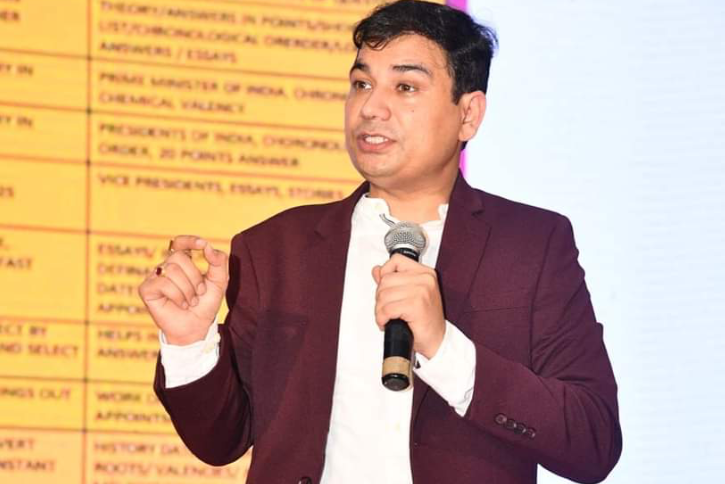
Dr. Vinod Sharma has emerged as one of India’s prominent figures in the field of brain science education, with a series of notable achievements that underline his contribution to transforming learning methodologies across the country.
Among his most distinguished accomplishments is securing recognition in the Guinness World Records for conducting one of the largest memory training sessions, where over 1,500 participants were trained simultaneously. This milestone not only set a global benchmark but also demonstrated the growing relevance of memory-based learning techniques in modern education. He has also been recognized by the Asia Book of Records for organizing a similarly large-scale memory training session, further strengthening his credibility in the domain.
Dr. Sharma’s work has consistently earned him national and international recognition. He was honored with the Indian Achievers Award (2020–21) for his exceptional contribution to education and nation-building. In addition, he received the ASEAN Excellence Award (2020 and 2022) for his innovative research and application of brain science in learning. His contributions have also been acknowledged through accolades such as the Education Icon Award and the Icons of India Award, highlighting his role in revolutionizing traditional education practices.
Earlier in his career, he was featured in the India Book of Records (2016) for training the highest number of individuals in memory and brain science techniques. He also received recognition under the “Record of the Decade” category, marking a significant milestone in his professional journey.
Beyond awards, Dr. Sharma’s achievements are reflected in his large-scale impact. He has trained over 500,000 students and more than 200,000 educators and professionals, both in India and internationally. His training programs, workshops, and seminars have collectively reached over 2 million individuals through online and offline platforms.
A key highlight of his work is the establishment of more than 25 Brain Science Labs across multiple states, including Rajasthan, Gujarat, Uttarakhand, and Delhi. These labs represent a practical implementation of his techniques and have been integrated into over 100 schools, offering students hands-on learning experiences focused on cognitive development and memory enhancement.
His expertise has also been recognized by government institutions. He has led training initiatives for teachers and principals under various state government projects and contributed to pilot programs supported by educational bodies such as NCERT. These collaborations signify institutional trust in his methodologies and their potential for large-scale educational reform.
Internationally, Dr. Sharma has extended his influence through training programs conducted in countries like Malaysia, where he worked with educational institutions and organizations to promote brain science-based learning techniques.
In addition to his training and institutional contributions, Dr. Sharma is a prolific author. His books on memory techniques and learning strategies have further solidified his position as a thought leader in the field. His work continues to inspire students, educators, and policymakers to adopt more effective and scientific approaches to learning.
As India continues to evolve its education system, Dr. Vinod Sharma’s achievements stand as a testament to the growing importance of innovation, cognitive science, and practical learning in shaping the future of education.