India look to protect home ODI record as NZ eye historic first series win

Indore (PTI): India's absolute dominance at home will come under examination when they meet a determined New Zealand in the decisive third ODI at the high-scoring Holkar Stadium here on Sunday, with the three-match series locked at 1-1.
India have not lost a bilateral ODI series at home since March 2019, when Australia overturned a 0-2 deficit to win 3–2, including the decider in Delhi. But that history is now firmly on the line.
For New Zealand, the context is equally compelling.
The Black Caps have toured India for bilateral ODIs since 1989 but have never won a series in India and this is arguably their best opportunity to break that barren run.
India head coach Gautam Gambhir would not like another tumbling at home under his regime after getting a number of unwanted firsts. India lost five Tests at home under Gambhir apart from losing an ODI series in Sri Lanka for the first time.
India's defeat in the second ODI at Rajkot was shaped less by one extraordinary innings than by how New Zealand seized control of the middle overs.
Daryl Mitchell's unbeaten century was built on calculated aggression, particularly against spin, an area where India have been struggling of late.
Indore, with its short boundaries and minimal assistance for bowlers, offers even less margin for error.
India's ability to tackle spin has raised questions. Despite depth and power, the side has continued to show discomfort against spin in the middle overs. Strike rotation has stalled at key phases, forcing batters into high-risk options rather than controlled accumulation.
On a ground where totals can quickly spiral beyond 350, those quiet overs can decisively tilt the momentum.
Will there be a RoKo show
=================
Much of the spotlight will be on Rohit Sharma, who is enduring a lean run in this series. His ultra-aggressive approach at the top has been a defining feature of India's recent ODI philosophy, but repeated early dismissals has added a bit of pressure.
Virat Kohli, meanwhile, remains the fulcrum around which India’s ODI batting revolves. With India’s next 50-over assignment for senior players likely to come in July during the tour of England, the fans would hope for another RoKo show.
Selection balance
=============
The choice between Nitish Kumar Reddy and Ayush Badoni is effectively a debate between depth and control.
Reddy adds seam-bowling insurance, though used sparingly, and late-innings power, while Badoni offers a tighter technique against spin and composure in the middle overs.
The case for including left-arm pacer Arshdeep Singh also gains weight at Indore, where variations rather than raw pace often determines success.
Arshdeep’s ability to swing the new ball, attack the stumps and execute yorkers at the death offers India a different tactical dimension, particularly against New Zealand’s largely right-handed top and middle-order.
His inclusion would also reduce the burden on the spinners in the middle and late phases, allowing India to rely more on pace-off deliveries, wide yorkers and hard lengths — methods better suited at Holkar Stadium than spin.
The challenge lies in whom he replaces. Mohammed Siraj’s new-ball role makes him difficult to leave out. The most likely trade-off would be a spinner or a seam-bowling all-rounder, depending on conditions and batting depth.
KL Rahul's role is one area where clarity already exists. His returns at number five underline the value of keeping him in that position rather than pushing him down to six, where his ability to manage tempo and rebuild under pressure is diluted.
New Zealand has oodles of confidence and clarity. Mitchell's dominance, supported by Devon Conway, has reflected the Black Caps' ability to identify match-ups and execute without overreach.
Their bowlers, though lacking headline names, have used variations and hard lengths effectively in conditions offering little natural assistance.
At a venue where bowlers are often reduced to do damage control, the contest is likely to hinge as much on decision-making as it is on skill.
For Shubman Gill and his side, the challenge is not just to win a series, but to demonstrate tactical flexibility and situational awareness — traits that define successful teams when margins are thin and pressure is real.
Teams (from): India: Shubman Gill (c), Yashasvi Jaiswal, Virat Kohli, Rohit Sharma, KL Rahul (wk), Dhruv Jurel (wk), Ravindra Jadeja, Nitish Kumar Reddy, Ayush Badoni, Kuldeep Yadav, Arshdeep Singh, Prasidh Krishna, Mohammed Siraj, Harshit Rana.
New Zealand: Michael Bracewell (c), Devon Conway (wk), Mitchell Hay (wk), Nick Kelly, Henry Nicholls, Will Young, Josh Clarkson, Zak Foulkes, Daryl Mitchell, Glenn Phillips, Adithya Ashok, Kristian Clarke, Kyle Jamieson, Jayden Lennox, Michael Rae.
Match starts at 1:30pm IST.
Let the Truth be known. If you read VB and like VB, please be a VB Supporter and Help us deliver the Truth to one and all.
VCK urges CM Vijay to enact stringent law against superstitious practices
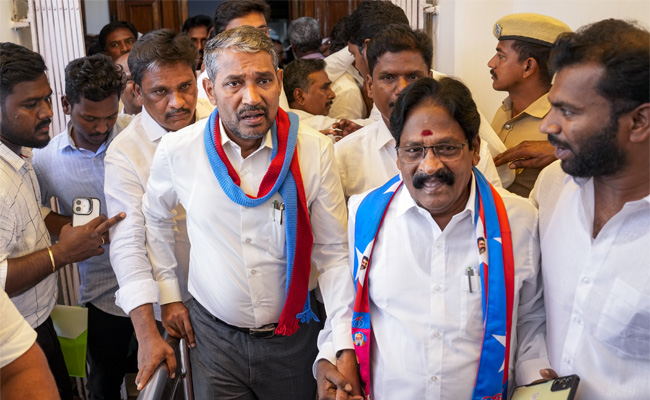
Chennai (PTI): VCK MLA Vanni Arasu on Wednesday urged the newly formed Tamil Nadu government to enact a stringent law against superstitious practices, citing similar legislations in Karnataka and Maharashtra to curb exploitation in the name of black magic and rituals.
VCK, which won two seats in the 2026 Assembly election, has offered support to TVK to form a government during the floor test.
Speaking during the discussion on the confidence motion in the Assembly, Arasu highlighted that states like Bihar, Jharkhand, Chhattisgarh, Odisha, and Rajasthan already have laws against witchcraft and sorcery.
"From 2013 in Maharashtra and 2020 in Karnataka, laws providing imprisonment for those who deceive through superstitious means have been in practice," he stated. The party noted that rationalist Narendra Dabholkar had fought for such a law in Maharashtra before being murdered by "Sanatana terrorists".
The VCK MLA further called on the government to prioritise scientific temper over beliefs in astrology and sorcery.
"Our government should give priority to projects that develop science without giving room for superstitions like astrology and black magic," Arasu said, citing Article 51A of the Indian Constitution, which defines the development of scientific temper as a fundamental duty of every citizen.
The party demanded a special law to prevent honour killings as well, which Arasu claimed are rising in Tamil Nadu as they once did in North Indian states.
The government was also urged to enact legislation protecting the "200-point roster system" for SC/ST employee promotions, utilising powers under Article 16(4A) of the Constitution.
Highlighting the recent arrest of 40 Tamil Nadu fishermen by the Sri Lankan Navy, the VCK sought a permanent solution to protect them from such attacks.
The party called on the state government to take initiatives toward the "right of Eelam Tamils to rule themselves" and requested that the state officially observe May 18 as International Genocide Day.