
India Open: Sindhu out; Srikanth, Prannoy advance
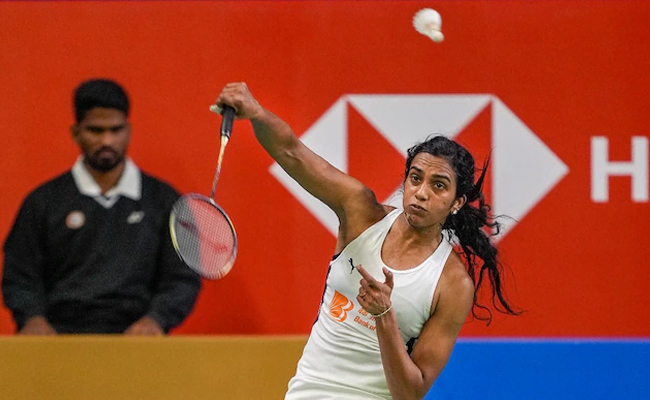
New Delhi (PTI): Two-time Olympic medallist P V Sindhu was knocked out of India Open but Kidambi Srikanth and HS Prannoy progressed to the second round on a mixed day for the hosts at the USD 950,000 Super 750 badminton tournament, here Wednesday.
Sindhu, who reached the semifinals of Malaysia Super 1000 last week, couldn't maintain the pressure after narrowly pocketing the opening game to eventually go down 22-20 12-21 15-21 to Vietnam's Thuy Linh Nguyen in 68 minutes.
"I don’t think it was my day, she isn’t an easy opponent. At this level, everyone plays well and you can’t expect easy points or easy wins. She has good strokes, you had to keep the tempo and keep the shuttle in play. Small mistakes in those moments become decisive," Sindhu said after her exit.
"I definitely need to be more consistent. Giving away easy or consecutive points is something I have to stop. After losing one point, I need to reset immediately and be ready for the next rally. That’s the main takeaway for me."
Earlier, former world No. 1 Srikanth had to dig deep to outlast fellow Indian Tharun Mannepalli 15-21, 21-6, 21-19, while Malvika Bansod, returning from an injury layoff, displayed patience and defensive solidity to beat Chinese Taipei’s Pai Yu Po 21-18, 21-19.
Prannoy, who received a last-minute entry in the tournament, made it count as he outwitted last year's runner-up Lee Cheuk Yiu 22-20 21-18 to advance to the second round. He will next face eighth seed and former world champion Loh Kean Yew of Singapore.
Tanvi Sharma, silver medallist at the BWF World Junior Championship, then played her heart out before going down fighting 20-22 21-18 13-21 to world number 2 Wang Zhi Yi.
Indian women’s doubles campaign also got off to a positive note with Treesa Jolly and Gayatri Gopichand cruising past Thailand’s Ornnicha Jongsathapornparn and Sukitta Suwachai 21-15, 21-11.
The Indian pair, fresh from defending their Syed Modi International title, will next face seventh seeds Li Yi Jing and Luo Xu Min of China.
However, it was a disappointing day for India in mixed doubles, with three Indian pairs exiting the tournament at an early stage.
Dhruv Kapila and Tanisha Crasto went down 15-21, 14-21 to Thailand’s Pakkapon Teeraratsakul and Sapsiree Taerattanachai, while Rohan Kapoor and Ruthvika Shivani Gadde lost 19-21, 14-21 to Germany’s Marvin Seidel and Thuc Phuong Nguyen.
Ashith Surya and Amrutha Pramuthesh were also shown the door after a 15-21, 7-21 defeat to Japan’s Yuichi Shimogami and Sayaka Hobara.
Sindhu vs Nguyen
=============
Coming into the match after two losses in her last two meetings against Nguyen, the Indian knew the importance of a strong start. She raced to a 3-0 lead.
The Vietnamese clawed back to 6-6 before Sindhu pulled away again to make it 12-6. Nguyen, however, stayed in touch, narrowing the gap to 11-12 and then 13-14.
A smash followed by a sharp cross court drop helped Nguyen close in at 16-17 before she drew level at 19-19 and earned a game point.
She failed to convert, though, spraying a return wide, and Sindhu capitalised immediately with a decisive smash to take the opening game.
The second game began on an even note with the scores locked at 4-4. Nguyen then moved ahead 7-4, but Sindhu once again reeled her in at 8-8. The Vietnamese went into the interval with a two point cushion and surged ahead to 15-9 after the restart.
A series of wide and long shots compounded Sindhu’s frustration as Nguyen raced to 19-11. A precise backline placement earned her multiple game points and she sealed the game with a body smash to force a decider.
The third game followed a similar script with neither player willing to yield ground. Two superb cross court smashes helped Sindhu stay level at 7-7 and the contest remained tight at 10-10 before another wide error from the Indian shifted momentum.
Nguyen seized control after the break, opening up a four point lead at 18-14 and then unleashed another accurate smash to move within two points of victory. The Vietnamese earned five match points. Sindhu erred again as she closed it out comfortably.
Let the Truth be known. If you read VB and like VB, please be a VB Supporter and Help us deliver the Truth to one and all.
SC refuses to entertain plea against deletion of names from WB voter list, terms it ‘premature’
_vb_77.jpeg)
New Delhi (PTI): The Supreme Court on Monday declined to entertain a plea by a group of 13 people seeking its intervention in the deletion of their names from the voter list during the Special Institutional Revision (SIR) in West Bengal, where polling for the first phase of the assembly election will be held on April 23.
A bench comprising Chief Justice Surya Kant and Justice Joymalya Bagchi termed the petition "premature", directing the aggrieved parties to approach the established appellate tribunals instead.
"Since the petitioners (Quaraisha Yeasmin and others) have already approached the appellate tribunals… in our considered view, the apprehensions expressed in the petition are premature. If the plea is allowed, then necessary consequences will follow,” the bench said in its order, adding that it has not expressed any views on the merits of the plea.
The plea alleged that the Election Commission was summarily deleting names without following due process, and that appeals against these deletions were not being heard in a timely manner.
The Chief Justice of Calcutta High Court has set up as many as 19 tribunals headed by former HC chief justices and judges to decide appeals against deletions of names of persons from the voters’ lists.
Senior advocate D S Naidu, appearing for the poll panel, informed the court that there are approximately 30 to 34 lakh appeals currently pending. "Every tribunal now has over one lakh appeals to handle," the bench said.
The petitioners’ counsel argued that the EC had failed to place necessary orders before the relevant judicial authorities and that the "freezing date" for the electoral rolls should be extended.
"If I am not allowed to argue, then what is the use? Will these appeals be decided within a timeframe or just kept extending?" the counsel asked.
Justice Bagchi, during the hearing, referred to the sanctity of the electoral process and said the right to vote is not merely a constitutional formality but a "sentimental" pillar of democracy.
"The right to vote in a country you were born in is not just constitutional, but sentimental. It is about being part of a democracy and helping elect a government," he said.
He, however, said that the tribunals, manned by former judges, cannot be overburdened by fixing the timelines for adjudications.
"It is not the end justifying the means, but the means justifying the end," Justice Bagchi said.
"We need to protect due process rights. The voter should not be sandwiched between two constitutional authorities," he said, adding that it would not interdict the election process at this stage.
Justice Bagchi noted that the Calcutta High Court Chief Justice had already formulated the manner and mode for appeals, which began on Monday.
"Unless and until an enormous number of voters are excluded or it materially affects the election... the election cannot be cancelled," the bench said, adding that judicial intervention is intended to "promote elections, not interdict them."
The CJI emphasised that the petitioners must exhaust their remedies before the appellate tribunals.
Assembly elections in West Bengal will be held in two phases on April 23 and 29, and votes will be counted on May 4.
_vb_67.jpeg)
_vb_65.jpeg)
_vb_52.jpeg)