India Outclass Australia To Claim Record 4th Under-19 World Cup Title
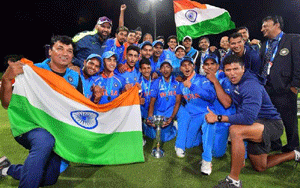
Tauranga (New Zealand): Promising opener Manjot Kalra played a starring role with an unbeaten century as India overpowered Australia by eight wickets in the final to claim the ICC U19 World Cup for a record fourth time here on Saturday.
The opener batted through the innings and remained unbeaten on 101 runs off 102 deliveries as the Indians romped past the modest target of 217 runs with 67 balls to spare.
Harvik Desai played an excellent supporting role at the other end and was not out on 47 runs off 61 balls.
Desai brought up the title win in style, smashing a boundary off Australian pacer Will Sutherland through the off-side.
Kalra was adjudged the man of the match while compatriot Shubman Gill took home the player of the tournament award.
"Great feeling. Enjoyed a lot. Conditions were very good. It was a flat wicket to bat on. In the team, it's been a great environment," an overjoyed Kalra told the media after the final.
India thus became the first nation to win the ICC U19 World Cup four times. They had earlier won the title in 2000, 2008 and 2012.
Australia are second on the list with three titles.
This is the second time that India have defeated Australia in the final. They had earlier defeated the boys from Down Under in the final of the 2012 edition.
Chasing a modest target, India got their chase off to a flying start with Manjot and skipper Prithvi Shaw piling up 71 runs for the opening stand.
India's chase was briefly halted by rain after just four overs, but Manjot and Prithvi ensured that they maintained their focus and after coming back they batted out the initial few overs before cutting loose.
But just when the Indian pair threatened to take the match away, pacer Will Sutherland drew first blood for the Australians by rattling Shaw's off-stump.
The Indian skipper scored 29 runs off 41 deliveries with four hits to the fence.
Shaw's dismissal brought in the centurion of the semi-final against Pakistan, Man-of-the-Tournament Shubman Gill, who raised 60 runs for the second wicket with Manjot before perishing to off-spinner Param Uppal on the personal score of 31.
This was unfortunately Gill's first below-50 score in the tournament but wicketkeeper-batsman Harvik Desai ensured that there were no more hiccups in India's road to the title.
With India just five runs shy of the title, Manjot got to his personal landmark, punching one down to square leg for a single even as the celebrations began on the sidelines with the Rahul Dravid-led side romping home in 38.5 overs.
Earlier, electing to bat after winning the toss, Australia rode on Jonathan Merlo's steady 102-ball 76 -- laced with six boundaries -- to set up a modest 216-run total.
Australia lost their three top batsmen with just 59 runs on the board, thanks to pacer Ishan Porel's twin strikes early on.
Porel's victims included the openers Max Bryant (14) and Jack Edwards (28) before fellow fast bowler Kamlesh Nagarkoti joined the party by removing Australian skipper Jason Sangha for an unlucky 13 off 24 balls.
Thereafter, Merlo and Param Uppal (34) steadied the innings with a 75-run fourth wicket stand which saw them going past the 100-run mark.
Left-arm spinner Anukul Roy ended Uppal's 58-ball stay with a brilliant catch in his own follow through.
With Australia tottering at 134/4, Merlo was joined by Nathan McSweeney (23).
The pair added 49 runs for the fifth wicket before McSweeney met the same fate as Uppal, this time caught and bowled by the other Indian spinner Shiva Singh.
Despite losing his partners at the other end, Merlo continued to torment the Indians, raising his maiden half century off 60 balls by chopping a slower delivery from Porel for a single to sweeper cover.
Merlo, however, succumbed under the pressure of scoring quick runs, when he attempted a reverse sweep off Roy only to manage a top-edge for Shiva to grab at sweeper cover, even as Australia's hopes were dashed after losing the last five wickets for just 33 runs.
For the boys-in-blue, Ishan Porel, Kamlesh Nagarkoti, Shiva Singh and Anukul Roy took two wickets each while Shivam Mavi grabbed one.
Let the Truth be known. If you read VB and like VB, please be a VB Supporter and Help us deliver the Truth to one and all.
Bantwal: Seven students seriously injured as car climbs on divider, hits power pole, topples on NH

Bantwal: Seven students sustained serious injuries in an accident that reportedly occurred in Maripalla near Farangipet in the taluk as the driver of the car lost control and climbed onto a road divider before hitting a power pole installed on the divider.
The accident is said to have occurred shortly after midnight on Thursday. The injured students, including four girls and three boys, are reportedly from Udupi.
They were traveling Mangaluru to BC Road on the National Highway when the driver lost control over the vehicle, resulting in the accident. The car reportedly hit the power pole, dragged it along for a distance and then overturned on the road.
Eyewitnesses have said that the overturned car was lifted and injured students were immediately taken to the Fr. Muller Hospital in Thumday with the help of locals.
Police officers have visited the accident site and also took further action.