India press advantage against desperate England as Rohit, Gill slam hundreds
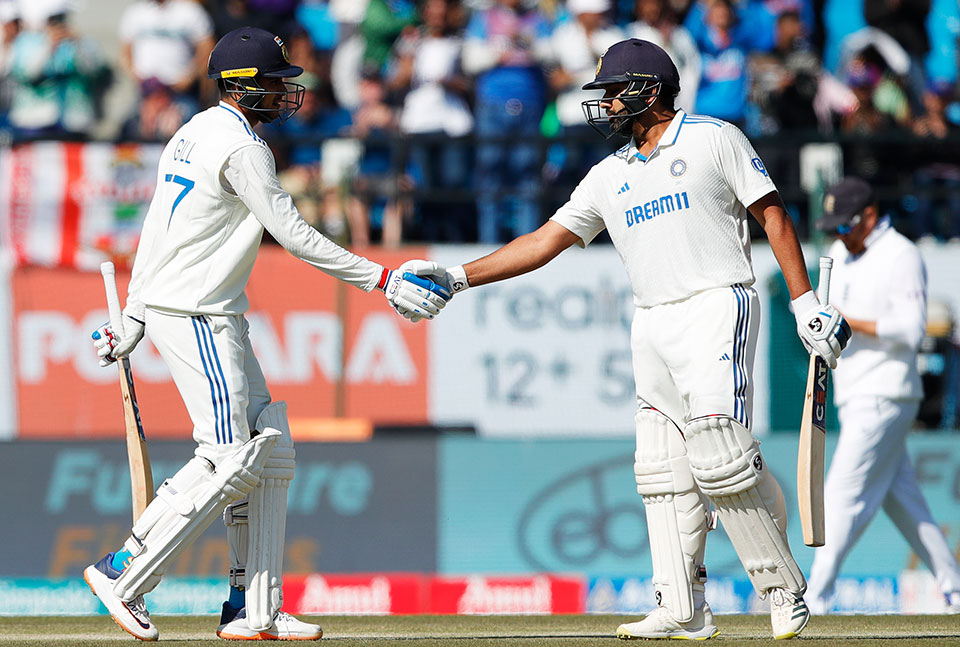
Dharamsala(PTI): Skipper Rohit Sharma and Shubman Gill struck sublime hundreds as India pressed the advantage in the fifth Test against England by reaching 264 for one at lunch on day two, here on Friday.
Rohit (102 batting off 160 balls) and Gill (101 batting off 142 balls) walked out in the middle in bright sunshine and milked the conditions to take India well past England's first innings total of 218 after resuming the innings at 135 for one.
At the break, they led the visitors by 46 runs and were on course for a massive first innings total.
England tried everything to contain them, whether it was employing the leg-slip for Rohit when Shoaib Bashir was in operation or Mark Wood using the odd short ball against the opening duo with as many as six fielders on the leg side.
However, nothing worked for the visitors despite the Barmy Army making a lot more noise than the Indian fans at the stunning HPCA stadium. Rohit and Gill collected 129 runs from 30 overs in the two hours of play.
Rohit and Gill, who were batting on 52 and 26 overnight, gave themselves an over each after start of play before going for their strokes.
Off-spinner Bashir opened the bowling alongside veteran pacer James Anderson and was put under immense pressure by Rohit, who deposited him for a straight six and a four in his second over to set the tone.
Gill, who played some audacious strokes on the opening day, carried on in the same vein as he took two steps forward against the great Anderson for a straight six, which was followed by a square cut.
The only real chance that England had in the session went begging when Zak Crawley could not latch on to a sharp catch offered by Rohit at leg-slip. Mark Wood replaced Anderson and Gill put him under the pump with a square cut and a beautiful cover drive. Sixty runs in 15 overs in the first hour of play summed up India's intent.
Wood resorted to the short ball tactic against the well-set duo but that did not work either. Stokes first put five fielders on the leg side before adding another one.
The mid-off was left vacant, prompting Rohit to make room and slap Wood in the region for a boundary.
Bashir returned for his second spell but Gill ensured he did not settle down by smashing for a maximum over the bowler's head. The off-spinner then decided to go round the wicket but to no avail.
Rohit completed his 12th Test hundred and second of the series by flicking Tom Hartley for a single.
Two ball later, Gill followed him into three digits by slog-sweeping Bashir for a four. After completing his second ton of the series, Gill took his helmet off and bowed to the spectators in the stands including his proud father.
Let the Truth be known. If you read VB and like VB, please be a VB Supporter and Help us deliver the Truth to one and all.
Shaheen Group announces free education for SSLC toppers scoring 95% and above

Bidar: Shaheen Group of Institutions has announced free education for students across Karnataka who have secured 95 per cent and above marks in the SSLC examinations.
The announcement was made by Dr. Abdul Qadeer, Chairman of the institution, as part of an initiative aimed at encouraging academic excellence and supporting deserving students.
According to the institution, eligible students from across the state will be provided free education for both First Year and Second Year PUC at Shaheen institutions.
The initiative is expected to benefit a large number of meritorious students by helping them continue higher education without financial burden.
In addition, Dr. Abdul Qadeer announced special scholarships for Kannada medium students and those studying in government schools, recognising their efforts and encouraging them to pursue further studies.
Speaking on the occasion, he said the initiative reflects Shaheen’s continued commitment to inclusive education and merit-based support, ensuring that talented students from all backgrounds receive opportunities to progress.