India record highest-ever team total in Women's Test cricket
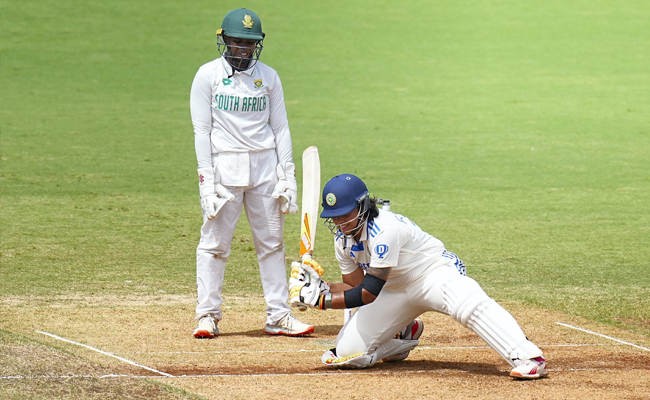
Chennai (PTI): India on Saturday recorded the highest team total in women’s Test cricket on day two of the one-off Test against South Africa, surpassing the previous best of 575/9 set by Australia.
Australia had posted the total in Perth this February but India achieved the new record when Richa Ghosh hammered a four in the opening ball of the 109th over bowled by Annerie Dercksen.
Much of the credit for the feat goes to Indian openers -- Shafali Verma (205) and Smriti Mandhana (149) -- who shared an iconic stand of 292 -- the highest opening partnership in women's cricket.
It has also been well aided by Jemimah Rodrigues (55) along with skipper Harmanpreet Kaur and Richa, who are currently unbeaten past their respective half-centuries.
On Day 1, India had finished on 525 for four, having posted the highest-ever single-day total in a Test match, breaking the previous record held by Sri Lankan men's team -- 509 for nine -- against Bangladesh in Colombo in 2002.
Let the Truth be known. If you read VB and like VB, please be a VB Supporter and Help us deliver the Truth to one and all.
Trump returns from China; terms meeting with Xi as 'G-2'
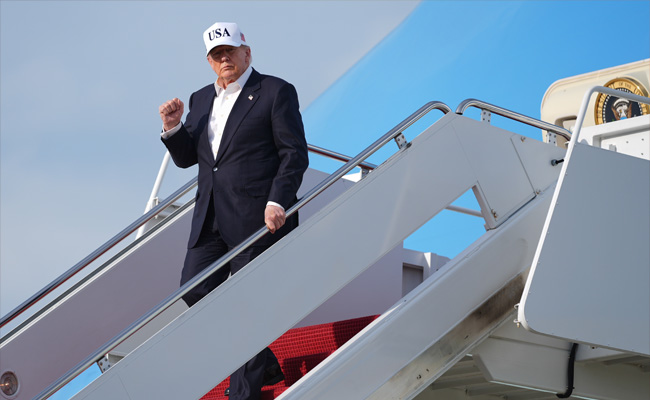
Washington (PTI): US President Donald Trump returned from a visit to China, describing his discussions with President Xi Jinping as a meeting of leaders of "two great countries".
Trump landed at the Joint Base Andrews in Maryland on the outskirts of the US capital on Friday evening, claiming to have struck important trade deals, including one for China's purchase of 200 aircraft from Boeing, with a promise for another 750, as well as agreements benefiting the American agriculture sector.
The US President reached here after a brief refuelling stop at Anchorage in Alaska.
“It’s the two great countries. I call it the G-2. This is the G-2. I think it’ll go down as a very important moment in history,” Trump told Fox News in an interview after meeting Xi on Thursday.
The Washington Post reported that Trump’s remarks put China on an equal footing with the US, exactly what Xi had aimed to achieve with the visit.
“Over two days of meetings here, the carefully choreographed pageantry and the reciprocal gestures of friendship and respect between the world’s two most powerful men displayed a geopolitical dynamic that the Chinese have long craved and Americans had resisted," the Post said.
Trump told Fox News that the relationship with Xi was important and suggested that China may not resort to any aggressive moves over Taiwan, at least till he is in office.
“It’s not a takeover. They just don’t want to see this place — we’ll call it a place because nobody knows how to define it — but they don’t want to see it go independent,” Trump said.
“I don’t think they’ll do anything when I’m here. When I’m not here. I think they might, to be honest with you,” Trump said.
"I want them to cool down. I want China to cool down," he said.
"We're not looking to have wars, and if you kept it the way it is, I think China's going to be OK with that," he added.
The US President said he had invited Xi for a visit to Washington in September.
“Xi has done something Chinese leaders have been working toward for decades — bringing an American president to Beijing as an undisputed peer,” said Julian Gewirtz, who served as China director on the National Security Council under President Joe Biden.
“Xi used the opulent optics of the visit to make clear to the world that China and the United States are the two dominant, equally matched superpowers. There is no going back.”
Trump’s friendly statements toward Xi and the Chinese people were being amplified in China’s state-controlled media, sending the message that “we’re getting along better with the Americans,” John Delury, a senior Fellow at the Asia Society, was quoted as saying by The New York Times.
It was understandable that Trump wanted to be polite to Xi, but that the American president’s gushing approach “weakens Trump and the US”, R. Nicholas Burns, the ambassador to China during the Biden administration, was quoted as saying in The New York Times.
“Xi did not hesitate to warn Trump over Taiwan. Trump should not hesitate to be frank about our concerns, too,” he said.
Trump and Xi are expected to meet at least three times this year.
The US President has invited Xi to the White House in September.
Trump may travel to Shenzhen in China for the Asia-Pacific Economic Cooperation meeting in November. And Xi could come to the G-20 summit in December in Miami.
“This is a summit again that was heavier on symbolism than it was on substance — focus on managing problems, not on solving the problems that exist between the US and China,” said Rush Doshi, former National Security Council deputy senior director for China and Taiwan in the Biden administration.
“The way that both leaders talked about the future indicates that this is going to be part of a process that will play out this year,” said Kurt Campbell, former deputy secretary of State in the Biden administration.