India record their lowest Test score of 36, Australia need 90 to win
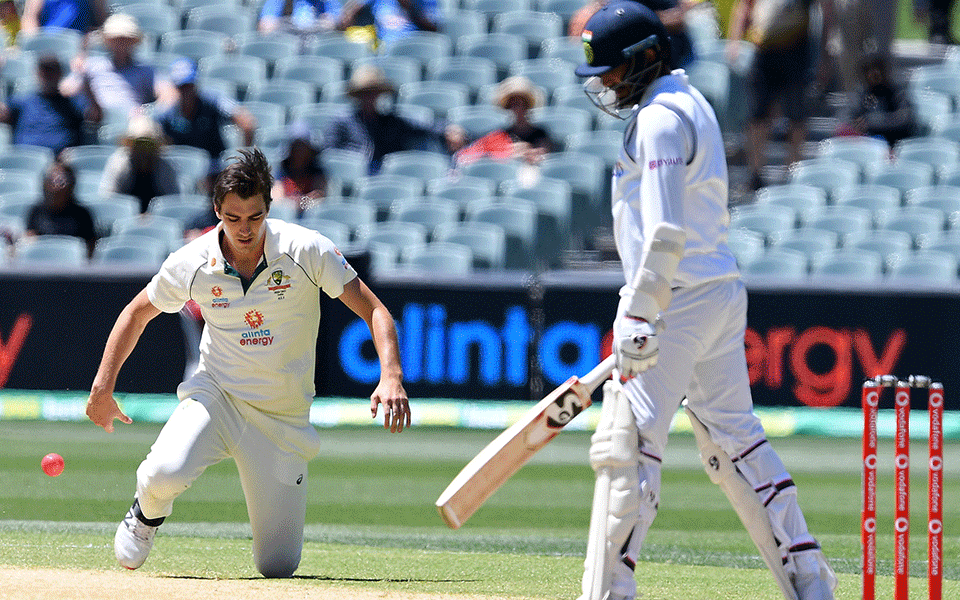
Adelaide: The Indian cricket team on Saturday suffered the ignominy of being restricted to its lowest ever total in Test cricket, collapsing to 36/9 in the terminated second innings against Australia on the third morning of the first Day/Night Test here.
India's earlier lowest score was 42 at the Lord's in 1974 against England, known in Indian cricket parlance as "Summer of 42".
To make matters worse, star pacer Mohammed Shami's series could well be over due to a wrist injury from a short ball from Pat Cummins, which could potentially be a fracture. Shami could not continue and the Indian innings was terminated at 36 for 9 in 21.2 overs.
After a decent 53-run first innings lead, India are now staring at a humiliating defeat with only 89 runs to defend.
At one stage, India were reduced to 26 for 8 and looked like equalling the lowest ever Test score (26 by New Zealand) but Hanuma Vihari's boundary helped them evade entry into the dark pages of cricketing history.
On the day, the Indian batting was completely exposed by the extra bounce generated by Australian pacers, who bowled every delivery on the off-middle channel after landing on the seam.
In an inexplicable collapse, India's much vaunted batsmen fell like nine pins with not a single one able to reach double figures.
Once nightwatchman Jasprit Bumrah (2) was out in the first over, the home pacers, led by Josh Hazlewood (5-3-8-5) and Pat Cummins (10.2-4-21-4), literally decimated the tourists and also caused lasting damage to their already bruised egos.
The likes of Mayank Agarwal (9), Cheteshwar Pujara (0) and Ajinkya Rahane (0) were all out in similar fashion.
All the deliveries were almost identical, angled in, which forced the batsmen to jab at them and just bounced a wee bit more. They deviated a shade taking outside edges to Tim Paine behind the stumps.
Skipper Virat Kohli (4) was dismissed in the manner he used to get out in England back in 2014, trying to drive a delivery on the fifth stump and caught at gully.
What Indian batsmen didn't factor in was the pitch suddenly becoming more livelier with extra bounce.
Let the Truth be known. If you read VB and like VB, please be a VB Supporter and Help us deliver the Truth to one and all.
Seven killed, three injured in separate road accidents in UP

Mainpuri/Muzaffarnagar/Deoria (UP) (PTI): Seven people were killed and three others injured in separate road accidents in Mainpuri, Muzaffarnagar and Deoria districts of Uttar Pradesh, police said on Wednesday.
All incidents took place on Tuesday night.
In Mainpuri, three persons, including a couple, were killed near the Shitala Devi Temple on Devi Road under Kotwali police circle when a pickup vehicle hit a motorcycle head-on, Superintendent of Police Ganesh Saha said.
The victims, Dharmendra Singh (50), his wife Baby (48), both residents of Ferozabad, and Sanjay Singh (40) of Tavepur village, were on the two-wheeler and were on their way to attend the cremation of a relative when the incident took place.
According to police, the pickup and a Wagon R car were attempting to overtake each other when the former went out of control and rammed into the motorcycle, killing all three riders on the spot. Police rushed to the scene and sent the bodies for post-mortem examination, Saha added.
In Muzaffarnagar's Charthawal town, a 30-year-old woman, identified as Imrana, was killed while another woman was injured after a speeding car hit them on Rajbaha Road.
Circle Officer Ravishankar said the victims were walking when the car struck them, throwing Imrana into a canal. She was declared dead by the doctors.
Following the incident, villagers staged a protest demanding action against the driver, who fled the spot without the vehicle. Police said efforts are underway to trace and arrest the accused.
In another incident in Deoria district, three persons were killed, and two others seriously injured when a car crashed into a tree in the Baghochghat area late Tuesday night, police said.
The accident occurred near Haji Market when a Bihar-registered Swift car coming from Pakaha went out of control and rammed into a roadside tree, leaving the vehicle badly mangled.
Police said five people were travelling in the car. Three of them died on the spot, while two injured persons were admitted to Maharshi Devaraha Baba Medical College in Deoria.
The deceased have been identified as Karan Kushwaha, a resident of Gopalganj district in Bihar, and Pintu Kumar of Dulharpur village under Phulwaria police station. The identity of the third deceased is yet to be established.
The injured have been identified as Govind Kushwaha (18) of Sisai village in Kushinagar and Bhola Srivastava alias Sonu (22). Police said the occupants had visited a relative's place in Kushinagar and were returning after attending a wedding function when the accident occurred.
Station House Officer Anil Tiwari said police had to use a gas cutter to rescue the victims trapped inside the vehicle.
The bodies have been sent for post-mortem examination, and further legal proceedings are underway, he added.