India rise to 2nd in ICC ODI rankings; Kohli, Bumrah remain on top
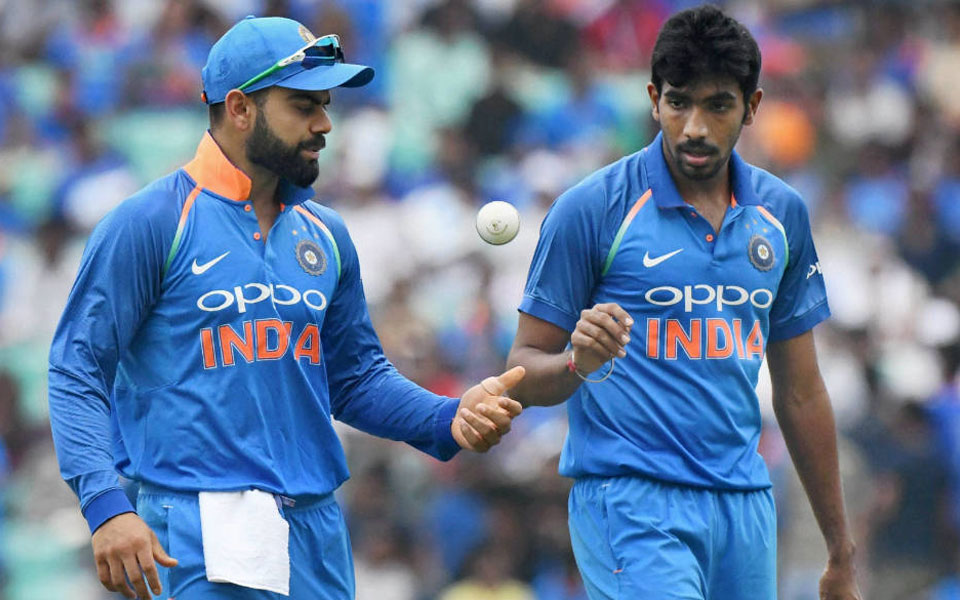
Dubai, Feb 4: The Indian cricket team Monday rose a rung to second in the ICC ODI rankings in which captain Virat Kohli and pacer Jasprit Bumrah continued to top the respective charts for batsmen and bowlers.
India have accumulated 122 points on the back of series wins over Australia and New Zealand and are placed behind England (126) in the fresh list, the ICC said in a statement.
Mahendra Singh Dhoni also moved up owing to a strong showing against Australia last month, which fetched him the player of the series award. Dhoni has moved up three places to 17th position in the batting list for a run, which included three consecutive half-centuries against Australia.
New Zealand fast bowler Trent Boult surged to third in the rankings for bowlers after finishing with 12 wickets in the series against India, which culminated in Wellington on Sunday with a 4-1 victory for the visiting side.
The 29-year-old left-armer, who swung the ball prodigiously to claim five for 21 and helped New Zealand to a win in the fourth match, has moved up seven places, the International Cricket Council said in a statement.
Boult topped the rankings in January 2016, and is again on his way up, with only Bumrah and Afghanistan leg-spinner Rashid Khan ahead of him.
India leg-spinner Yuzvendra Chahal (up one place to fifth) and fast bowler Bhuvneshwar Kumar (up six places to 17th) are among others to move up in the latest rankings.
The latest update also takes into account India's preceding three-match series against Australia, the five-match series between South Africa and Pakistan, and the three matches between the United Arab Emirates and Nepal.
Kedar Jadhav (up eight places to 35th) is another one to advance for India in the list led by Kohli.
For South Africa, Quinton de Kock (up one place to eighth), Hashim Amla (up three places to 13th) and Reeza Hendricks (up 36 places to 94th) have moved up among batsmen while Andile Phehlukwayo's eight wickets have seen him gain 13 places and reach 19th position and Dwaine Pretorius has moved up from 53rd to 44th slot.
In team Rankings, New Zealand have slipped behind South Africa to fourth place. Nepal now have a full ranking after crossing the threshold of eight matches and are now tied with the UAE at 15 points with their 2-1 win but marginally behind on decimals.
Let the Truth be known. If you read VB and like VB, please be a VB Supporter and Help us deliver the Truth to one and all.
Women BJP MLAs protest against opposition in UP assembly premises
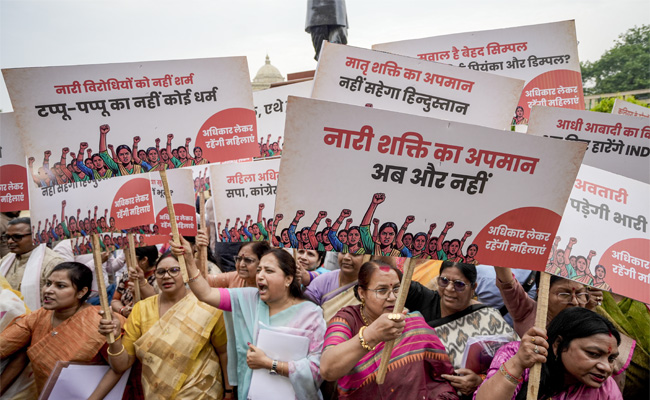
Lucknow (PTI): Women BJP MLAs held a protest in the Vidhan Bhawan complex before the one-day special session of Uttar Pradesh assembly, slamming the opposition for defeating the passage of a bill, which would have led to implementation of the Women's Reservation Law, in the Lok Sabha.
This followed another demonstration by Samajwadi Party MLAs, who alleged that the BJP was misleading public in the name of women's reservation.
The women BJP legislators assembled in front of Chaudhary Charan Singh's statue in the assembly premises, holding banners inscribed with the slogan "Insult to Matrushakti (women's power), India will not tolerate it". The protesting members entered the main hall of Vidhan Bhawan carrying the banners.
Participating in the protest, the state Minister for Women Welfare and Child Development, Baby Rani Maurya, told reporters that all opposition parties, including the Samajwadi Party and the Congress, had opposed the women's reservation, a stance for which they would have to pay a heavy political price.
"On this issue, all of us women stand united. We will ensure that we secure our reservation," she said.
BJP MLA Ketki Singh remarked that their protest represents the collective outrage of millions of women across the state.
Singh asserted that the opposition has betrayed women by creating hurdles in the path of women's reservation. The current demonstration is merely the beginning, and very soon, women from every street, intersection and household will join the protest movement, she said.
Minister Vijaylakshmi Gautam said, "We strongly condemn the despicable act committed by the Samajwadi Party and the Congress in an attempt to hold back 'half the population' (women). Their action was directed against the very bill that Prime Minister Narendra Modi had introduced to empower and strengthen Nari Shakti (women's power), and which he strived to pass expeditiously."
Uttar Pradesh assembly is holding a one-day special session on Thursday. During the session, the government is set to move a censure motion against the opposition parties over their failure to pass the Constitution Amendment Bill, which would have led to implementation of the Women's Reservation Act, in the Lok Sabha.