India skipper Rohit Sharma retires from T20Is after World Cup triumph
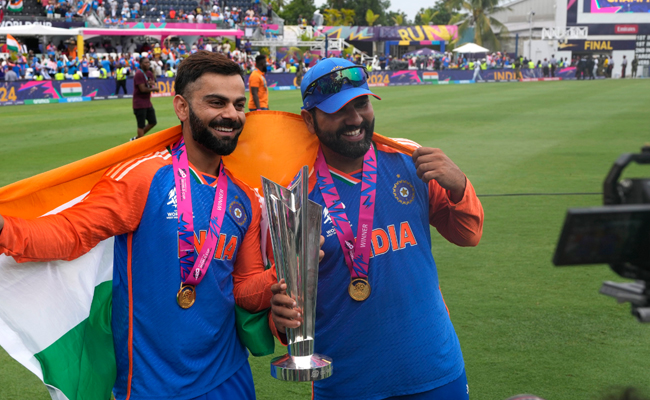
Bridgetown (PTI): India skipper Rohit Sharma announced his retirement from T20 Internationals after guiding the team to its second World Cup in the format, describing it as the perfect time to "say goodbye".
This was after his long-time teammate Virat Kohli brought down curtains on his fabled career minutes after India defeated South Africa by seven runs at the Kensington Oval in the final.
"This was my last game as well. No better time to say goodbye. I wanted this (trophy) badly. It's very hard to put in words," Rohit told the post-match press conference.
"This what I wanted and it happened. I was very desperate for this in my life. Happy that we crossed the line this time," he added.
The 37-year-old had led India in the 2022 T20 World Cup where the team was ousted in the semifinals by eventual champions England.
A year later, India reached the final of the 50-over World Cup at home under his leadership, but succumbed to Australia in the summit clash at Ahmedabad.
Rohit leaves T20Is with 4231 runs from 159 matches, having made five hundreds and 32 fifties. He continues to be active in the Test and ODI formats.
Let the Truth be known. If you read VB and like VB, please be a VB Supporter and Help us deliver the Truth to one and all.
Trump says Islamic State group leader was killed in joint US-Nigerian mission
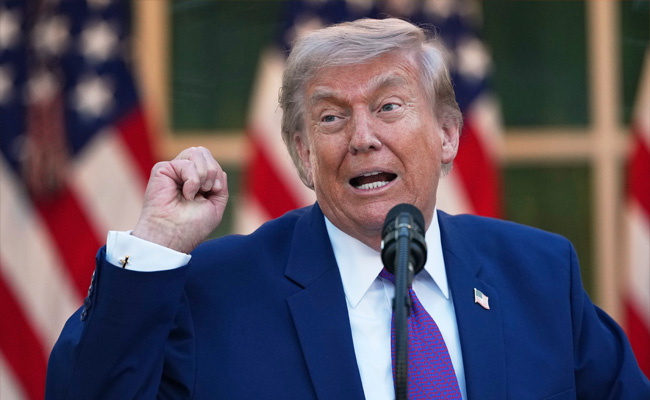
Washington (AP): President Donald Trump said US and Nigerian forces killed a leader of the Islamic State group in Nigeria in a mission carried out Friday.
Trump announced the joint operation in a late-night social media post that offered few details. He said Abu Bakr al-Mainuki was second in command of the Islamic State group globally and “thought he could hide in Africa, but little did he know we had sources who kept us informed on what he was doing.”
The US viewed Al-Mainuki as the key figure in IS organising and finance, and believed he was plotting attacks against the United States and its interests, according to an official who spoke on condition of anonymity because they were not authorised to share sensitive information.
Born in Nigeria's Borno province in 1982, al-Mainuki took the helm of the IS branch in West Africa after the group's previous leader in the region, Mamman Nur, was killed in 2018, according to the Counter Extremism Project, which tracks militant groups.
Al-Mainuki was based in the Sahel area, the monitoring group said, adding that it is believed that he fought in Libya when IS was active in the North African nation more than a decade ago. He was sanctioned by the US in 2023.
Trump in December directed US forces to launch strikes against the Islamic State group in Nigeria, though he released little detail then about the impact.
Nigeria has been battling multiple armed groups, including at least two affiliated with IS.
The Friday night operation was the latest instance in a string of covert missions abroad that Trump has announced this year, starting with the stunning overnight raid in January to capture and remove Venezuela's then-leader Nicolás Maduro and whisk him to the US, followed nearly two months later by the launch of strikes that kicked off the war with Iran.