South Africa lose Markram in pursuit of tough 305-run target against India
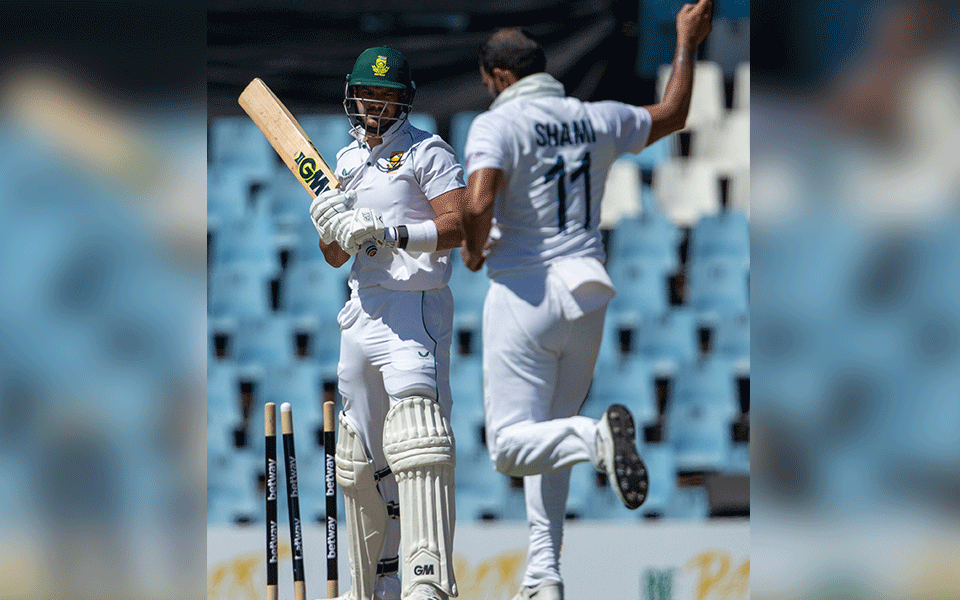
Centurion(PTI): Indian batters struggled to cope with uneven bounce but did enough to set up a stiff 305-run victory target for South Africa as they managed to score 174 runs in their second innings on the fourth day of the opening Test, here on Wednesday.
On an ever-deteriorating surface, South Africa were 22 for 1 at the tea break. The hosts lost opener Aiden Markram (1) with Mohammed Shami drawing first blood when the batter failed to remove his blade only to be played on.
India's struggling senior troika of Cheteshwar Pujara (16), skipper Virat Kohli (18), Ajinkya Rahane (20) played some indiscreet shots while some of the others were done-in by widening cracks that led to deliveries rearing up awkwardly from short of length.
KL Rahul (23), Rishabh Pant (34) and Ravichandran Ashwin (14) got snorters that grew big on them as Kagiso Rabada (4/42), debutant Marco Jansen (4/55) and Lungi Ngidi (2/31) looked menacing during the one and half sessions that the Indians batted.
South Africa have more than 140 overs to score 305 but on this Supersport Park track, it will be a Herculean task to make a match of the target with highest successful chase here being 251 by England back in 2000-01.
For South Africa's batting line-up that distinctly lacks class of bygone era, facing Jasprit Bumrah, Shami and Mohammed Siraj will be more than a tall order.
Indian team certainly owes it to openers on Day one and the ever-consistent fast bowling unit that has helped them gain control of proceedings.
Otherwise the middle-order has cut a sorry picture and more so skipper Kohli, who is promising a lot with some delectable boundaries but the propensity to drive anything pitched fuller outside the off-stump is bringing about his downfall.
Young Jansen, who had impressed the India skipper as a net bowler during their last tour of 2018, would certainly remember his debut as he angled one across at fuller length enticing the skipper to go for a drive.
Pujara once again played a lot of dot deliveries and then tickled one down the leg-side to Quinton de Kock off Ngidi.
The most embarrassing of the dismissals was Rahane's after he had hooked and cover drove Jansen for a six and a four.
The first hook shot was off a bouncer above his left shoulder and the second one was over his right shoulder at a slightly lower height. He couldn't check his pull-shot and holed out at deep square leg.
Had it not been for Pant's counter-attacking run-a-ball 34, India wouldn't have gained the psychological advantage of a target of 300 plus.
India had scored 63 runs in the morning session with KL Rahul (23 off 74 balls) showing admirable patience during the first hour, leaving a lot of deliveries outside the off-stump before Ngidi softened him up with one that came in sharply and hit him on the knuckle.
A close look showed considerable swelling and Rahul needed medical treatment and there was a lapse of concentration as he fished at one outside the off-stump and skipper Dean Elgar at first slip took an overhead catch.
The likes of Ravichandran Ashwin and Shami also got hit on the knuckles as Rabada and Ngidi consistently hit one spot - short of good length with a widening crack. However that was certainly a welcome sign for Indian pacers.
Let the Truth be known. If you read VB and like VB, please be a VB Supporter and Help us deliver the Truth to one and all.
Tribal man brings dead sister's skeleton to bank to withdraw money from her account
Keonjhar (PTI): A tribal man in Odisha's Keonjhar district on Monday brought the skeleton of his dead sister to a bank to withdraw the money deposited in her name, police said.
The incident occurred at Maliposi branch of Odisha Grameen Bank located at Patana block of Keonjhar district. The man was identified as Jeetu Munda (50) of Dianali village. He was seeking to withdraw Rs 20,000 from the bank account of his elder sister, Kalra Munda (56), who died on January 26, 2026.
"I have run several times to the bank, and the people there told me to bring the account holder to withdraw money deposited in her name. Though I told them that she had died, they did not listen to me and insisted on bringing her to the bank. Therefore, out of frustration, I dug the grave and brought out her skeleton as proof of her death," an illiterate Jeetu Munda told reporters.
Patana Police Station Inspector in charge (IIC) Kiran Prasad Sahu, who reached the bank after getting information, said, "Jeetu is an illiterate tribal man. He does not know what the legal heir or nominee is. The bank officials have failed to make him understand the procedure to withdraw money from the dead person's account."
However, after the incident, the police assured Jeetu Munda that they would facilitate the withdrawal of money from the bank account of his dead sister. Later, the skeleton was again buried at the graveyard in presence of police.
Meanwhile, local Block Development Officer (BDO) Manas Dandpat said that he was not approached by anyone for the legal heir of late Kalra Munda. "Today only, I came to know about it. We will see what can be done to resolve the issue," the BDO said.
Meanwhile, bank sources said that the nominee in Kalra Munda's bank account was also dead. Therefore, Jeetu Munda was the lone claimant over the money deposited in her name.
The local administration has directed the bank officers to make arrangements and ensure that Jeetu Munda, who is the only claimant as per the rules, gets the money as soon as possible.