India vs South Africa: Indian openers make strong statement in first session
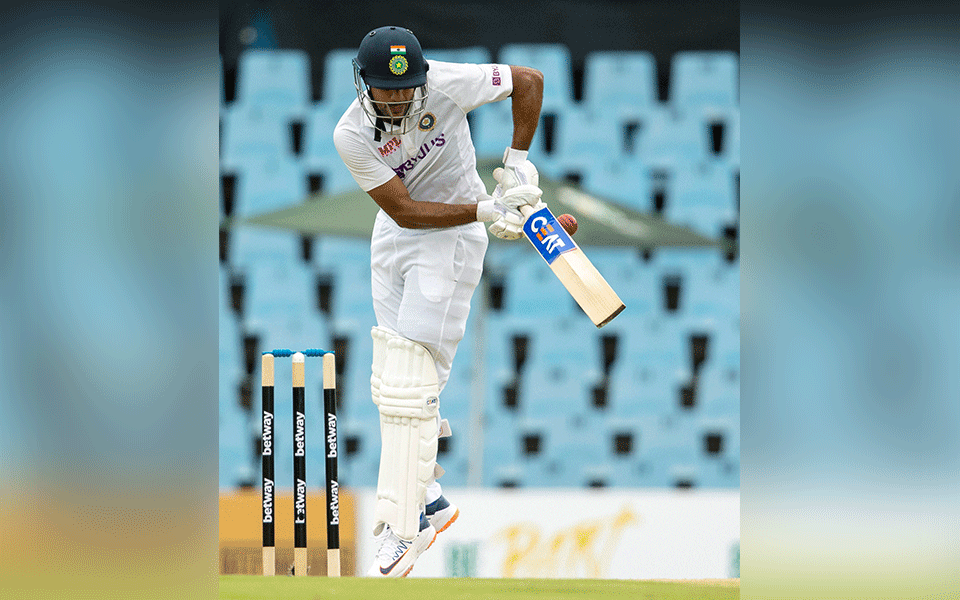
Centurion (PTI): Openers Mayank Agarwal and K L Rahul played with the required discipline in testing conditions to take India to 83 for no loss at lunch on day one of the first Test against South Africa here on Sunday.
India skipper Virat Kohi made a brave call to bat first on a greenish surface which is expected to get quicker as the game progresses.
Both Rahul (29 batting off 84) and Agarwal (46 batting off 84), who are close friends and play for the same domestic team, left the ball well against a pace attack which did not bowl well enough in favourable conditions.
Agarwal carried his good from the home series against New Zealand to SuperSport Park while Rahul stuck to the approach that brought him a lot of success in England earlier this year when he opened the batting alongside the now injured Rohit Sharma.
Rahul was more watchful to start with, showing absolute clarity in leaving the ball while Agarwal was quick to cash in on freebies offered by the opposition pacers.
Agarwal drove Lungi Ngidi through point for the first four of the innings. Rahul, who took 21 balls to get off the mark, played an exquisite straight drive off Kagiso Rabada to get going.
Debutant left-arm pacer Marco Jansen made a nervy start to his career with Agarwal dispatching him for three fours in his opening over.
The 6 feet 8 inch bowler's first ball in Test cricket was a gentle full toss which Agarwal duly dispatched through cover point. Then the lanky pacer bowled a couple into the pads which were crisply flicked away.
The South African pacers bowled a tad too short in the first hour of play with India reaching 42 for no loss. The Dean Elgar-led side also wasted a review early in the session.
The only chance that came South Africa's way went begging with a diving Quinton de Kock dropping Agarwal off Jansen. He was batting on 36 at that time.
South Africa decided to leave out in-form pacer Duanne Oliver from the playing eleven while India picked the struggling Ajinkya Rahane ahead of Hanuma Vihari and Shreyas Iyer.
Let the Truth be known. If you read VB and like VB, please be a VB Supporter and Help us deliver the Truth to one and all.
CCTVs in police stations: SC asks amicus to convene meeting on utilisation of funds
New Delhi (PTI): The Supreme Court on Tuesday said that a meeting be convened on May 6 to deliberate on the aspect of utilisation of funds by the states on installation of CCTVs in police stations across the country.
A bench of Justices Vikram Nath and Sandeep Mehta asked senior advocate Siddhartha Dave, who is assisting it as an amicus curiae in a suo motu matter concerning lack of functional CCTVs in police stations, to hold a meeting on May 6 with the Centre, all states and Union Territories.
"We are of the view that a meeting be convened by the amicus, as done earlier, in which the home secretary of the central government or his nominee not below the rank of joint or additional secretary and the home secretary of states/Union Territories will participate," the bench said.
The issue cropped up after the amicus flagged the aspect of utilisation of funds by the states.
Dave told the bench that in UTs, the Centre gives 100 percent funds while in hilly states, the central government gives 90 percent funding.
He said in remaining states, the Centre gives 60 percent while the rest 40 percent funding is by the respective state.
"Why don't we get responses of the states only on utilisation of funds?" the bench said.
The top court suggested that the amicus can convene a meeting with the Centre, states and UTs on the issue.
It posted the matter for hearing on May 13 and said that a report be submitted before it.
On April 7, the Centre told the top court that all issues concerning installation of CCTVs in police stations would be sorted out within two weeks.
Attorney General R Venkataramani had told the bench that he was taking stock of the issue and a lot of things were happening.
On February 26, the apex court directed the Centre and others to participate in a meeting to deliberate upon the feasibility, modalities and implementation framework of the issues, including creation of a centralised dashboard and standardisation of CCTV infrastructure in police stations.
The top court had earlier directed registration of a suo motu case over the lack of functional CCTVs in police stations after taking cognisance of a media report.
The apex court had in 2018 ordered the installation of CCTV cameras across police stations to check human rights abuses.
In December 2020, the top court directed the Centre to install CCTV cameras and recording equipment at the offices of investigating agencies, including the Central Bureau of Investigation (CBI), the Enforcement Directorate (ED) and the National Investigation Agency (NIA).
It said that states and UTs should ensure that CCTV cameras were installed at every police station, at all entry and exit points, main gate, lock-ups, corridors, lobby and reception, as well as in areas outside the lock-up rooms so that no part was left uncovered.
The top court said that CCTV systems must be equipped with night vision and have audio as well as video footage.
The court made it mandatory for the Centre, states and the UTs to purchase such systems which allow storage of data for at least one year.