Indian spinners reduce England to 215/8 at tea

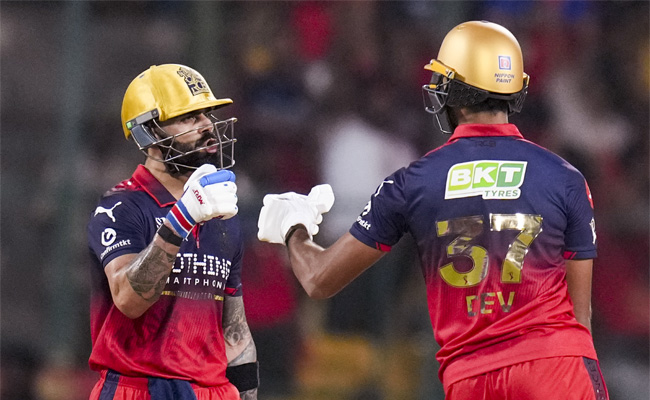
Hyderabad (PTI): The Indian spin troika rudely nudged England's tradition-resisting plunderbats back to reality while limiting them to 215 for eight at tea in their first innings on the opening day of the first Test here on Thursday.
Captain Ben Stokes (43 batting) and Mark Wood (7 batting) are keeping the visitors above the water.
In the morning, Stokes decided to bat first in the hope of making the most of a fresh surface before it gets ragged.
But his batters were woefully equipped to challenge Ravichandran Ashwin (2/55), Ravindra Jadeja (3/75) and Axar Patel (2/33) on a pitch that offered them turn and grip as early as from the ninth over.
Ashwin set in motion the process of dismantling England's batting order in that over, though it was more of a result of Ben Duckett (32) playing for non-existent spin.
The 37-year-old managed to skid one on to beat Duckett's defence to hit his pads.
Umpire Chris Gaffaney did not have to think long before raising his finger, and even a review could not save Duckett as England's opening stand ended at 55.
It was also, perhaps, the most reassuring phase in England's innings as they were able to give a peek into their Bazball' approach while scoring at five runs an over.
In fact, they milked 25 runs from the first four overs bowled by pacers Jasprit Bumrah and Mohammed Siraj.
But once that partnership was broken, England failed to press on against Indian spinners as Ollie Pope, Zak Crawley, Joe Root and Jonny Bairstow stumbled badly.
Axar castled Bairstow with a peach after the England batter failed to cover the spin and the ball crashed on to the top of off-stump.
It also signalled the end of a 61-run alliance for the fourth wicket between Bairstow and Root, as it kept England afloat for a while even though not in the most assured manner.
However, the dismissal of Root would haunt the visitors the most among all the other dismissals. Root is one batsman in the English line-up who can counter spin well, but here his approach was too pre-meditative to be successful.
The former captain kept on sweeping the spinners and Jadeja hit a fuller length which resulted in a top-edge to short fine leg where Jasprit Bumrah did not have to strain himself much to complete the catch.
Ben Foakes has this reputation of being a fine player of spin but on this day only struggle was visible as he departed with a 24-ball four, offering a simple catch to KS Bharat behind the wickets off Axar.
It left captain Stokes, who employed conventional and non-conventional sweeps to counter spin, to wage a lonely battle in the company of tailenders and even looked solid during his stay in the middle as well.
But then on dire occasions like the one England encountered here, even a lion-hearted warrior like Stokes can only add a modicum of respectability to the total.
Let the Truth be known. If you read VB and like VB, please be a VB Supporter and Help us deliver the Truth to one and all.
T'gana RTC strike: Talks between govt, employees successful

Hyderabad (PTI): Talks between employees of Telangana State Road Transport Corporation (RTC) who were on strike and the state government concluded successfully on Friday as the government agreed to the key demands of the workmen.
Following a day-long marathon of talks between the leaders of the employees' Joint Action Committee (JAC) and the cabinet sub-committee, the government announced after midnight that it acceded to the demands, including a merger of RTC with the government, 11 per cent pay revision and elections to the employees' unions.
A committee comprising officials and employee leaders would be appointed over the merger of RTC with the government, it said.
The RTC management has also agreed to address the remaining issues as well, an official release said.
The employees would call off their strike and the RTC buses would hit the roads shortly, it said.
The employees had been on an indefinite strike since April 22 over a series of demands, including the merger of RTC with the government.
Earlier in the day, a driver of the RTC, who attempted suicide on April 23 during the strike, died at a hospital here in the early hours of Friday.
Shankar Goud, a 55-year-old driver, set himself ablaze by pouring petrol at Narsampet in Warangal district when the employees were staging a protest on Thursday in support of their demands.
Goud suffered serious burns, was initially admitted to a state-run hospital in Warangal, and later shifted to a super-speciality hospital in Hyderabad for advanced treatment.
"He succumbed (to injuries) at about 1.30 am on Friday," a senior official said.
The driver’s body was taken to his relative’s village, Muttojipet in Warangal district, for funeral rites.
Tension prevailed in Muttojipet as his family members and RTC employees attempted to take the body to the Narsampet bus station, where he worked, to enable his colleagues to pay their last respects. However, police did not permit this, citing law-and-order concerns.
This led to a deadlock before the funeral could proceed.
Union Minister Bandi Sanjay Kumar criticised the Telangana government for not allowing the body to be taken to the Narsampet bus station.
Kumar, Minister of State (Home), visited Muttojipet village in Warangal district, where the funeral was held, and paid homage to Goud.
“They (family members) want to take the body to the bus depot for five minutes. Is the RTC bus depot in Pakistan or Bangladesh? They are emotionally attached to taking the body there. The government is hurting sentiments and creating fear among RTC employees,” Kumar told reporters.
He also expressed anger at the police for not allowing the body to be taken to the bus station and staged a protest, according to a release from his office.
RTC employees and BJP workers attempted to take the mortal remains in an ambulance to Narsampet, but were stopped by the police.
Later, after discussions with the police, the family members and RTC employees agreed to conduct the funeral in the village.
Sanjay Kumar, stating he would abide by the family’s decision, left the village after the funeral was conducted there.
Transport Minister Ponnam Prabhakar said an ex gratia of Rs 10 lakh, a house, and a government job would be provided to the kin of Goud.
Chief Minister A Revanth Reddy expressed shock over the employee’s death and conveyed deep condolences to the grieving family, according to the release.
The RTC employees’ JAC had earlier announced an agitation programme from April 24 to 29, including silent marches and submission of memorandums to MLAs and other leaders.