New Delhi/Colombo, Jul 9: The Indian cricket team's six-match limited-overs series against Sri Lanka was on Friday rescheduled owing to a COVID-19 outbreak in the home team camp, with the first ODI now starting on July 17 instead of July 13.

Sri Lanka's batting coach Grant Flower and data analyst G T Niroshan have tested positive for the dreaded virus on return from the United Kingdom, which has forced Sri Lanka Cricket (SLC) to extend the hard quarantine period from the stipulated three days.

"Yes, the series will now start from 17th of July instead of 13th. The decision was taken in consultation with SLC keeping the safety and security of players in mind," a senior BCCI official told PTI, confirming the development.

After talking to sources in SLC, it has been learnt that new dates are still being chalked out in consultation with the BCCI. The tentative dates could be July 17, 19 and 21 for the 50-over games, while the three-match T20I rubber is likely to start from July 24.

"We are discussing a few options on the fresh itinerary," a source in SLC told PTI.

As per the original schedule, the series was to start with the ODI leg on July 13, followed by matches on July 16 and July 18. The T20I games were scheduled for July 21, July 23 and July 25.

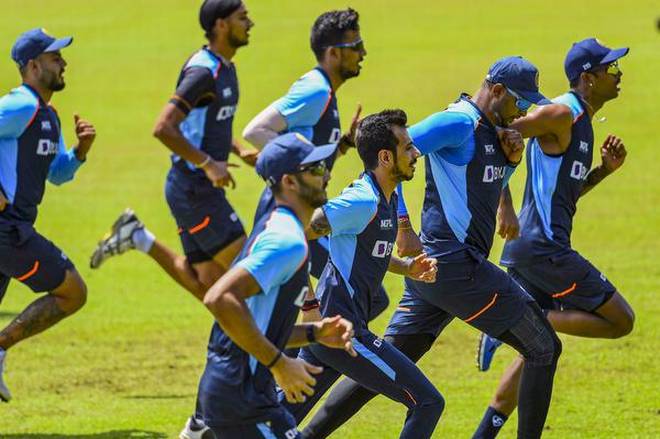
The second-string Indian team, being led by Shikhar Dhawan with Rahul Dravid as chief coach, has completed its hard quarantine and has been training in Colombo.

The SLC source informed that all the Sri Lankan players who came back from UK have tested negative.

"Once the contingent returned from the UK, Grant tested positive on arrival in RT PCR on the first day. All other players were then in their respective room (hard) quarantine. We removed Grant immediately in separate isolation zone. He is asymptomatic," the source added.

"Yesterday we tested the others once again and today G T Niroshan's report came positive and he was also isolated. Since we didn't receive any other positive reports as of now, it means that the players who returned from UK have tested negative in their second RT PCR test."

The series is now being pushed back by four days despite the SLC keeping two groups of players in separate bio-bubbles.

"Apart from the UK-returned batch, we have created two more bio-bubbles in Colombo. In one bubble there are 13 players and in another there are 26. So, 39 players are available to pick a squad from. But BCCI would like to play the first team for obvious reasons," the SLC source said.

Since the Sri Lanka white-ball team doesn't have any commitments after this, the rescheduling wasn't a big problem.

With all the games at the Premadasa Stadium, the dates can be kept flexible as no travelling is involved.

The Indian team is staying at its preferred location for the last three decades -- Taj Samudra.

While Niroshan's conformation was given on Friday, Sri Lanka's batting coach Flower tested positive for COVID-19 on Thursday, 48 hours after the squad's arrival from England.

All the other players who are quarantining have also been tested.

Before testing negative, Sri Lanka's squad had faced an anxious wait for the results of their RT-PCR tests on returning home, following a COVID-19 outbreak in the England squad after the final match of their tour in Bristol on Sunday.

The Lankans have been in a bit of turmoil even otherwise with a dispute over contracts and an ongoing inquiry into bio-bubble breach by three players during the England tour adding to their woes.

Let the Truth be known. If you read VB and like VB, please be a VB Supporter and Help us deliver the Truth to one and all.


New Delhi (PTI): India and Canada on Monday sealed key pacts on supplies of Uranium and critical minerals and vowed to soon conclude a comprehensive economic partnership agreement, with Prime Minister Narendra Modi and his Canadian counterpart Mark Carney finalising a new framework to shore up ties including taking bilateral annual trade to USD 50 billion by 2030.

In their wide-ranging talks, the two leaders also pledged to ramp up cooperation in defence, critical technologies, small and modular nuclear reactors, education and renewable energy as Modi said the relations between the two countries are now filled with new energy, mutual trust and positivity.

Canada is set to support India's civil nuclear energy sector under the USD 2.6 billion uranium supply agreement.

The prime minister said both sides agreed that terrorism, extremism, and radicalisation are common and serious challenges not only for India and Canada but for all humanity. "Our close cooperation against these is crucial for global peace and stability," he said.

Modi and Carney also deliberated on the precarious security situation in West Asia with PM Modi asserting that India supports the resolution of all conflicts through dialogue and diplomacy.

"The current situation in West Asia is a matter of deep concern for us. India supports the resolution of all disputes through dialogue and diplomacy. We will continue to work with all countries to ensure the safety of all Indian citizens in the region," the prime minister said in his media statement.

The major outcomes of the Modi-Carney talks were their decision to expand trade relations, a move that comes amid Canada's increasingly frosty economic ties with the Trump administration.

The fresh move to bolster ties came as part of ongoing efforts by the two sides to reset the relations that came under severe strain following a diplomatic row over the killing of a Khalistani separatist in 2023.

"Our goal is to reach USD 50 billion in trade by 2030. Unlocking the full potential of economic cooperation is our priority. Therefore, we have decided to finalise the Comprehensive Economic Partnership Agreement soon.

"This will create new investment and employment opportunities in both countries," Modi said.

"Canada's pension funds have invested USD 100 billion in India. This symbolises their deep belief in India's growth story," he said.

The volume of two-way annual trade at present is around USD 13 billion.

The prime minister said the Memorandum of Understanding (MoU) on critical minerals will strengthen resilient supply chains. Canada is known for its significant reservoir of critical minerals and rare earth materials.

"In the energy sector, we are building a next-generation partnership, which will focus on hydrocarbons as well as renewable energy, green hydrogen and energy storage," Modi said.

"In civil nuclear energy, we have signed a landmark deal for long-term uranium supply. We will also work together on small modular reactors and advanced reactors," he said.

Modi said the growing cooperation between the two countries in the field of defence and security symbolises the deep mutual trust and the maturity of the relationship.

"We will work to enhance defence industries, maritime domain awareness and military exchanges. To this end, today we have decided to establish the India-Canada defence dialogue," he said.

The prime minister also highlighted the expansion of two-way ties in the education sector.

"New partnerships between several universities in AI, healthcare, agriculture and innovation are being announced. We also agreed on Canadian universities opening campuses in India," he said.

The prime minister also made a mention of how India and Canada share an "unwavering belief" in democratic values.

"We celebrate diversity. The well-being of humanity is our shared vision. This vision inspires us to move forward in every field. Today, we discussed transforming this vision into a next level partnership," he said.

In his remarks, Carney mentioned the future of India-Canada energy ties.

"Today, we are launching a strategic energy partnership with significant potential to expand bilateral energy trade. We've signed a new critical minerals partnership spanning development, processing and secure supply chains for clean energy, electric vehicles and advanced manufacturing," he said.

"We're deepening our cooperation in clean energy, expanding collaboration across wind, solar and hydrogen, because Canada has big plans as well," he said.

Carney described the uranium supply agreement as a reflection of shared commitment to clean, reliable energy.

"All of these agreements under one planet are the beginning of a new, prosperous relationship that will offer generational opportunities for workers and businesses in both their countries and which will protect the planet for future generations," he said.

Carney landed in New Delhi on Sunday after spending two days in Mumbai, where he met several industry leaders.

In the face of its tense trade ties with the Trump administration, Canada is looking at building a stronger, independent and more resilient economy.

In the last few months, India and Canada have taken several steps to normalise their relations.

India-Canada ties hit rock bottom following then-Prime Minister Justin Trudeau's allegations in 2023 of a potential Indian link to the killing of Hardeep Singh Nijjar. India dismissed Trudeau's accusation as "absurd".

In October 2024, India recalled its high commissioner and five other diplomats after Ottawa attempted to link them to the Nijjar case. India also expelled an equal number of Canadian diplomats.

However, Liberal Party leader Carney's victory in the parliamentary election in April last year helped in beginning the process to reset relations.

Subsequently, both sides have already posted their high commissioners in each other's capitals.

Last June, Modi travelled to Kananaskis, Canada, to attend the G7 summit. Modi and Carney held extensive talks on the margins of the summit with a focus on rebuilding the ties.