IOA elections: PT Usha to be officially elected as first woman president
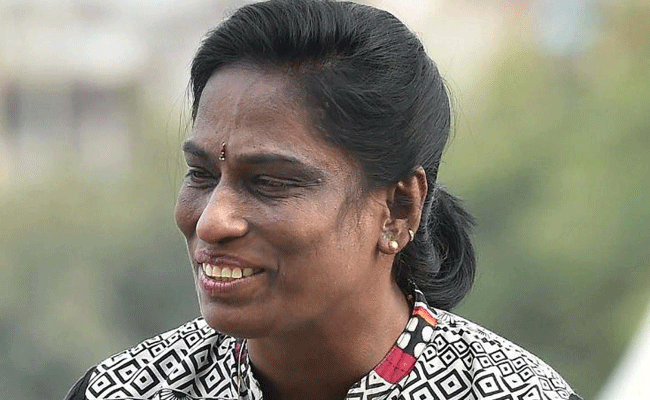
New Delhi (PTI): The legendary PT Usha will be officially elected as the first woman president of Indian Olympic Association (IOA) during the governing body's polls on Saturday, ushering in a new era in country's sports administration.
The 58-year-old Usha, a multiple Asian Games gold medallist and fourth place finisher in the 1984 Los Angeles Olympics 400m hurdles final, will be declared elected unopposed for the top post in the polls being held under the supervision of Supreme Court-appointed retired SC judge L Nageswara Rao.
The elevation of Usha to the top job will also mark the end of the long drawn crisis in the faction-ridden IOA, which was warned of a possible suspension by the International Olympic Committee if elections, originally due in December last year, are not held this month.
The elections will be held to choose joint secretary (female) and four ordinary members of the executive council and 77 members of the electoral college will cast their votes.
Alaknanda Ashok of Badminton Association of India and Suman Kaushik of Netball Federation of India are in the fray in a straight fight for the joint secretary's (female) post.
The voters will choose four members of the executive council out of the eight candidates in the fray.
The eight candidates are Amitabh Sharma, Bhupender Singh Bajwa, Cyrus Poncha, Harjinder Singh, Harpal Singh, Parminder Singh Dhindsa, Rohit Rajpal and Vitthal Shirgaonkar.
It will be an altogether new responsibility for Usha, an iconic track and field star, as she has no experience of holding any top office earlier. She is currently the chairperson of junior selection committee of Athletics Federation of India. She has also been in the various national awards committees set up by the government, over the years.
Usha, fondly known as the 'Payyoli Express', is being seen as a candidate of the ruling Bharatiya Janata Party, which had nominated her as a Rajya Sabha member in July.
She will also become the first Olympian and first international medallist to head the IOA in its 95-year-old history, adding another feather in her cap after dominating Indian and Asian athletics for two decades before retiring in 2000 with a bagful of international medals.
Usha is the first sportsperson to have represented the country and also become IOA chief since Maharaja Yadavindra Singh, who played a Test match in 1934. Singh was the third IOA president who held office from 1938 to 1960.
Ajay Patel of National Rifle Association of India (NRAI) will be elected unopposed as senior vice-president. Olympic medallist shooter Gagan Narang and Rowing Federation of India president Rajlaxmi Singh Deo will also be elected unopposed as vice presidents.
Indian Weightlifting Federation (IWF) president Sahdev Yadav will be the treasurer as he is the lone candidate for the post.
All India Football Federation president and former goalkeeper Kalyan Chaubey will be elected unopposed as the joint secretary (male).
Olympic medallist wrestler Yogeshwar Dutt and archer Dola Banerjee will be in the executive council as male and female representatives of the eight Sportspersons of Outstanding Merit (SOM).
One candidate for vice president (female) and four for the executive council members had earlier withdrawn from the fray.
High-profile politicians like Union Minister Arjun Munda, Assam chief minister Himanta Biswa Sarma and BJP Member of Parliament Brijbhushan Sharan Singh are expected to cast their votes.
Some of the country's past and present top sporstpersons like Sakshi Malik, PV Sindhu, MM Somaya and Akhil Kumar, besides Usha, Gagan Narang, Yogeshwar Dutt, will also cast their votes.
The new executive council will also be substantially different from the earlier ones. At least five of the 14 executive council members (including IOC member in India, Nita Ambani), will be former sportspersons, which is unprecedented in the IOA history.
Only the likes of Sahdev Yadav and Rajlaxmi Singh Deo remain in the top post from the earlier IOA executive council.
The IOA adopted the new constitution, prepared by justice Rao, on November 10 after getting approval from the international committee.
The 77-strong electoral college has 66 members from 33 National Sports Federations which have nominated one male and one female each, eight SOMs (four male and four female), two from the Athletes Commission (one male and one female) and IOC member in India, Nita Ambani.
The IOA electoral college also has more women members (39) compared to male (38).
The IOA elections were due in December last year but could not be held owing to a pending case in the Delhi High Court where a petition was filed, seeking amendment in its constitution before holding elections to align it with the National Sports Code.
The Supreme Court later appointed justice (retired) Rao to draft the constitution and also hold elections.
On Tuesday, the IOC has noted the "significant progress" made by the IOA in resolving its governance issues but said that it will not decide on withdrawing the warning for a ban until it completes the elections process.
Let the Truth be known. If you read VB and like VB, please be a VB Supporter and Help us deliver the Truth to one and all.
Late flourish masks CSK’s batting woes on lively Chepauk track, hosts post 158/7
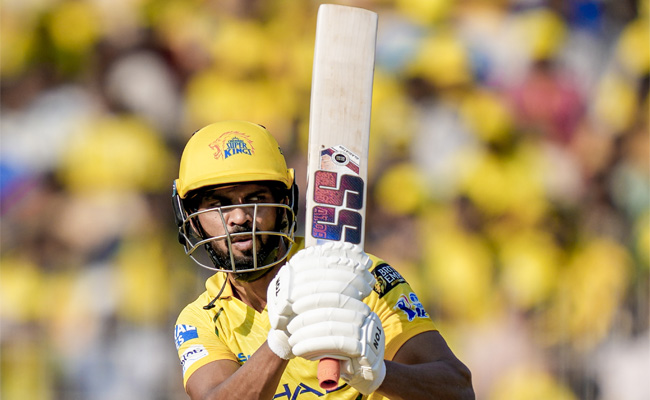
Chennai (PTI): Bowlers calling the shots in a format dominated by big hitters is a rarity, but that script played out at Chepauk on Sunday as Gujarat Titans exploited a lively, bounce-friendly surface to stifle Chennai Super Kings before the hosts managed a late flourish to reach 158 for 7.
On a pitch that offered sharp carry, stroke-making demanded discretion and adaptability. Instead, CSK’s batters often opted for high-risk shots without fully assessing conditions, and paid the price with a flurry of miscued dismissals.
Invited to bat, CSK never quite found rhythm but skipper Ruturaj Gaikwad’s maiden half-century (74 not out) of the current IPL season lent a semblance of respectability to the total in a season where 200-plus scores have become commonplace.
Gaikwad's knock came off 60 balls with six fours and four sixes after a laboured start.
The tone was set early by GT pacer Mohammed Siraj, who extracted steep bounce and forced errors.
Sanju Samson (11) began watchfully, negotiating the first over before opening up against Kagiso Rabada to bring up his 5000 IPL runs milestone. However, Rabada’s bounce soon accounted for him as a hard slash outside off resulted in a faint edge that Jos Buttler pouched safely.
The dismissal triggered a collapse. Urvil Patel (4) fell in the same Rabada over attempting an ambitious pull, while Sarfaraz Khan (0) succumbed to Siraj’s extra lift, mistiming a short ball to offer a simple catch.
At 28 for 3 inside the Powerplay, CSK were already in trouble.
Gaikwad and Dewald Brevis (2) needed to rebuild, but the latter’s impatience against spinner Manav Suthar led to his downfall, holing out after failing to get to the pitch of the ball.
The mounting wickets forced Gaikwad into a shell — an approach that, while understandable, further stalled the momentum. His reluctance to improvise allowed dot balls to pile up, with CSK reaching 50 only in the 12th over.
The skipper eventually broke free, taking on Arshad Khan and Jason Holder with a couple of towering sixes, but the acceleration came too late.
Shivam Dube, dropped thrice on 6, 11 and 22, struggled for fluency before Arshad cleaned him up.
Kartik Sharma (15) and Jamie Overton (18) provided late impetus with a few lusty hits, but the damage had already been done.
On a pitch that rewarded discipline and smart shot selection, Titans' bowlers executed their plans to perfection, while CSK’s batters failed to read the conditions in time, a lapse that ultimately defined the innings.