Israel taps top legal minds, including a Holocaust survivor, to battle genocide claim at world court
Tel Aviv (AP): Israel is sending top legal minds, including a Holocaust survivor, to The Hague this week to counter allegations that it is committing genocide against Palestinians in Gaza.
The robust engagement with the International Court of Justice is unusual for Israel, which normally considers the United Nations and international tribunals as unfair and biased. The decision to participate rather than boycott reflects Israeli concerns that the judges could order Israel to halt its war against Hamas and tarnish its image internationally.
"Israel cannot run away from an accusation that is so serious," said Alon Liel, a former director general of Israel's Foreign Ministry and a former Israeli ambassador to South Africa.
Israel, which as one of the parties in the case is entitled to send a judge, has tapped a former Israeli Supreme Court chief justice to join the court's 15 regular members who will rule on the accusation. It has also enlisted a British barrister and lauded international law expert as part of its defense team.
Israel hopes their expertise will trounce the South African claim that Israel's military campaign in Gaza amounts to genocide and prevent an interim court order to force Israel to stop the fighting. Israel says halting the war when Hamas' capabilities are intact in many places and with hostages still in its captivity would amount to a Hamas victory.
The genocide charge strikes at the heart of Israel's national identity. The country sees itself as a bulwark of security for Jews after 6 million were killed in the Holocaust. International support for Israel's creation in 1948 was deeply rooted in outrage over Nazi atrocities.
The same year, with Israel's involvement, world powers drew up the convention against genocide in hopes of preventing similar atrocities.
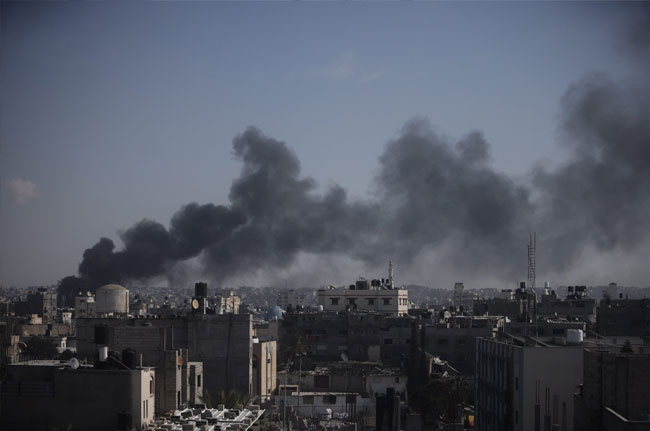
Israel's unprecedented air, ground and sea offensive has killed more than 23,200 Palestinians, two-thirds of them women and children, according to health officials in Hamas-run Gaza. Israel's military campaign has displaced roughly 85 per cent of Gaza's 2.3 million population, many with no homes to return to. More than a quarter of the population is starving.
South Africa, which has long been a critic of Israel's treatment of the Palestinians, launched the case at the United Nations' top court in The Netherlands. Many South Africans compare Israel's policies toward Palestinians in Gaza and the West Bank with their own country's former apartheid regime of racial segregation.
Israel vehemently disputes the genocide claims, saying it is fighting a war of self-defense after Hamas launched its October 7 attack on southern Israel. Israel says its actions comply with international law and that it does its best to prevent harm to civilians, blaming Hamas for embedding in residential areas.
South Africa's 84-page filing says Israel's actions, including killing Palestinians and causing serious mental and bodily harm, "are genocidal in character." It says Israeli officials have expressed genocidal intent.
The case will likely drag on for years. But South Africa's filing includes a request for the court to urgently issue legally binding interim orders for Israel to "immediately suspend its military operations in and against Gaza."
Abiding by such a ruling would be politically costly for Prime Minister Benjamin Netanyahu, with Israelis still largely supportive of the war. Israel would also fall short of its declared goal of crushing the enemies.
If it doesn't abide, Israel could face UN sanctions. Although the US, Israel's closest ally, could veto such a move, doing so would anger many Democrats who have already soured on President Joe Biden over his strong support for Israel in the war. That could be damaging for Biden as he seeks reelection. US Secretary of State Anthony Blinken said Tuesday that the case is "meritless."
Eylon Levy, an Israeli government spokesman, criticised South Africa, saying it was giving Hamas political and legal cover.
"We are appalled that South Africa has chosen to play advocate for the devil," he said.
An Israeli official said Israel agreed to cooperate with the court because it is confident it will prevail. The official spoke on condition of anonymity because he was not authorised to discuss the matter with the media. Israel boycotted a prominent case at the court in 2004 about its West Bank separation barrier, which the court ruled was "contrary to international law," saying the proceedings were politically motivated.
Israel chose Aharon Barak a mainstay of the country's legal world for decades to join the panel of international judges. A former attorney general and peace negotiator who served as chief justice of Israel's highest court from 1995-2006, Barak has ruled in cases related to Israel's treatment of the Palestinians.
The internationally renowned 87-year-old has received honorary degrees from multiple universities, including Yale and Oxford.
British lawyer Malcolm Shaw, who will defend Israel, is the author of what's seen as the definitive textbook on international law. He has represented numerous states, including Ukraine and the United Arab Emirates, in international litigation, including at the International Court of Justice, according to a biography posted online by Essex Court Chambers, where Shaw is a barrister.
Let the Truth be known. If you read VB and like VB, please be a VB Supporter and Help us deliver the Truth to one and all.
T'gana RTC strike: Talks between govt, employees successful

Hyderabad (PTI): Talks between employees of Telangana State Road Transport Corporation (RTC) who were on strike and the state government concluded successfully on Friday as the government agreed to the key demands of the workmen.
Following a day-long marathon of talks between the leaders of the employees' Joint Action Committee (JAC) and the cabinet sub-committee, the government announced after midnight that it acceded to the demands, including a merger of RTC with the government, 11 per cent pay revision and elections to the employees' unions.
A committee comprising officials and employee leaders would be appointed over the merger of RTC with the government, it said.
The RTC management has also agreed to address the remaining issues as well, an official release said.
The employees would call off their strike and the RTC buses would hit the roads shortly, it said.
The employees had been on an indefinite strike since April 22 over a series of demands, including the merger of RTC with the government.
Earlier in the day, a driver of the RTC, who attempted suicide on April 23 during the strike, died at a hospital here in the early hours of Friday.
Shankar Goud, a 55-year-old driver, set himself ablaze by pouring petrol at Narsampet in Warangal district when the employees were staging a protest on Thursday in support of their demands.
Goud suffered serious burns, was initially admitted to a state-run hospital in Warangal, and later shifted to a super-speciality hospital in Hyderabad for advanced treatment.
"He succumbed (to injuries) at about 1.30 am on Friday," a senior official said.
The driver’s body was taken to his relative’s village, Muttojipet in Warangal district, for funeral rites.
Tension prevailed in Muttojipet as his family members and RTC employees attempted to take the body to the Narsampet bus station, where he worked, to enable his colleagues to pay their last respects. However, police did not permit this, citing law-and-order concerns.
This led to a deadlock before the funeral could proceed.
Union Minister Bandi Sanjay Kumar criticised the Telangana government for not allowing the body to be taken to the Narsampet bus station.
Kumar, Minister of State (Home), visited Muttojipet village in Warangal district, where the funeral was held, and paid homage to Goud.
“They (family members) want to take the body to the bus depot for five minutes. Is the RTC bus depot in Pakistan or Bangladesh? They are emotionally attached to taking the body there. The government is hurting sentiments and creating fear among RTC employees,” Kumar told reporters.
He also expressed anger at the police for not allowing the body to be taken to the bus station and staged a protest, according to a release from his office.
RTC employees and BJP workers attempted to take the mortal remains in an ambulance to Narsampet, but were stopped by the police.
Later, after discussions with the police, the family members and RTC employees agreed to conduct the funeral in the village.
Sanjay Kumar, stating he would abide by the family’s decision, left the village after the funeral was conducted there.
Transport Minister Ponnam Prabhakar said an ex gratia of Rs 10 lakh, a house, and a government job would be provided to the kin of Goud.
Chief Minister A Revanth Reddy expressed shock over the employee’s death and conveyed deep condolences to the grieving family, according to the release.
The RTC employees’ JAC had earlier announced an agitation programme from April 24 to 29, including silent marches and submission of memorandums to MLAs and other leaders.