Jemimah, Shikha dropped from Mithali Raj-led India squad for ICC Women's World Cup in NZ
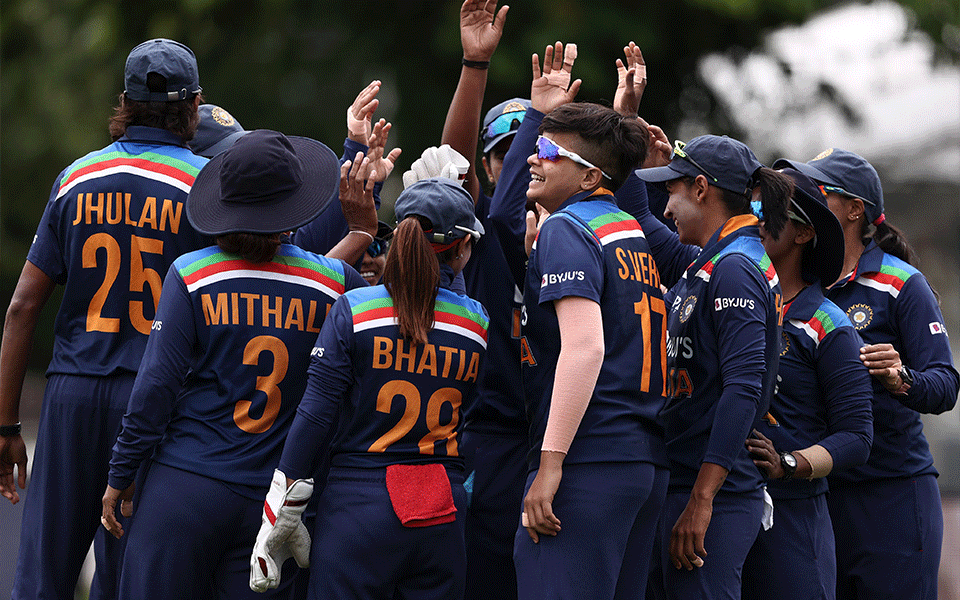
New Delhi(PTI): Star batter Jemimah Rodrigues was on Thursday dropped from the 15-member Indian women's cricket squad announced for the ICC ODI World Cup to be held in New Zealand from March 4 to April 3.
Veteran Mithali Raj will lead the last edition's runner-up side with Harmanpreet Kaur as her deputy. The 39-year-old Mithali has announced that she would chalk out her retirement plans after the mega-event.
The squad expectedly includes veterans Smriti Mandhana, Deepti Sharma, Jhulan Goswami and the young Shafali Verma among others. However, Rodrigues and all-rounder Shikha Pandey have been ignored from due to lack of form.
A BCCI source confirmed to PTI that the two have been "dropped" on account of their form in the ODI format.
Rodrigues failed to hit the double figure mark during the last year in all the international assignments she was a part of but was in good touch during The Hundred tournament in England and the subsequent Big Bash League in Australia.
Pandey was similarly off colour during her national duties.
In Richa Ghosh and Taniya Bhatia, India have included two wicket-keepers for the tour, while Sabbhineni Meghana, Ekta Bisht and Simran Dil Bahadur have been named as three stand-by players.
The same 15-member squad will also feature in a five-ODI series against New Zealand from February 11 to 24.
India will open their World Cup campaign against arch-rivals Pakistan on March 6 at the Bay Oval, Tauranga before facing hosts New Zealand on March 10 at Hamilton, followed by the West Indies (March 12, Hamilton), defending champions England (March 16, Tauranga), Australia (March 19, Auckland), Bangladesh (March 22, Hamilton) and South Africa (March 27, Christchurch).
In the last edition of the tournament in 2017, India narrowly missed out on creating history as they lost by nine runs to hosts England in the title clash.
In a meeting held on Wednesday, the All India Women's Selection Committee also named a 16-member squad to be led by Harmanpreet Kaur for the lone T20 International against New Zealand to be played on February 9 before the ODIs.
The one-off T20 and the first ODI against New Zealand will be hosted by Napier, followed by remaining 50-over games in Nelson on February 14 and 16, and Queenstown on February 22 and 24.
The Squads:
ICC Women's World Cup 2022 & New Zealand ODIs: Mithali Raj (C), Harmanpreet Kaur (VC), Smriti Mandhana, Shafali Verma, Yastika Bhatia, Deepti Sharma, Richa Ghosh (WK), Sneh Rana, Jhulan Goswami, Pooja Vastrakar, Meghna Singh, Renuka Singh Thakur, Taniya Bhatia (WK), Rajeshwari Gayakwad, Poonam Yadav.
Standby Players: Sabbhineni Meghana, Ekta Bisht, Simran Dil Bahadur.
One-off T20I against New Zealand: Harmanpreet Kaur (C), Smriti Mandhana (VC), Shafali Verma, Yastika Bhatia, Deepti Sharma, Richa Ghosh (WK), Sneh Rana, Pooja Vastrakar, Meghna Singh, Renuka Singh Thakur, Taniya Bhatia (WK), Rajeshwari Gayakwad, Poonam Yadav, Ekta Bisht, Sabbhineni Meghna, Simran Dil Bahadur.
Let the Truth be known. If you read VB and like VB, please be a VB Supporter and Help us deliver the Truth to one and all.
Tribal man brings dead sister's skeleton to bank to withdraw money from her account
Keonjhar (PTI): A tribal man in Odisha's Keonjhar district on Monday brought the skeleton of his dead sister to a bank to withdraw the money deposited in her name, police said.
The incident occurred at Maliposi branch of Odisha Grameen Bank located at Patana block of Keonjhar district. The man was identified as Jeetu Munda (50) of Dianali village. He was seeking to withdraw Rs 20,000 from the bank account of his elder sister, Kalra Munda (56), who died on January 26, 2026.
"I have run several times to the bank, and the people there told me to bring the account holder to withdraw money deposited in her name. Though I told them that she had died, they did not listen to me and insisted on bringing her to the bank. Therefore, out of frustration, I dug the grave and brought out her skeleton as proof of her death," an illiterate Jeetu Munda told reporters.
Patana Police Station Inspector in charge (IIC) Kiran Prasad Sahu, who reached the bank after getting information, said, "Jeetu is an illiterate tribal man. He does not know what the legal heir or nominee is. The bank officials have failed to make him understand the procedure to withdraw money from the dead person's account."
However, after the incident, the police assured Jeetu Munda that they would facilitate the withdrawal of money from the bank account of his dead sister. Later, the skeleton was again buried at the graveyard in presence of police.
Meanwhile, local Block Development Officer (BDO) Manas Dandpat said that he was not approached by anyone for the legal heir of late Kalra Munda. "Today only, I came to know about it. We will see what can be done to resolve the issue," the BDO said.
Meanwhile, bank sources said that the nominee in Kalra Munda's bank account was also dead. Therefore, Jeetu Munda was the lone claimant over the money deposited in her name.
The local administration has directed the bank officers to make arrangements and ensure that Jeetu Munda, who is the only claimant as per the rules, gets the money as soon as possible.