Kerala’s Mohammed Azharuddeen smashes joint-third fastest T20 century by an Indian
Syed Mushtaq Ali T20
This report was first published in scroll.in and has been posted here without any alterations or editing. To read the original report, CLICK HERE
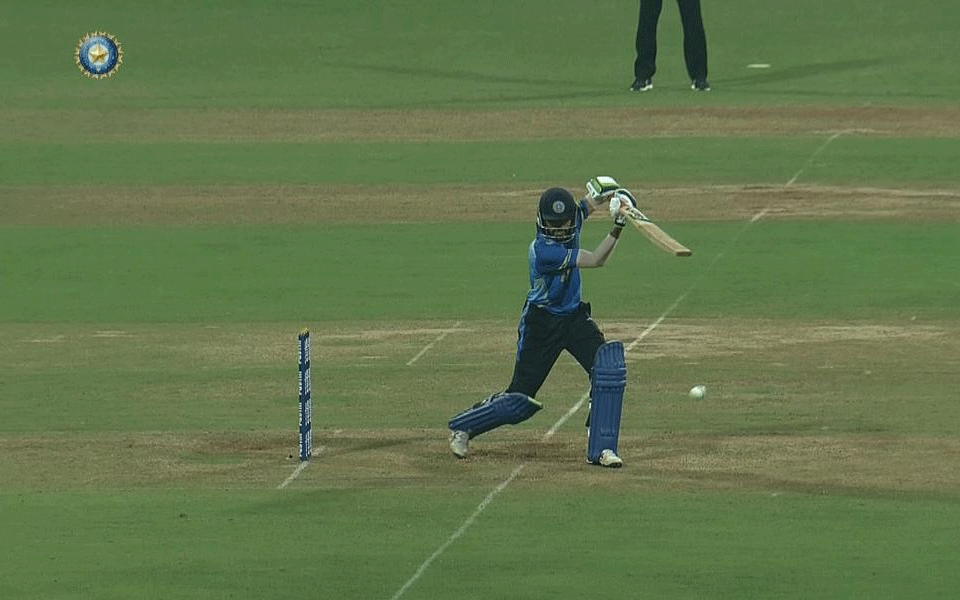
Kerala’s Mohammed Azharuddeen hit the second fastest century in the history of Syed Mushtaq Ali T20 Trophy and the joint-third fastest by an Indian batsman in the shortest format as he took apart Mumbai’s bowling attack at the Wankhede Stadium on Wednesday.
Mohammed Azharuddeen hit a 37-ball century during his innings as Kerala thrashed Mumbai at the Wankhede Stadium. The 26-year-old finished with a 54-ball 137, in a knock that was studded with nine fours and 11 sixes.
Thanks to the fireworks from Azharuddeen, Kerala chased down Mumbai’s 196 in just 15.5 overs.
Let the Truth be known. If you read VB and like VB, please be a VB Supporter and Help us deliver the Truth to one and all.
Student found dead in hostel room in IIT Kharagpur

Kolkata (PTI): A 22-year-old M Tech student was found dead in his hostel room in the Indian Institute of Technology, Kharagpur, the second such incident reported on the campus within a span of 10 days.
The student, identified as Soham Haldar, was found hanging from the ceiling of his hostel room on Tuesday and he was immediately taken to the institute hospital, where doctors declared him brought dead, an IIT Kharagpur official said.
Haldar, a dual-degree student in Electronics and Electrical Communication Engineering, was a boarder of the Pandit Madan Mohan Malaviya Hall of Residence on the campus.
Police from the Kharagpur Town police station have initiated a probe into the incident as preliminary findings indicated that it could be a case of suicide, though the exact cause of death will be ascertained following the post-mortem examination, the official said.
In a statement, the institute expressed deep grief over the student's death and said a detailed inquiry has been initiated.
The authorities have informed the family and are extending all possible assistance to them, it added.
Director Suman Chakraborty told PTI that the institute will strengthen the mechanism to identify stressed-out and depressed students and take follow-up steps to address their issues.
The grief-stricken parents of the student, who hailed from Barasat in North 24 Parganas district, have come to the campus and the authorities will speak to them, he said.
"Haldar's friends, faculty and staffers also could not gauge any stress or anxiety in him. But we need to enable students suffering from anxiety and extreme stress to open up their minds and do everything needed to prevent such incidents," he said.
Investigators are also scrutinising CCTV footage from the hostel premises to piece together the sequence of events leading to the incident.
The incident comes close on the heels of another student's death reported on April 18, when 21-year-old Jaibir Singh Dodia, a third-year Mechanical Engineering student from Ahmedabad, allegedly died after jumping from the eighth floor of the Atal Bihari Vajpayee Hall of Residence. That case is also under investigation.
The back-to-back incidents have once again brought the issue of mental health and student support systems at the institute into focus, especially in view of several such cases reported last year.