2nd ODI: KL Rahul anchors India's series-clinching win with unbeaten half-century
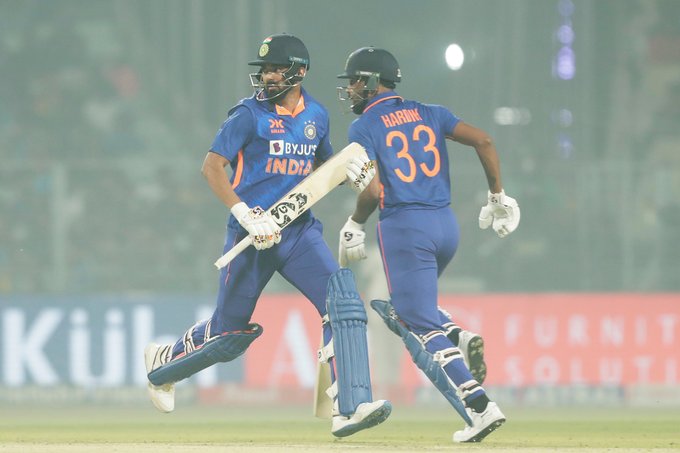
Kolkata, Dec 12: Under-fire KL Rahul made amends for his poor run of form as he anchored India's series clinching four-wicket victory over Sri Lanka in the second ODI with a dogged 64 on a tricky Eden Gardens track.
Snubbed time and again by Indian think-tank, Kuldeep Yadav proved his mettle yet another time as he formed a lovely bowling alliance with pacer Mohammed Siraj to demolish Sri Lanka for 215 inside 40 overs after they opted to bat.
The paltry chase on the quick Eden outfield however was not a cakewalk for Indian team, which lost its top-four batters for 86 runs in 14.2 overs.
Needing 130 from 214 balls, Rahul was the only designated batter left as he once again proved his utility in the middle overs with an unbeaten 64 off 103 balls that took India home with 40 balls to spare.
While there was a bit of seam movement on offer and ball from spinners gripping a bit, to be fair, there was no scoreboard pressure on the home team.
The win also gave India an unassailable 2-0 series lead going into the Trivandraum ODI on Sunday.
"I won't say it was a flat wicket, or it was doing a lot that it was impossible to bat. When Sri Lanka started, I thought it was a 280-300 wicket," Rahul said after the match.
Having started off with a boundary, Rahul was quick to slow down as he ran hard for his singles en route to a 93-ball fifty.
The need of the hour was to play sensibly as Rahul and Hardik Pandya curbed their natural strokeplay in a decisive 75-run partnership that came off 119 balls.
It was also a different Pandya (36; 53b) on display as he took time and gave Rahul a perfect support. Pandya however departed against the run of play, leaving 55 runs required from 95 balls.
India earlier endured some tense moments inside the powerplay when Rohit Sharma (17) and Shubman Gill (21) departed in four deliveries after an attacking start, while Virat Kohli (4) became the third casualty to be 63/2 in 9.3 overs.
Rohit took a faint edge behind the stumps to be dismissed by Karunaratne. In the next over Shubman Gill, who wowed the packed Eden crowd with his delectable cover drives, had a soft dismissal giving a straight catch to Avishka Fernando at short midwicket off Lahiru Kumara.
The pacer, who replaced an injured Dilshan Madushanka (dislocated shoulder), was all charged up when he cleaned up the last match centurion Kohli with a delivery that jagged back in.
More anxiety was in store as India were reduced to 86/4 in 14.2 overs when Shreyas Iyer was dismissed leg before by a ball going down the leg.
However, Rahul, relishing his role as a No. 5 was never in tearing hurry as he anchored the chase to perfection. He needed one good stand and in vice-captain Hardik Pandya (36) he got an able ally as they put up 75 runs.
"The good thing about batting at No. 5 is you don't have to rush. You can take a shower, put your feet up and watch the game. But I always think what team needs of me. If you can read the situation when you go in, it helps you and team. Batting at No. 5 has helped me understand my game better," Rahul said.
Brief Scores:
Sri Lanka: 215 all out in 39.4 overs (Nuwanidu Fernando 50, Kusal Mendis 34; Kuldeep Yadav 3/51, Mohammed Siraj 3/30.)
India 219/6 in 43.2 overs (KL Rahul 64 not out, Lahiru Kumara 2/64, Chamika Karunaratne 2/51).
Let the Truth be known. If you read VB and like VB, please be a VB Supporter and Help us deliver the Truth to one and all.
Trump says he called off dispatching envoys to Iran talks
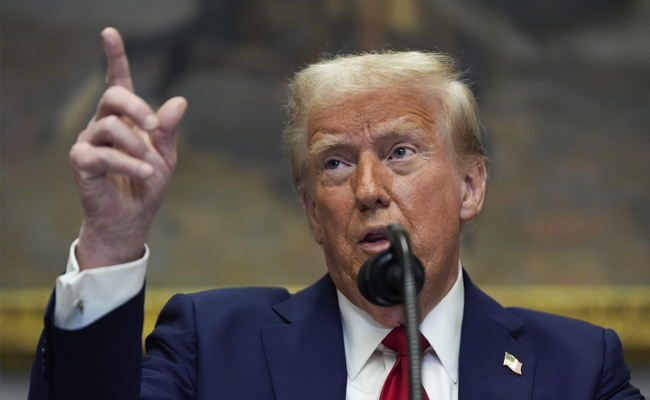
Dubai (PTI): US President Donald Trump said he told his top envoys Steve Witkoff and Jared Kushner not to travel to Pakistan to negotiate with Iran, stating on Fox News that "they can call us any time they want”.
Iran's President Masoud Pezeshkian said his country won't negotiate while the United States imposes a blockade on its ports. Pezeshkian told Pakistani Prime Minister Shehbaz Sharif during a phone call Saturday night that the US “should first remove operational obstacles, including the blockade,” to allow a new round of negotiations, according to the ISNA and Tasnim news agencies in Iran.
Iranian Foreign Minister Abbas Araghchi left Pakistan on Saturday evening, two Pakistani officials told The Associated Press. Iran's state-run IRNA news agency said Araghchi is expected back in Pakistan's capital Islamabad on Sunday.
Trump said Thursday that Israel and Lebanon agreed to extend a ceasefire between Israel and Hezbollah by three weeks after talks at the White House. The meeting was the second high-level negotiation between the two countries this month. The initial 10-day ceasefire had been due to expire Monday.
The Trump administration is placing economic sanctions on a major China-based oil refinery and roughly 40 shipping companies and tankers involved in transporting Iranian oil.
The move announced Friday is part of the administration's threat to impose secondary sanctions on entities doing business with Iran in an effort to cut off Iran's oil exports, which are a key source of its revenue.
Airlines worldwide have begun cancelling flights as the war in the Middle East strains jet fuel supplies and pushes up prices. Experts have offered information to travelers about what to do if a flight is cancelled.
Iran President Masoud Pezeshkian said his country won't negotiate while the United States imposes a blockade on its ports, according to Iranian media.
Pezeshkian told Pakistani Prime Minister Shehbaz Sharif during a phone call Saturday night that the US “should first remove operational obstacles, including the blockade”, to allow a new round of negotiations, the ISNA and Tasnim news agencies reported.
The Pakistani premier described the call as a “warm and constructive discussion”.
Iranian Foreign Minister Abbas Araghchi concluded a one-day trip to Pakistan's capital Islamabad on Saturday after meeting with Pakistani military and government officials.
The trip did not produce a breakthrough in efforts to relaunch negotiations after US President Donald Trump canceled a planned trip by his envoys to Islamabad.
Iran's state-run IRNA news agency said Foreign Minister Abbas Araghchi will return to Pakistan after his current visit to Oman on his way to visiting Russia.
The report said he was expected to be back in Pakistan's capital Islamabad on Sunday and would join other members of his delegation who had gone to Tehran for consultations and “instructions on the topics related to the end of the war.”