Kohli, Gaikwad hundreds in vain as South Africa chase 359 to level ODI series
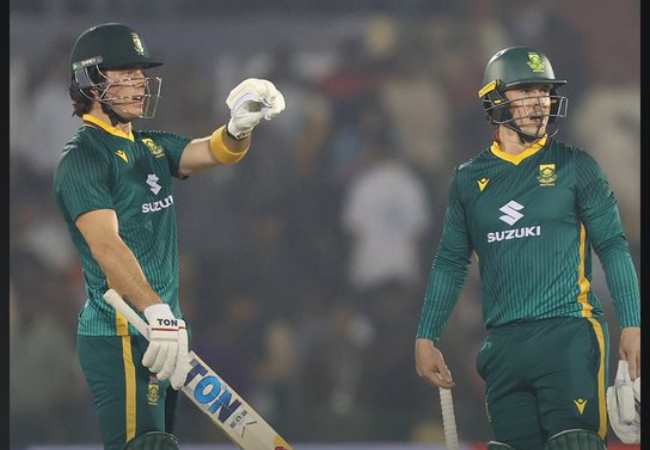
Raipur (PTI): Virat Kohli’s 53rd ODI ton and Ruturaj Gaikwad’s maiden century were eclipsed by a collective effort from South Africa in a steep run chase, giving the visitors a series levelling four wicket-win in the second ODI against India here on Wednesday.
Chasing 359, South Africa rode on a brilliant century from Aiden Markram (110), a brutal 34-ball 54 (1x4s, 5x6s) from Dewald Brevis and Matthew Breetzke's 68 to get over the line in another resilient effort with the bat.
The series-deciding third and final ODI will be played in Visakhapatnam on Saturday.
India’s job was far from done even after putting a daunting total on board as heavy dew in the second half not only made spinners’ job tougher, but poor returns from Prasidh Krishna (2/79) did not help their cause.
Prasidh, who had broken a second-wicket century partnership earlier by dismissing Temba Bavuma (46), got it right finally to pin Breetzke leg-before late in the game, and soon after, Arshdeep Singh (2/54) removed the dangerous Marco Jansen (2), but Corbin Bosch (29 not out off 15) and Keshav Maharaj (10 not out off 14) took the Proteas over the line with four balls to spare.
Markram was in his elements utilising a flat deck under lights to notch up his maiden century against India and providing South Africa a heavy contribution from the top to push on.
He took the initiative in the opening partnership and even though he lost Quinton de Kock (8) early with Arshdeep drawing first blood, Markram found a stable partner in Bavuma to put on 101 for the second wicket.
Markram had to remain the aggressor as Bavuma farmed the strike from the other end. Markram pierced gaps at will with brute force as well as some artistry.
He also hit through the line and over the bowlers’ head to clear the ropes while using the feet well against Indian spinners, with heavy dew making their job even more difficult as the innings progressed.
But the opener also had luck favouring him when a powerful hit off Kuldeep Yadav towards long on saw the ball going through Yashasvi Jaiswal’s hands for a six.
Had the catch been taken, Markram’s charge would’ve ended on 53.
Markram eventually fell off a short off-cutter from Harshit Rana (1/70) but his dismissal had Brevis and Breetzke teaming up, who waltzed to 92 off the next 64 balls to put South Africa in complete control.
While Brevis fell after his quick fifty which featured some massive sixes , Breetzke made a composed 68 for a second consecutive half-century.
Incidentally, it was only the second occasion where India lost an ODI despite scoring in excess of 350, with the first instance being against Australia in March 2019 when they lost by a similar margin of four wickets despite making 358/9 at Mohali.
Earlier, Kohli’s successive hundred, maiden century from Gaikwad (105) and KL Rahul’s quickfire 66 not out propelled India to a formidable 358 for five.
Kohli (102 off 93 balls, 7x4s, 2x6s) and Gaikwad (105 off 83 balls, 12x4s, 2x6s) reset the record for highest third-wicket stand for India in ODIs against South Africa as their 195-run association built the platform for the hosts to launch themselves into a big score.
And Rahul’s (66 not out off 43 balls, 6x4s, 2x6s) second fifty in a row ensured that, even as India continued to tinker with their batting line-up with the stand-in skipper coming in at No 5 ahead of Washington Sundar, who endured another failure.
Unlike at Ranchi where he did not look accustomed to batting in the middle order, Gaikwad emerged a perfect foil for Kohli as the two began racking up runs with ease.
With Ajinkya Rahane in tow, Kohli had put on 189 at Durban in February 2018 but perhaps on some counts, this partnership with Gaikwad was the one he may have enjoyed a little more as the Maharashtra batter matched his style of play.
The rotation of strike was deft, the singles were seamlessly converted into doubles and at times it was difficult for one to distinguish who had pierced the gap for those runs — not necessarily boundaries — as Gaikwad even appeared to be matching Kohli in terms of stroke-play.
If he was roughed up at the start, Gaikwad grew in confidence to post a fine half-century. Once past the milestone, he picked up pace.
Off the blocks with a perfect pull shot which sent the ball sailing over the ropes, it was yet another day in the office for Kohli who did not put a foot wrong on way to a record extending 53rd ODI ton.
Let the Truth be known. If you read VB and like VB, please be a VB Supporter and Help us deliver the Truth to one and all.
'Ab kya hoga, ye rab jane...': Tharoor takes dig at failed US-Iran talks in Pakistan
 (3)_vb_24.jpeg)
New Delhi (PTI): Senior Congress leader Shashi Tharoor on Monday took a swipe at the "failed" US-Iran peace talks in Pakistan with an Urdu couplet, saying only god knows now what will happen.
"Ab kya hoga, ye rab jane; Na woh mane, na ye mane (only god knows what will happen now as both sides did not agree)," Tharoor said on X, tagging a post-talks video clip of US Vice President J D Vance, who led the American delegation at the negotiations in Islamabad.
The United States and Iran failed to reach a peace deal at their historic 21-hour talks in Pakistan, leaving the fate of a tenuous two-week ceasefire in doubt, with both sides attempting to hold each other responsible for the collapse of the negotiations.
अब क्या होगा, ये रब जाने
— Shashi Tharoor (@ShashiTharoor) April 13, 2026
ना वो माने, ना ये माने https://t.co/DYrXpa7C8h
Vance said the Iranian side did not accept Washington's terms for ending the war even as the US presented its "final and best offer".
Hours after the talks collapsed, US President Donald Trump said on social media that the negotiations with Tehran failed as "Iran is unwilling to give up its nuclear ambitions".
Trump said the US Navy will actively interdict any vessel in international waters found to have paid tolls to Iran for transiting through the Strait of Hormuz, a critical shipping route that handles roughly 20 per cent of global oil and LNG (Liquefied Natural Gas).
Iranian Parliament Speaker Mohammad Bagher Ghalibaf, the head of the Iranian negotiation team, said it is for the US to decide whether it can "earn our trust or not".
The Iranian foreign ministry, without elaborating, said the US side resorted to "excessive" and "illegal demands".
The failure to reach an agreement has dimmed the prospect of reopening the Strait of Hormuz to stabilise the global energy marke