Kohli hits ton to guide India to 289-4 at lunch against Bangladesh
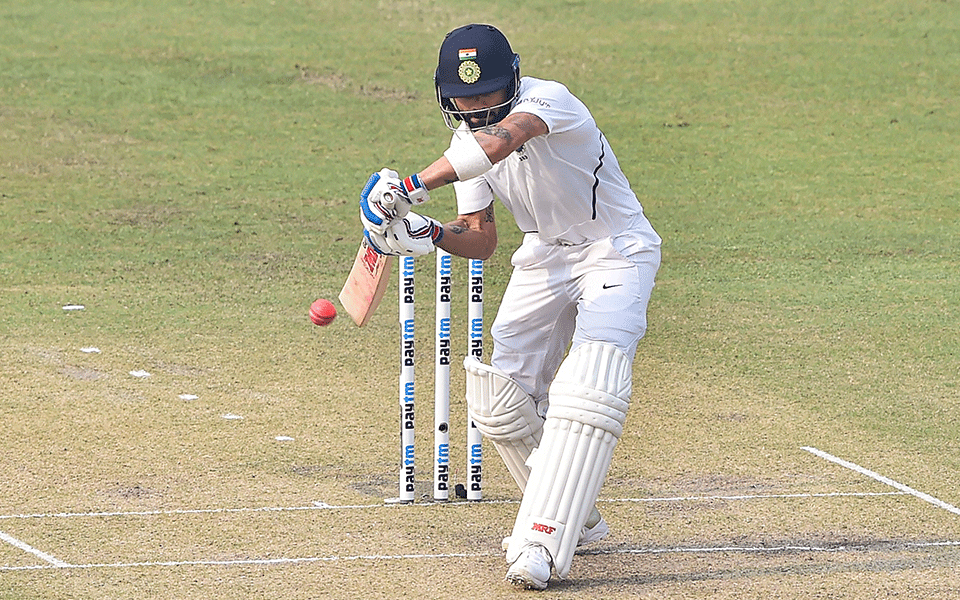
Kolkata: Skipper Virat Kohli became the country's first centurion in Day/Night Test as India reached 289 for four at lunch on day two against Bangladesh here on Saturday.
Resuming at 59, skipper Kohli looked at his sublime best as he brought up his 27th Test century to keep India on track for an early finish.
India added 115 runs in the first session, extending their lead to 183.
While Kohli pushed Taijul Islam for a double in the square leg region to bring up his hundred, his deputy Ajinkya Rahane (51) too looked in good touch, striking his fourth successive half-century.
Rahane was done in by some extra bounce as he top-edged a Taijul delivery to be holed out at point.
But Kohli, who had become the first Indian skipper to go past the 5000-run mark in the longest format, grew from strength to strength en route to his 70th International hundred.
Kohli hit top gear after his hundred, smashing Bangladeshi pacer Abu Jayed for four successive boundaries to remain unbeaten at 130 from 179 balls at the break.
With this century, Kohli equalled Ricky Ponting's record of most hundreds -- 41 -- as captain in International cricket (Tests/ODI/T20I). The India skipper took exactly half the innings (188) than the Aussie great for the world record.
Kohli had come to the crease under lights with India in a tricky 43/2 inside 13 overs on a day Indian openers had a rare failure.
But the skipper soaked the pressure under lights and batted with both caution and authority for his back-to-back Test hundred at Eden Gardens as India stepped closer to their 12th successive home series win.
Kohli's last ton here had come against Sri Lanka on November 2017.
Bangladesh's ground fielding looked appalling while their bowlers absolutely did not show any fight in a damp squib to the pre-match hype for the first pink ball Test in India.
Earlier, the reigning and former world champion duo of Magnus Carlsen and Viswanathan Anand made the opening move by ringing the customary Eden Bell before the start of the second day.
Let the Truth be known. If you read VB and like VB, please be a VB Supporter and Help us deliver the Truth to one and all.
Bengaluru Police bust major drug network; 16 arrested, narcotics worth Rs 36.67 crore seized

Bengaluru: In a major crackdown on drug trafficking and illegal narcotics trade, Bengaluru City Police have arrested 16 accused persons and seized narcotic substances worth Rs 36.67 crore.
According to Bengaluru City Police Commissioner Seemanth Kumar Singh, those arrested include four foreign nationals, eight persons from other states and four locals. Police said the network had interstate as well as international links.
Police recovered 9 kg 64 grams of MDMA, 5 kg 195 grams of hydro ganja, 19,755 LSD strips, 156 grams of heroin, 618 grams of charas, 332 grams of cocaine, 315 grams of drug-mixed gummies and 11 kg 470 grams of ganja from the accused.
The Commissioner said the action was carried out as part of a major anti-drug operation in the city. The network was busted with the support of the CCB Narcotics Control Squad and police stations of Bagaluru, Adugodi, Chikkajala, HSR Layout, Yeshwanthpur, Jalahalli and Jnanabharathi.
Cases were registered in CCB, East Division and West Division police stations based on specific intelligence received on different dates, following which raids were conducted.
Preliminary investigation revealed that the accused were procuring drugs at lower prices from foreign, interstate and local sources and selling them in Bengaluru at higher rates.
Police said college students and working professionals were among the main targets of the accused.