Kohli is one of the finest captains, once in a generation cricketer: BCCI
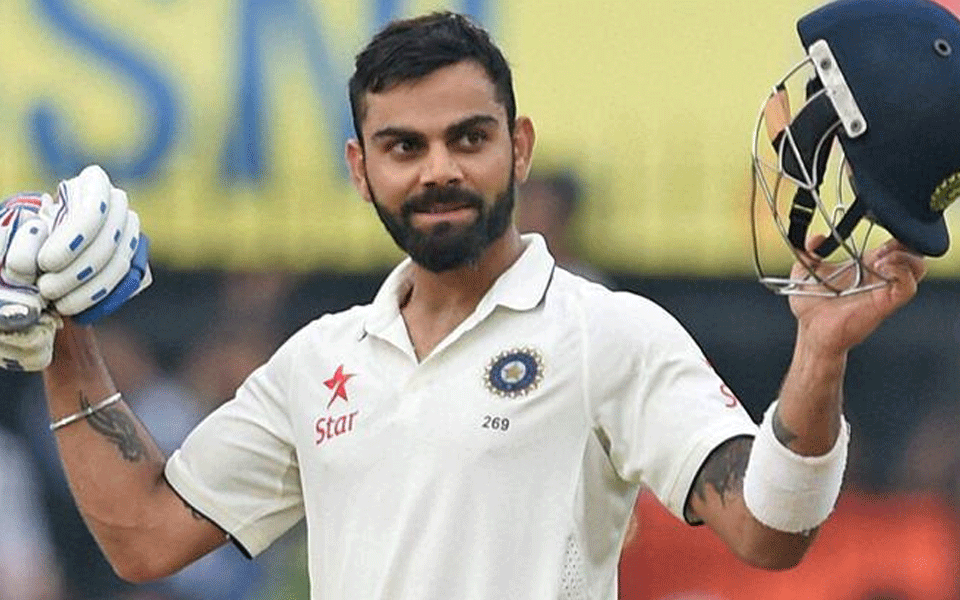
New Delhi(PTI): Virat Kohli is "one of the finest captains" and "once in a generation" cricketer, BCCI said in its rich tribute after the star batter quit as Test captain and asserted that it was a personal decision which the cricket body respects.
Kohli on Saturday ended his seven-year reign as India's most successful Test captain, a day after an unexpected 1-2 series loss against South Africa.
Under Kohli, India won 40 out of 68 Tests, a record which made him one of the most successful Test captains in world cricket.
"I personally thank Virat for his immense contributions as captain of the Indian cricket team. Under his leadership, the Indian cricket team has made rapid strides in all formats of the game. His decision is a personal one and the BCCI respects it immensely," BCCI president Sourav Ganguly said in a statement.
"He will continue to be a very important member of this team and take this team to newer heights with his contributions with the bat under a new captain. Every good thing comes to an end and this has been a very good one," Gnaguly added.
Kohli's strained relations with the BCCI recently made headlines when the star batter quit T20 captaincy and was later sacked as ODI captain. Ganguly had said they had requested Kohli to stay back till the T20 World Cup, a claim which Kohli contradicted.
Kohli has been the most successful Test captain India has ever produced. After taking over the reins from Mahendra Singh Dhoni, he led India in 68 Test matches and secured 40 wins at a win percentage of 58.82.
As Test captain, he registered his first series win against Sri Lanka in 2015, a victory that India registered in the Emerald Island after 22 years.
"Virat Kohli has been one of the finest captains to have ever led the Indian cricket team. His record and contribution towards the team as a leader has been second to none. To lead India in 40 Test wins is proof that he led the side with aplomb," BCCI secretary Jay Shah said.
"He led the team to some of its finest Test match wins in India and overseas including Australia, England, West Indies, Sri Lanka and South Africa and his efforts will inspire the fellow and upcoming cricketers who aspire to represent the country.
"We wish Virat the best for the future and hope that he will continue to make memorable contributions on the field for the Indian team."
Under Kohli's leadership, India also registered their first Test series win in Australia in 2018, clinched series in the West Indies, attained the No.1 spot in Test rankings and later in the subsequent years marched into the maiden ICC World Test Championship Final in 2021.
Kohli also holds the impeccable record of winning 24 out of the 31 Tests played at home as captain, having lost only two Tests.
"A cricketer like Virat comes once in a generation and Indian cricket is fortunate to have him serve the team as a leader," said BCCI vice-president Rajeev Shukla.
"He captained the side with passion and aggression and played a pivotal part in many of India's memorable wins at home and abroad. We wish him the best for his career ahead."
While Kohli is India's most successful Test skipper, MS Dhoni is second in the list with 27 victories in 60 games and Ganguly comes third with 21 wins.
Kohli also ranks fourth in the list of most victories as Test captain behind South Africa's Graeme Smith (53) and Australian duo of Ricky Ponting (48) and Steve Waugh (41).
"With his never-say-die attitude, Virat gave his all to the side as leader and his fabulous record as a captain speaks for that. From the moment he became India's Test captain, he made sure that India always strives for excellence and dominates world cricket," said Arun Singh Dhumal, BCCI Treasurer.
"While Virat the batsman remained a powerhouse, Virat the captain did not leave any stone unturned, powering the team to some of its finest performances across the globe. I wish him all the very best for the future."
It is expected that Rohit Sharma will now lead India in Tests apart from captaining the side the white-ball games.
As Virat Kohli steps down as Team India’s Test Captain, the Board of Control for Cricket in India congratulates him on an outstanding career as #TeamIndia’s Test Captain.
— BCCI (@BCCI) January 16, 2022
More Details 🔽
Let the Truth be known. If you read VB and like VB, please be a VB Supporter and Help us deliver the Truth to one and all.
Woman's decomposed body found at rented flat in Bengaluru

Bengaluru (PTI): The body of a 34-year-old woman was found in a decomposed condition at her rented flat in Bengaluru, police said on Tuesday.
The deceased was identified as Pooja Dutta, a native of Dhanbad in Jharkhand, who was employed with a private company here, they said.
The incident in Adugodi came to light on Monday after neighbours alerted police about a foul smell emanating from her flat, police added.
Police said a team reached the spot, broke open the door and found Dutta's body in a nude and decomposed state, lying in a pool of blood. Preliminary suspicion is that the death may have occurred two to three days earlier, they said.
According to police, no death note was recovered from the spot, though torn papers were found scattered inside the house, prompting suspicion that she may have died by suicide after locking the door from inside.
The body has been sent for post-mortem examination to ascertain the exact cause of death. Once the autopsy report is received, it will be confirmed if it was a suicide or a murder, a senior police officer said, adding that all angles are being probed.
According to the landlady, Dutta had been living in the rented flat for the past three years and was last seen on April 23 when she went out to buy groceries.
The Adugodi police have registered a case of unnatural death, and further investigation is underway.