Kohli, Rohit exempted as Gill, Pant, Rahul, Jadeja set to play Duleep Trophy
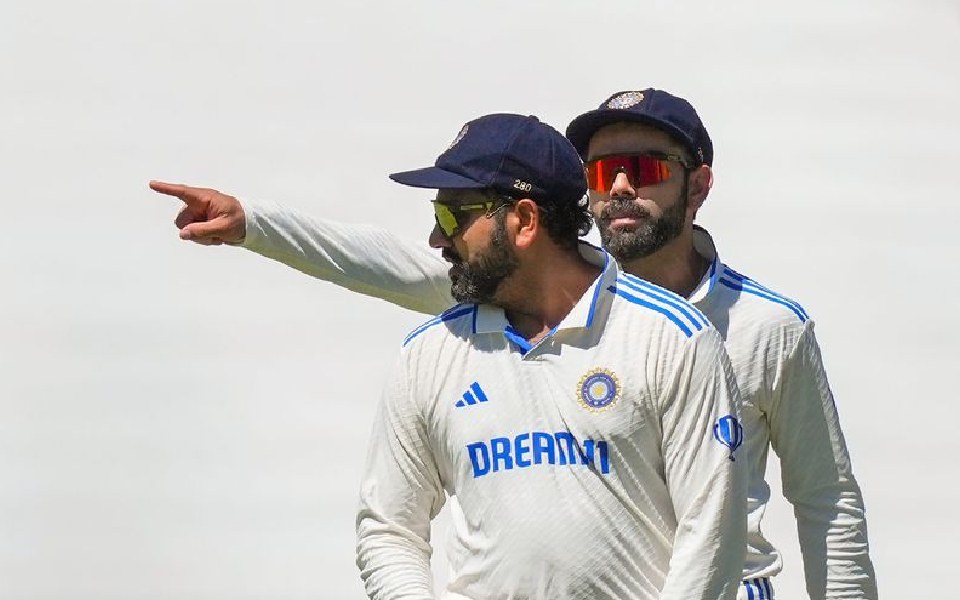
New Delhi, Aug 14: Senior stars including skipper Rohit Sharma, premier batter Virat Kohli, pace spearhead Jasprit Bumrah and leading spinner R Ashwin received exemptions as the national selectors struck a fine balance between domestic performers and potential talent while picking up four squads for the Duleep Trophy starting September 5 in Bengaluru.
The tournament will feature international stars such as Shubman Gill, Yashasvi Jaiswal, leading all-rounders Ravindra Jadeja, Axar Patel, wrist spinner Kuldeep Yadav and pacer Mohammed Siraj.
T20 captain Suryakumar Yadav, who had played one Test against Australia in 2023 has also been picked. Apart from Surya, the others have confirmed slot in the team.
Wicketkeeper Rishabh Pant, who was part of India's T20 World Cup winning team, will also be featuring in the tournament, making it his first red-ball assignment after coming back from that horrific car accident in 2022.
Also back in business will be another left-handed keeper Ishan Kishan, who was removed from BCCI's central contracts list after he skipped the Ranji Trophy tournament last season giving priority to cash-rich IPL.
Sarfaraz Khan and Dhruv Jurel, both of whom played vital role in India's home series win against England are also in the mix. Keepers Aryan Juyal and Abhishek Porel are also part of the various squads.
India players were supposed to play only one match and hence Kohli, Rohit, Bumrah and Ashwin were given exemptions. They had the choice to opt out as first reported by PTI on July 16.
Suryakumar is part of Team C, led by Ruturaj Gaikwad, which also has two exciting young pacers -- Anshul Khamboj and Himanshu Chauhan, who would be under the scanner of the selectors following their exploits last season.
Mohammed Siraj and Jadeja will turn up for Team B which also comprises Pant, Yashasvi Jaiswal and Washington Sundar, while Shubman Gill will captain Team A, which consists of Kuldeep, KL Rahul, Shivam Dube and Riyan Parag among others.
Apart from Parag, Goalpara-born Akash Sengupta is the other cricketer from Assam to feature in the tournament. He is part of Team D, which will be led by Shreyas lyer with Ishan Kishan, Axar Patel, Arshdeep Singh as other teammates.
Pace sensation Mayank Yadav, who is recovering from lower abdominal injury, is yet to regain fitness and will miss the event. Nitish Kumar Reddy’s participation is also subject to fitness.
India are slated to play two Test matches against Bangladesh – from September 19 at Chennai and from September 27 at Kanpur.
"The athletes who will be selected to represent India for the home Test series against Bangladesh will be replaced in the Duleep Trophy," BCCI secretary Jay Shah said in a release.
The Duleep Trophy was earlier scheduled to kick-off with two sets of first round matches at Anantapur in Andhra Pradesh from September 5, but now one of those games has been shifted to the M Chinnaswamy Stadium here to reduce the logistical inconveniences.
The four squads for the first round of the tournament:
Team A: Shubman Gill (C), Mayank Agarwal, Riyan Parag, Dhruv Jurel, KL Rahul, Tilak Varma, Shivam Dube, Tanush Kotian, Kuldeep Yadav, Akash Deep, Prasidh Krishna, Khaleel Ahmed, Avesh Khan, Vidwath Kaverappa, Kumar Kushagra, Shaswat Rawat.
Team B: Abhimanyu Easwaran (C), Yashasvi Jaiswal, Sarfaraz Khan, Rishabh Pant, Musheer Khan, Nitish Kumar Reddy*, Washington Sundar, Ravindra Jadeja, Mohd Siraj, Yash Dayal, Mukesh Kumar, Rahul Chahar, R Sai Kishore, Mohit Awasthi, N Jagadeesan (WK).
Team C: Ruturaj Gaikwad (C), Sai Sudharsan, Rajat Patidar, Abishek Porel (WK), Suryakumar Yadav, B Indrajith, Hrithik Shokeen, Manav Suthar, Umran Malik, Vyshak Vijaykumar, Anshul Khamboj, Himanshu Chauhan, Mayank Markande, Aryan Juyal (WK), Sandeep Warrier.
Team D: Shreyas lyer (C), Atharva Taide, Yash Dubey, Devdutt Padikkal, Ishan Kishan (WK), Ricky Bhui, Saransh Jain, Axar Patel, Arshdeep Singh, Aditya Thakare, Harshit Rana, Tushar Deshpande, Akash Sengupta, KS Bharat (WK), Saurabh Kumar.
Let the Truth be known. If you read VB and like VB, please be a VB Supporter and Help us deliver the Truth to one and all.
Road crash in UP leaves 10 dead
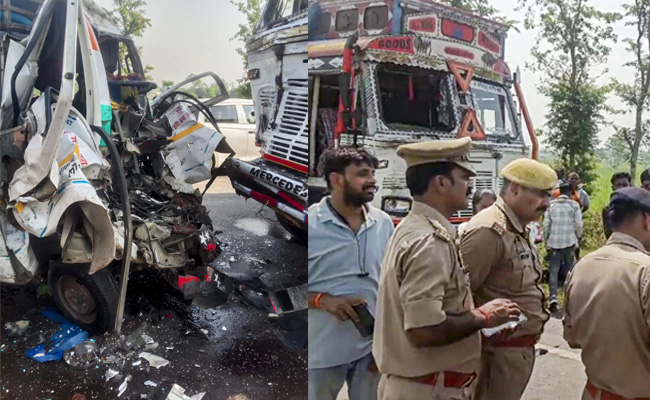
Lakhimpur Kheri (UP) (PTI): Ten people were killed when a van collided head-on with a truck on the Sisaiya-Lakhimpur national highway on Monday, police said.
The van was going to Sisaiya from Lakhimpur when the accident took place between Unchgaon and Bharehta villages.
Circle Officer of Dhaurahra, Shamsher Bahadur Singh, said all nine passengers travelling in the van and the driver were killed.
District Magistrate of Lakhimpur Kheri Anjani Kumar Singh told reporters that the van collided with a truck coming from the opposite direction, leading to nine casualties on the spot, while one succumbed to injuries at the district hospital.
Circle Officer, Dhaurahra, Shamsher Bahadur Singh told PTI, "Efforts are on to establish the identity of other deceased persons."
The seven of the deceased have been identified as Jaideep Singh (25), Pawan (23), Sohan (21), Ram Goyal (42), Sahajram (35), Pappu (18), all residents of Bahraich district and Adnan Khan (15), a resident of Lakhimpur Kheri district, police said.
Condoling the loss of lives in the accident, Uttar Pradesh Chief Minister Yogi Adityanath in a post on X, said, "The loss of life in the unfortunate road accident in Lakhimpur Kheri district is deeply distressing and heart-wrenching. My condolences are with the bereaved families."
"I have directed the local administration to provide prompt and adequate assistance to the injured and the victims. I pray to Lord Shri Ram to grant the departed souls a place at His divine feet and to bestow a speedy recovery upon the injured," Adityanath said on X.
Deputy Chief Minister Keshav Prasad Maurya and Brajesh Pathak too condoled the loss of lives in the accident.
"The loss of lives resulting from the road accident in Lakhimpur Kheri district is deeply tragic and heart-wrenching. My deepest condolences go out to the bereaved families," Maurya said.