Lucknow Super Giants beat CSK by six wickets
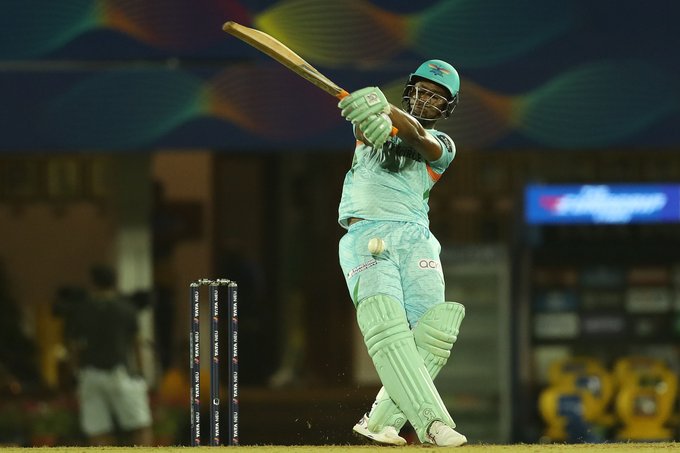
Mumbai, Mar 31: Evin Lewis, who looks up to Chris Gayle for inspiration, batted, or rather, belted the ball like the legendary Jamaican to power Lucknow Super Giants to an incredible six-wicket win over Chennai Super Kings in the IPL on Thursday.
Lewis blazed away to an unbeaten 23-ball 55 as LSG, from a hopeless situation, overhauled an imposing target of 211 with three balls to spare.
Openers KL Rahul (40) and Quinton de Kock (61) laid the foundation with a rollicking stand but the increasing required run rate made the task extremely difficult for LSG.
However, Lewis had other ideas and along with the talented Ayush Badoni, who played his part with a nine-ball 19, made it look quite easy in the end.
The script changed completely in the blink of an eye as Lewis and Badoni smashed Shivam Dube for 25 runs in the penultimate over to bring the equation down to nine from the last six balls.
For sure, handing the ball to Dube to bowl the 19th over will be debated for a while.
In all, Lewis hit six fours and three sixes as first-timers LSG recorded their maiden win in the lucrative league. Badoni hit two maximums, which turned out to be crucial in the context of the final result.
Earlier, leg-spinner Ravi Bishnoi (2/24) did a tremendous job with the wet ball in difficult conditions, even as Robin Uthappa turned back the clock with his beautiful yet brutal assault to propel CSK to a strong total.
Rahul and de Kock were off to a flyer, punishing the CSK bowlers into submission.
The duo was at its destructive best, dealing only in four and sixes and at one point it looked like they were going to finish the game in quick time.
But Dwaine Pretorius (2/31) was right on his mark as he got rid of Rahul before Dwayne Bravo (1/35) engineered Manish Pandey's dismissal to bring the defending champions back in the game.
Pretorius struck once again, accounting for compatriot de Kock as CSK continued to put pressure with good fielding.
Then, Lewis joined forces with Badoni to do the job for LSG.
With just nine required in the last over and Mukesh Choudhary bowling a couple of wides, Badoni smashed a six to level the score and then took his side over the line.
Earlier, Uthappa scored a fluent 50 off 27 balls to give CSK a solid start before Dube made 49 off 30 deliveries, while skipper Ravindra Jadeja (17 off 9) and MS Dhoni (16 off 6), who slammed two fours and a six, provided the final flourish.
Uthappa looked like a man on a mission as he slammed Avesh Khan (2/38) for back-to-back boundaries off the first two balls of the innings.
With the ball coming nicely onto the bat, he smashed it all over the park.
CSK were dealt a blow when a direct hit by Bishnoi from backward point marked the end of Ruturaj Gaikwad (1), who was well short of the crease in the third over.
But Uthappa, and new man Moeen Ali (35), continued the assault by dealing only in fours and sixes.
The Super Giants bowlers had no answer for the duo as CSK raced to 73 for one at the end of the Powerplay.
In all, Uthappa slammed eight fours and one maximum, while Moeen hit four boundaries and two sixes during his 22-ball stay.
It was Bishnoi again who gave the second breakthrough when he trapped Uthappa leg before with a quick delivery, soon after the batter reached his fifty.
Dube picked up from where Uthappa left, cracking three boundaries off Dushmantha Chameera (0/49), who struggled with his line, in the ninth over. It was a bad day for the Sri Lankan as he repeatedly fumbled with the ball in the field, giving away easy boundaries.
With the bowlers struggling after getting nothing from the wicket, sloppy fielding made matters worse for LSG.
Dube and Ambati Rayudu (27), then, shared a 60-run stand to keep CSK on course for a big total.
Let the Truth be known. If you read VB and like VB, please be a VB Supporter and Help us deliver the Truth to one and all.
Putin meets Iran's FM Araghchi, says Russia ready to do its best to help bring peace to West Asia
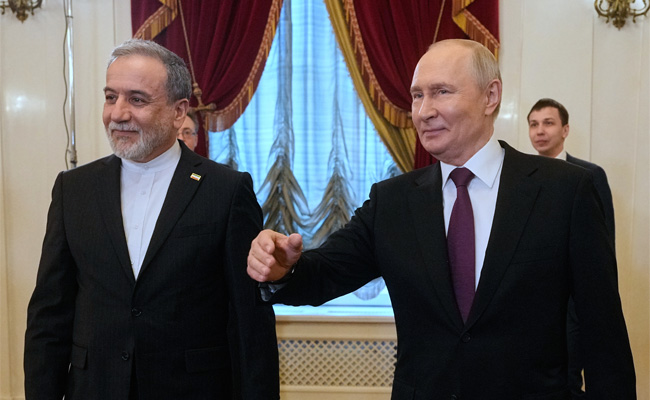
Moscow (PTI): Iran's Foreign Minister Abbas Araghchi on Monday met Russian President Vladimir Putin, who hailed the Iranian people for fighting bravely and heroically for their sovereignty and said Moscow is ready to do its best to help bring peace to West Asia as soon as possible.
Araghchi, who held talks with Omani and Pakistani leadership before arriving in Russia, met Putin in St. Petersburg and thanked him for supporting Iran, state-owned TASS news agency reported.
"Russia is ready to do everything in its power to ensure that peace in the Middle East is achieved as soon as possible," Putin said during his meeting with Araghchi, which was also attended by Russian Foreign Minister Sergey Lavrov.
Revealing that he received a message from Iranian Supreme Leader Mojtaba Khamenei last week, Putin asked Araghchi to convey his "gratitude for this message and best wishes for his health and well-being."
He praised the Iranian people for fighting "bravely and heroically" for their sovereignty, Iran's state-run PRESS TV reported.
"We really hope that, based on the courage and desire for independence, the Iranian people, under the guidance of the new leader, will weather this difficult period of trials and peace will come,” Putin said.
He also stressed that Russia “intends to maintain” its strategic relations with Iran.
Araghchi said that the world witnessed Iran’s strength in countering the US during the recent war, and that the Islamic Republic is a "stable and powerful establishment."
"With their courage, the Iranian people succeeded in resisting the US aggression and will be able to endure it,” he said.
He said that it became clear that Iran has “great friends and allies” like Russia, and conveyed “warmest greetings” from Supreme Leader Mojtaba Khamenei and President Masoud Pezeshkian to the Russian leader.
Araghchi said relations between Moscow and Tehran represent a “strategic partnership at the highest level” and will continue to develop "regardless of circumstances."
"We are grateful to you for the solid and strong positions in support of the Islamic Republic of Iran," he said.
Foreign Minister Lavrov said that the talks between President Putin and the Iranian Foreign Minister were "useful and constructive."
Kremlin Spokesman Dmitry Peskov later said that Russia is "ready to provide any good offices, any mediation services that are acceptable to the parties."
"We will be ready to do everything so that ultimately peace ensues, guaranteed peace, and that there is no return to hostilities," Peskov was quoted as saying by TASS.
He was asked how Moscow can assist in future negotiations on the Iranian settlement.
Araghchi arrived in Russia after his whirlwind trip to Islamabad, which, according to him, was “very productive” and involved “good consultations" with Pakistan's Army Chief Field Marshal Asim Munir, amid uncertainty over the second round of peace talks to resolve the war in West Asia.
"We held good consultations with our friends in Pakistan. The trip was successful. We assessed the outcome of our recent (meetings) and discussed in what direction and under what conditions talks can move on,” Araghchi said in a video posted on his Telegram channel upon his arrival in St Petersburg.
Referring to the second round of talks between the US and Iran to resolve the conflict in West Asia, Araghchi said: "Developments have taken place in the negotiations."
"Despite some progress in earlier rounds, the talks failed to reach their objectives due to the Americans' approach, the excessive demands they made, and the wrong approaches they adopted. Therefore, it was necessary to consult with our friends in Pakistan to review the latest situation,” Iran's official news agency IRNA quoted him as saying.
He said that the trip to Pakistan was a good opportunity to review developments related to the US-Israeli war against Iran, expressing confidence that “these consultations and coordination between the two countries will be highly significant.”
Araghchi arrived at St. Petersburg's Pulkovo Airport early Monday, where he was welcomed by Russian officials and Iran’s ambassador to Russia, Kazem Jalali, the report said.
The first round of peace talks between Iran and the US, held on April 11 and 12, failed to bring the desired result for the parties to the conflict.
The Iranian minister arrived in Islamabad for the second time on Sunday after a short visit to Oman, where he held talks with Sultan Haitham bin Tariq al-Said on security in the Strait of Hormuz and diplomatic efforts to end the Iran-US conflict.
After Araghchi left Pakistan for Oman on Saturday, President Donald Trump announced that US negotiators Steve Witkoff and Jared Kushner would no longer be going to Islamabad for talks with Iran, contending that Washington held all the cards on the matter.
Trump on Sunday reiterated that the US and Iranian officials can talk by phone for a peace solution to the conflict.
On Tuesday, Trump extended the two-week ceasefire with Iran indefinitely to give Tehran more time to prepare a unified proposal to end the war, just hours before the truce was set to expire.
The war began when the US and Israel jointly attacked Iran on February 28, killing Iranian Supreme Leader Ayatollah Ali Khamenei and several top commanders. The retaliation by the Islamic Republic extended the war to the entire Gulf region.