Meeting Messi a dream and a duty, his art my antidote when I'm sad: Chhetri
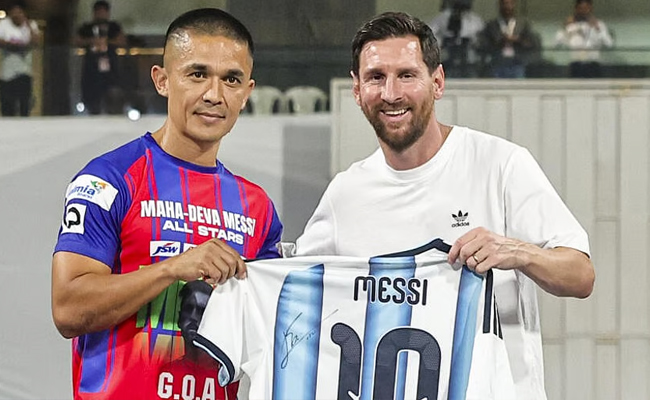
New Delhi (PTI): Meeting Argentine football icon Lionel Messi during his G.O.A.T. India Tour was "a dream and duty" for former India striker Sunil Chhetri as he almost missed the event due to an injury.
Chhetri, who recently retired from the international game as the fourth highest scorer in history with 95 goals, met Messi on Sunday during the World Cup winning captain's third leg in Mumbai. Messi is second in the list with 115 goals.
The former India captain described Messi as the player whose "art" on a football field acted as an "antidote" when he felt sad.
"To be able to express my gratitude to @leomessi in person for everything that he has done for our sport, felt like both - a dream and a duty," Chhetri wrote on his Instagram page.
"I’ve been nursing an injury that’s restricted me to a hobble and needless to say, I don’t like being around even myself when I’m spending more time on the physios table than the pitch.
"I almost didn’t make the trip to Mumbai, till the fan in me rebelled and went anyway. Turned out, meeting the man who makes me very happy, and whose art is my antidote for all the times I am sad, was exactly what I needed."
ALSO READ: Football fans in frenzy as Messi winds up G.O.A.T. India Tour with Delhi leg
Messi spent time chatting with Chhetri and even presented him his Argentina jersey.
The Indian football star was also cheered on by the fans at the Wankhede Stadium with chants of “Chhetri… Chhetri” amid the exhibition football match and other activities he took part in.
Chhetri also expressed satisfaction at meeting Luis Suarez and Rodrigo De Paul who made the trip to India with Messi.
"It was lovely to meet another World Cup winner in Rodrigo De Paul, and then there was the child-like excitement to share the frame with arguably the most complete No.9 of our generation - Luis Suarez.
"And Mumbai, you absolute beauty, thank you for making me feel so loved. I do not take it for granted."
Chhetri said he had to fight with himself on whether to travel to Mumbai to meet Messi or not.
"The build-up to Saturday was filled with little fights, and in a rare win, Sunil Chhetri the fan beat Sunil Chhetri the pro, and I couldn’t be happier about it.
"At the end of it, I guess, both the Chhetri’s turned up on Saturday and the joy was twice as much."
Let the Truth be known. If you read VB and like VB, please be a VB Supporter and Help us deliver the Truth to one and all.
EAM Jaishankar meets Jamaican PM, gifts over 10 BHISHM Cubes
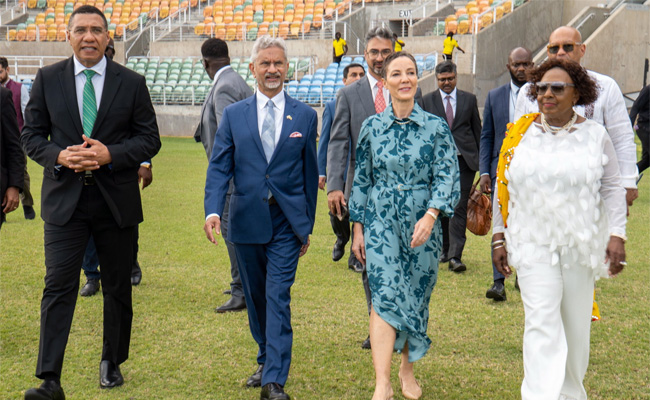
Kingston (PTI): External Affairs Minister S Jaishankar on Monday met Jamaican Prime Minister Andrew Holness and discussed ways to further deepen "political, economic and people-to-people cooperation."
Jaishankar also conveyed greetings from Prime Minister Narendra Modi to Holness.
"Pleased to call on Prime Minister @AndrewHolnessJM in Kingston. Conveyed the greetings of PM @narendramodi," Jaishankar posted on X.
"Discussed deepening our political, economic and people-to-people cooperation. Value his commitment towards further strengthening India-Jamaica relations," the post further read.
Also, the external affairs minister handed over 10 BHISHM (Bharat Health Initiative for Sahyog Hita & Maitri) Cubes as a gift to Jamaica.
"Formally handed over 10 BHISHM Cubes as a gift from India to Jamaica, in the presence of PM @AndrewHolnessJM, Health Minister @christufton and FM @kaminajsmith," Jaishankar posted on X.
"The BHISHM Cube mobile hospital system, designed for rapid deployment, will help Jamaica during disasters and emergencies. The gift of these cubes is a statement of friendship, a commitment to disaster preparedness, and an outcome of innovation," the post said.
Jaishankar arrived in Kingston on Saturday evening, marking the first leg of his nine-day tour of Jamaica, Suriname, and Trinidad and Tobago, aimed at further strengthening India's strategic and cultural ties with the Caribbean nations.
Earlier in the day, he interacted with the Indian diaspora and discussed India's ongoing transformation in infrastructure, human development and technology-driven governance and entrepreneurship with them.
He also highlighted the cricket bond between both countries as India gifted a scoreboard to Jamaica.
A scoreboard was dedicated at Sabina Park in Kingston. It is the home of the Jamaica cricket team and is the only Test cricket ground in the Caribbean island nation.
The minister expressed hope that the new scoreboard would witness many memorable innings, including those symbolising the enduring friendship between the two countries.
Cricket has long been a strong cultural bridge between India and Jamaica, which is part of the West Indies cricket team.
Jamaican players, including Chris Gayle, Courtney Walsh and Michael Holding, have played a major role in shaping the legacy of West Indies cricket in the international arena, contributing to its dominance in earlier decades and its continued global appeal.