Former Pakistan PM Nawaz's wife dies in London
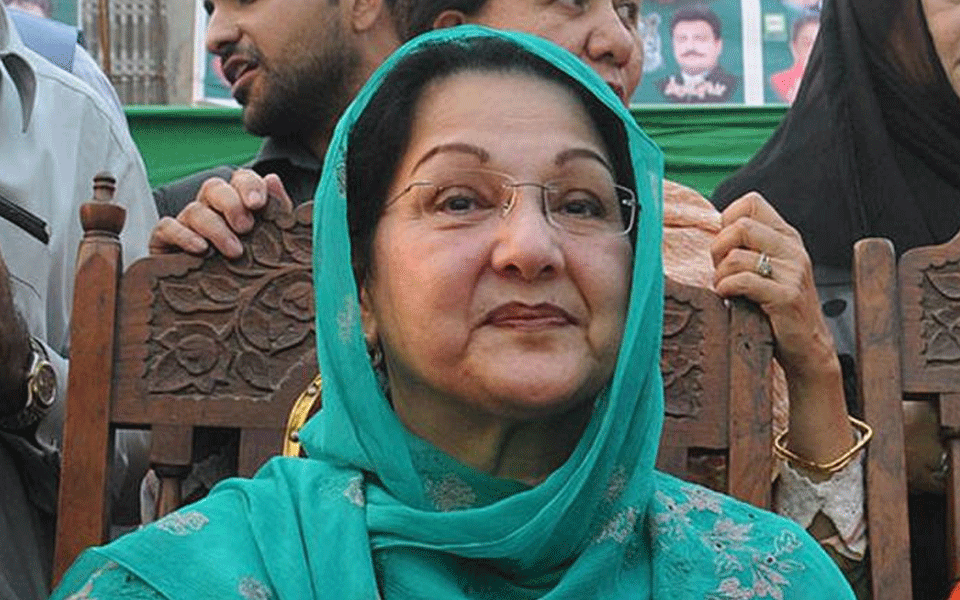
London, Sep 11: Begum Kulsoom Nawaz, wife of former and now jailed Pakistan Prime Minister Nawaz Sharif, passed away in a hospital here on Tuesday after months of battle with cancer, the family said.
She is survived by her husband and four children, Hassan, Hussain, Maryam and Asma.
Kulsoom was placed on life support earlier in the day as her health deteriorated, Geo News reported.
The three-time former first lady was diagnosed with early-stage lymphoma in August last year and had been since then in London where she underwent multiple surgeries.
She was elected from Lahore's NA-120 constituency in a by-election after her husband was disqualified from the seat by the Supreme Court last year but left for Britain even before she could start campaigning.
In her absence, Maryam ran her campaign. Due to her illness, Kulsoom was unable to return and formally take oath as a member of the National Assembly.
Born in 1950 in Lahore to a Kashmiri family, Kulsoom attended Islamia College and graduated from the Forman Christian College in Lahore. She received a Master's degree in Urdu from Punjab University in 1970.
Let the Truth be known. If you read VB and like VB, please be a VB Supporter and Help us deliver the Truth to one and all.
Parag fined 25 percent of match fees for vaping incident, BCCI exploring 'stringent action' on RR
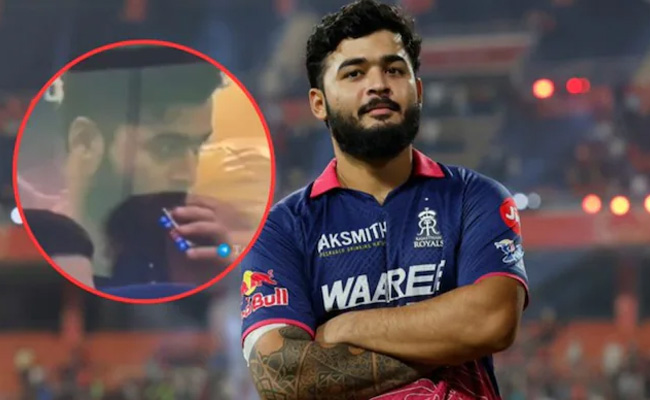
New Delhi (PTI): Rajasthan Royals captain Riyan Parag was on Thursday fined 25 per cent of his match fee for bringing the game into "disrepute" after being caught vaping on camera during the IPL game against Punjab Kings in Mullanpur.
Parag's actions during the Royals' chase on Tuesday night drew condemnation on social media.
PTI has learned that on field umpires Tanmay Srivastava and Nitin Menon had not reported the matter to match referee Amit Sharma right after the game. They only did that after seeing visual proof and Sharma found Parag guilty for a code of conduct breach as per the IPL guidelines.
The Level 1 offence carries 25 per cent deduction from match fees and one demerit point.
ALSO READ: 3 held, hunt on for 4 accomplices after they kidnap, assault and urinate on man in Bhopal
"Riyan admitted to the offence and accepted the sanction imposed by the Match Referee, Amit Sharma," said the IPL in a statement.
"The BCCI is also exploring other options to initiate proceedings for stringent action against the erring team, its officials and players to ensure that the reputation of IPL remains intact," the statement added.
When PTI reached out to BCCI secretary Devajit Saika on possible action on Rajasthan Royals, he said: "As it is written clearly in the statement, we are exploring what action to take on the team. It is not decided yet."
The Indian government had banned e-cigarettes back in 2019, prohibiting their production, sale and distribution. As per the law, the offender faces imprisonment up to one year and/or a Rs one lakh fine for a first time offence.
"Article 2.21 of IPL Code of Conduct is intended to cover all types of conduct that bring the game into disrepute and which is not specifically and adequately covered by the specific offences set out elsewhere in this Code of Conduct, including Article 2.20," the IPL Code of Conduct states.
"By way of example, Article 2.21 may (depending upon the seriousness and context of the breach) prohibit, without limitation, the following: (a) public acts of misconduct; (b) unruly public behaviour; and (c) inappropriate comments which are detrimental to the interests of the game.
"When assessing the seriousness of the offence, the context of the particular situation, and whether it was deliberate, reckless, negligent, avoidable and/or accidental, shall be considered.
"Further, the person lodging the Report shall determine where on the range of severity the conduct lays (with the range of severity starting at conduct of a minor nature (and hence a Level 1 Offence) up to conduct of an extremely serious nature (and hence a Level 4 Offence)."
Since it is a Level 1 offence there was no need for a hearing.
Parag, who has not had the best of times with the bat this IPL, was seen inhaling an e-cigarette, also known as vaping, in the dressing room during the live broadcast of their game against Punjab Kings. Royals won the game to end Kings' unbeaten run in the tournament.
This is not the first controversy to hit the Royals this season. Earlier this month, team manager Romi Bhinder was fined Rs one lakh for breaching PMOA protocol after being found using his phone in the dugout.
IPL and BCCI officials involved in the conduct of the IPL termed it as a careless act in the age of social media and prying TV cameras.
Royals next host Delhi Capitals in Jaipur on Friday night.