Neeraj finishes second in Lausanne Diamond League with season's best 89.49m
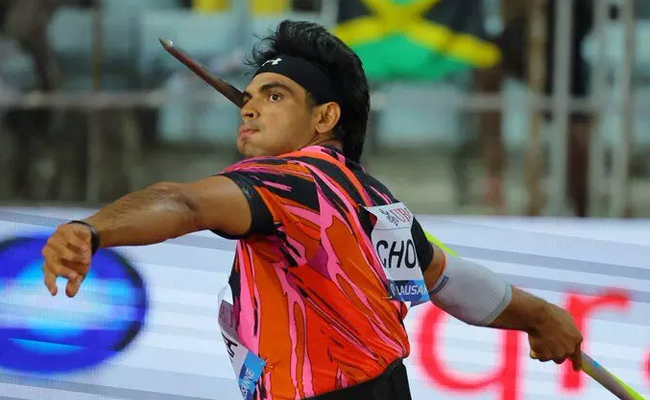
Lausanne (PTI): Star Indian javelin thrower Neeraj Chopra finished second in the Lausanne Diamond League as he recovered in time to produce a season's best effort of 89.49m in his last attempt on Thursday.
The 26-year-old Chopra was at fourth spot till the fourth round before sending his spear to 85.58m in his fifth attempt. He saved the best for the last as his sixth and final attempt measured 89.49m, which was better than his performance in the Paris Olympics.
He was in danger of missing the sixth throw but his fifth round effort of 85.58m saved him. Only the top three after five rounds get their respective final attempts.
Two-time world champion and Paris Olympics bronze medallist Anderson Peters of Grenada won the event with his second round monster throw of 90.61m while Julian Weber of Germany took the third spot with 87.08m.
"The feeling wasn't great at first, but I´m happy with my throw, especially the second (career) best throw on my last attempt. It was a tough start, but the comeback was really nice and I enjoyed the fighting spirit I showed," Chopra said after the event.
"Even though my early throws were around 80-83m, I pushed hard in the last two attempts finishing strong. Competing at this high level, it's important to stay mentally tough and fight through."
Nursing a long-standing groin injury, Chopra claimed a silver in the Paris Olympics on August 8 with an 89.45m throw, having won a historic gold in the Tokyo edition of the Games three years ago.
Pakistan's Arshad Nadeem had beaten Chopra for the gold in Paris with an Olympic record throw of 92.97m.
Peters, who had struggled to find his form last year, led the competition from beginning to end and he stamped his class with the 90m-plus throw in the last round. He has a personal best of 93.07m which he had produced in 2022.
With seven points from Thursday's second-place finish, Chopra will be on joint third spot with Weber on Diamond League standings with 15 points. Peters jumped to top spot with 21 points.
Czech Republic's Jakub Vadlejch, who finished seventh (82.03m) on Thursday, is in second spot with 16 points.
On Saturday, Chopra had confirmed his participation at the Diamond League meeting in Lausanne, leaving a decision on a possible surgery after the end of the season.
Chopra was the Diamond League champion in 2022 and finished second behind Jakub Vadlejch of Czech Republic in the winner-takes-all DL final in Eugene, USA, last year.
This season's DL finals will be held in Brussels on September 14. He needs to finish in the top-six of the Diamond League meetings series standings to qualify for the season finale.
There is another DL meeting -- in Zurich on September 5 -- which has a men's javelin throw event in its roster.
Chopra had won the Lausanne leg of the Diamond League in 2022 and 2023, but could not do so this time. In fact, Chopra is yet to win a DL meeting this year. He finished second behind Vadlejch in Doha on May 10.
Chopra has been managing his groin injury since winning the gold in the Budapest World Championships last year.
Let the Truth be known. If you read VB and like VB, please be a VB Supporter and Help us deliver the Truth to one and all.
PM Modi is controlled by Donald Trump, wants to do the same in TN: Rahul Gandhi
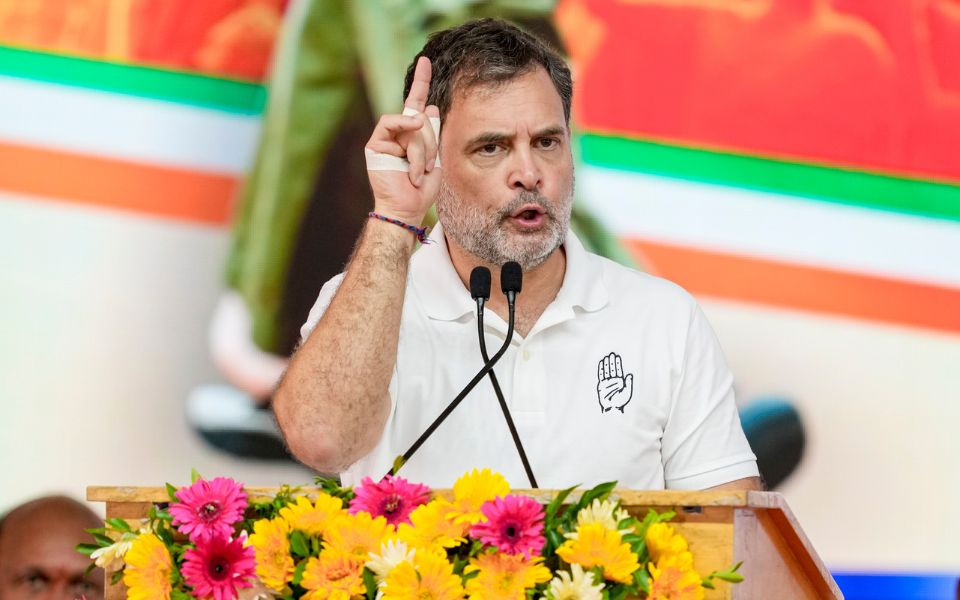
Ranipet (Tamil Nadu) (PTI): Congress leader Rahul Gandhi on Saturday alleged that Prime Minister Narendra Modi was being "controlled" by US President Donald Trump and that the PM wanted the AIADMK to capture power so that he could control Tamil Nadu Chief Minister.
Also, he claimed that the prime minister "handed out our energy security and gave away our data, besides selling our farmers and small and medium industries."
"You saw yesterday (in Parliament) the face of Prime Minister Narendra Modi completely lacking confidence," Rahul said on the delimitation bill.
"He (PM) could not even face the opposition. He was sitting sideways. And the reason is, he is controlled by the United States. He signed the India-US deal that sold our country out," Rahul said while addressing an election rally here.
He further said, "Today, if Donald Trump tells Modi to jump, Modi jumps. If Donald Trump tells Modi to lie down, Modi lies down. Why? Because Donald Trump controls Modi fully. How does he control him? He controls through the Epstein files. He controls him because he knows Modi's financial systems and understands Modi's link with Adani," the Congress leader alleged.
Just as he was being controlled by Trump, Modi wanted to do the same to the chief minister of Tamil Nadu. "That is why he wants to put AIADMK in power in TN," Rahul said.
The Union government had rejected references to PM Modi in the latest Jeffrey Epstein case files, describing it as “little more than trashy ruminations by a convicted criminal that deserves to be dismissed with the utmost contempt”.