New T20I captain Suryakumar Yadav affirms unchanged role for Hardik Pandya
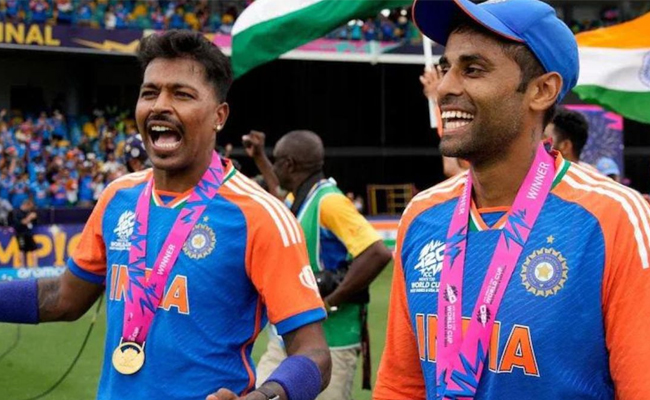
Mumbai: The newly appointed captain of the Indian T20 cricket team, Suryakumar Yadav, confirmed that Hardik Pandya's role in the team would remain unchanged. In a media interaction, Yadav emphasized Hardik's importance to the team and praised his contributions during the 2024 T20 World Cup in England.
"Hardik's role has always been the same. He is a very important player for the team. The way he performed in the World Cup, I hope he will continue to do the same," Suryakumar told PTI.
The announcement of Yadav as the new T20I captain raised questions among fans about his relationship with Pandya, particularly after the close race for captaincy. However, both players respect each other and often bond during training sessions.
Addressing the change of captaincy, Yadav reassured fans that the team's aggressive brand of cricket would only grow stronger.
"The same train will go ahead; only the engine has changed and the bogies remain unchanged," Yadav explained. "Nothing changes; the brand of cricket remains the same. It doesn't change anything. It has given me an added responsibility. It is good that now I can do a 'walk the talk'."
Reflecting on Rohit Sharma's leadership, Yadav expressed his admiration for his predecessor. "What I have learned from Rohit is that he was always a leader on the ground and off it. He was not just a captain, there is a lot of difference between the two. He was a leader who stood in the middle of the group and showed people the way. How to play T20 cricket and how to win a tournament? That is what I have learned from him," he elaborated.
In addition to the captaincy change, Shubman Gill has been declared the vice-captain for both the ODI and T20I teams, replacing Hardik Pandya. Hardik Pandya will continue as an all-rounder for the T20I series against Sri Lanka, scheduled to begin on July 27.
Let the Truth be known. If you read VB and like VB, please be a VB Supporter and Help us deliver the Truth to one and all.
3 killed, 4 injured in truck-autorickshaw collision in UP
Shahjahanpur (UP) (PTI): Three people were killed and four injured in a collision between a truck and an autorickshaw here on Sunday afternoon, police said.
Superintendent of Police (SP) Saurabh Dixit said the truck was coming from the Jalalabad side and the auto-rickshaw from the opposite direction.
Due to the impact of the collision, Ramkshatriya (28), an unidentified 40-year-old woman and Kallu (45) died on the spot, the SP said.
On receiving information about the accident, police rescued four injured people, who were admitted to the government medical college for treatment. The bodies have been sent for post-mortem, Dixit said.
The truck driver fled the scene after the accident and the vehicle has been seized. Efforts are underway to trace the driver, police said.