New Zealand Cricket to host Indian men & women simultaneously

Wellington, July 31 : New Zealand Cricket (NZC) on Tuesday announced the itinerary for India's tour early next year, which will see both the men's and women's teams playing limited overs matches simultaneously.
According to a release from NZC, the men-in-blue team will play five ODIs and three T20Is while the women play three ODIs and as many T20Is.
The T20Is will be double-headers, to be played on February 6, 8 and 10 in Wellington, Auckland and Hamilton, respectively. Three of the men's ODIs will precede the women's 50-over games on the previous day.
The Virat Kohli-led side will start their campaign with the first ODI in Napier on January 23, followed by the second and third matches on January 26 and 28 at Tauranga.
Hamilton will host the fourth ODI on January 31 while the fifth ODI and the first T20I will be played here on February 3 and February 6. Auckland and Hamilton will host the second and third T20Is on February 8 and 10, respectively.
Similarly, the Indian eves will clash with the White Ferns' in the first ODI in Napier on January 24, followed by the second ODI at Tauranga. The third and final 50-over match will be hosted at Hamilton.
Wellington will host the first T20I on February 6 while the second and third T20I will be played on February 8 and 10 at Auckland and Hamilton, respectively.
In a first in New Zealand's cricket history, the women's matches will be televised.
"It's exciting to have the India men's and women's team here. The men are currently ranked No.2 in ODIs and T20s and the women arrive as ICC Cricket World Cup finalists," NZC Chief Operating Officer Anthony Crummy said.
"All six of the White Ferns' (New Zealand Women) fixtures will be televised live for the first time in New Zealand history," he added.
Let the Truth be known. If you read VB and like VB, please be a VB Supporter and Help us deliver the Truth to one and all.
Rickelton's ton in vain as SRH beat MI by 6 wickets
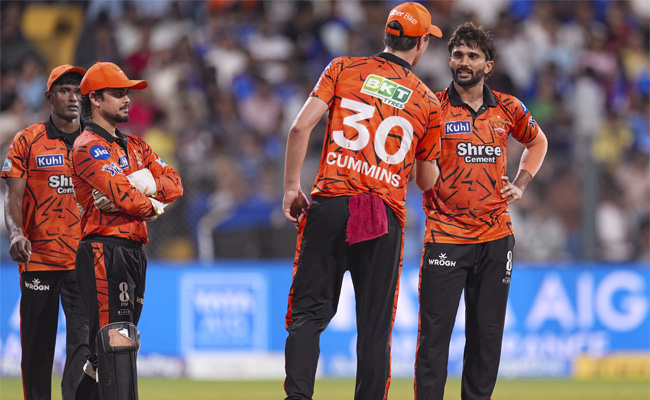
Mumbai (PTI): Ryan Rickelton's whirlwind unbeaten ton was overshadowed by Heinrich Klaasen's unbeaten 65 as Sunrisers Hyderabad defeated Mumbai Indians by six wickets in an IPL match here on Wednesday.
Chasing an imposing 244-run target, Travis Head (76 off 30) and Abhishek Sharma (45 off 24) shared 129 runs for the opening wicket to set the platform for SRH.
Klaasen (65 not out off 30 balls) then displayed his all-round hitting abilities to guide SRH home with the help of Nitish Kumar Reddy (21) and Salil Arora (30 not out off 10) in 18.4 overs.
Earlier, Rickelton's knock powered MI to 243 for five.
MI rode on a 93-run stand between Rickelton (123 not out off 55 balls) and Will Jacks (46 off 22) in 7.1 overs for the opening stand to power the side.
MI skipper Hardik Pandya scored a valuable 31 off 15 balls before being dismissed.
Praful Hinge (2/54), Eshan Malinga (1/29), Sakib Hasan (1/39) and Nitish Kumar Reddy (1/31) were the wicket-takers for SRH.
Brief Scores:
Mumbai Indian: 243 for 5 in 20 overs (Ryan Rickelton 123 not out; Praful Hinge 2/54).
Sunrisers Hyderabad: 249 for 4 in 18.4 overs (Travis Head 76, Heinrich Klaasen 65 not out; AM Ghazanfar 2/51).