New Zealand player collapses to death on-field during match
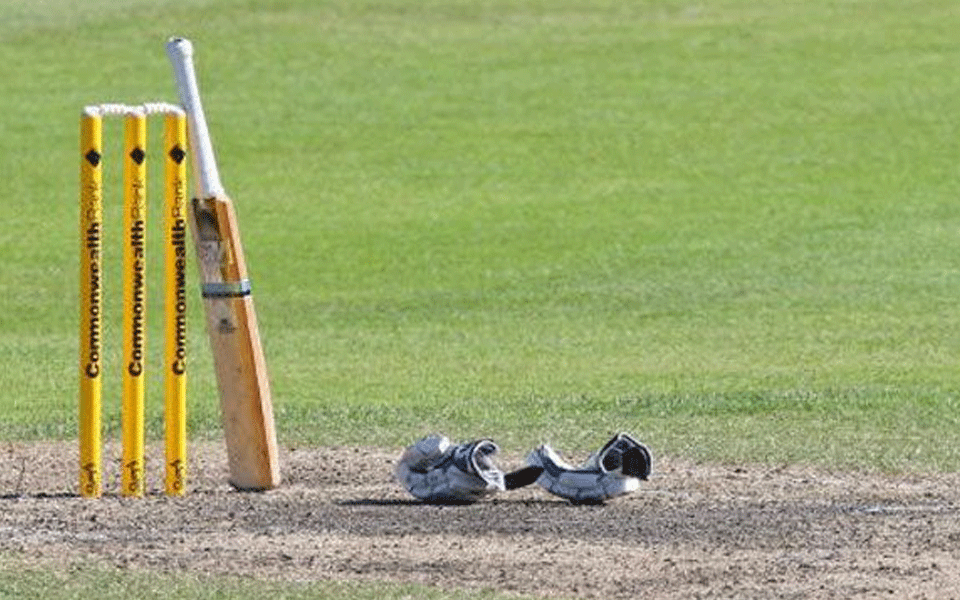
New Zealand cricketer Hareesh Gangadharan, in a heartbreaking incident, collapsed on the field during the match on Saturday (February 2) and died. He was a member of Green Island Cricket Club’s Second Grade team and the incident took place around 4 PM at the Sunnyvale Sports Centre, Main South Road in Green Island. Being an Indian origin, Hareesh played in a team made up predominantly of Indian players.
The club president John Moyle confirmed in a statement about Hareesh’s demise in an unfortunate manner while also expressing shock over the same. He also informed that the team is also in a shock after the incident and went on to add that despite all the efforts made by the medical staff, the cricketer of the Indian ethnicity could not be saved.
According to a report in Otago Daily Times, the onlookers told that Hareesh Gangadharan collapsed while walking away after bowling the second over of his spell. He complained of struggling to breathe and eventually lost consciousness.
courtesy : crictracker.com
Let the Truth be known. If you read VB and like VB, please be a VB Supporter and Help us deliver the Truth to one and all.
Women BJP MLAs protest against opposition in UP assembly premises
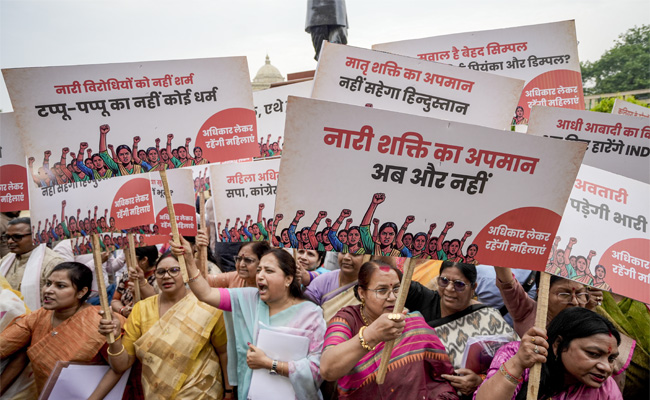
Lucknow (PTI): Women BJP MLAs held a protest in the Vidhan Bhawan complex before the one-day special session of Uttar Pradesh assembly, slamming the opposition for defeating the passage of a bill, which would have led to implementation of the Women's Reservation Law, in the Lok Sabha.
This followed another demonstration by Samajwadi Party MLAs, who alleged that the BJP was misleading public in the name of women's reservation.
The women BJP legislators assembled in front of Chaudhary Charan Singh's statue in the assembly premises, holding banners inscribed with the slogan "Insult to Matrushakti (women's power), India will not tolerate it". The protesting members entered the main hall of Vidhan Bhawan carrying the banners.
Participating in the protest, the state Minister for Women Welfare and Child Development, Baby Rani Maurya, told reporters that all opposition parties, including the Samajwadi Party and the Congress, had opposed the women's reservation, a stance for which they would have to pay a heavy political price.
"On this issue, all of us women stand united. We will ensure that we secure our reservation," she said.
BJP MLA Ketki Singh remarked that their protest represents the collective outrage of millions of women across the state.
Singh asserted that the opposition has betrayed women by creating hurdles in the path of women's reservation. The current demonstration is merely the beginning, and very soon, women from every street, intersection and household will join the protest movement, she said.
Minister Vijaylakshmi Gautam said, "We strongly condemn the despicable act committed by the Samajwadi Party and the Congress in an attempt to hold back 'half the population' (women). Their action was directed against the very bill that Prime Minister Narendra Modi had introduced to empower and strengthen Nari Shakti (women's power), and which he strived to pass expeditiously."
Uttar Pradesh assembly is holding a one-day special session on Thursday. During the session, the government is set to move a censure motion against the opposition parties over their failure to pass the Constitution Amendment Bill, which would have led to implementation of the Women's Reservation Act, in the Lok Sabha.