New Zealand women win 1st T20
Mandhana shines but India fail
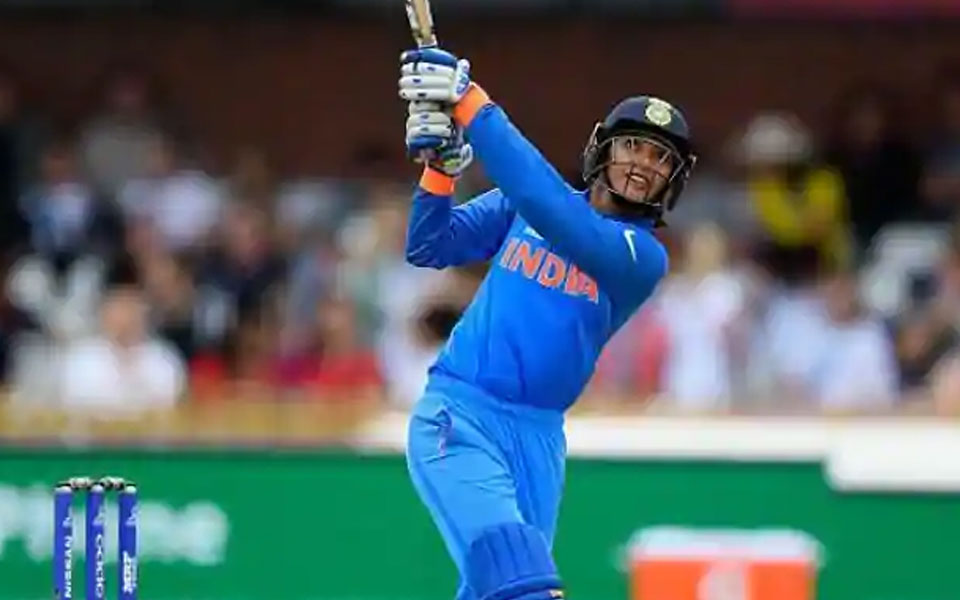
Wellington, Feb 6: Smriti Mandhana remained an unstoppable juggernaut with a record-smashing half century but the Indian women's cricket team failed to make it count, going down by 23 runs in the opening T20 International against New Zealand here Wednesday.
Mandhana held the record for the fastest fifty by an Indian before the match and she bettered it by a ball during her 58-run knock at the WestPac Stadium. The Indian faced 34 balls in all but reached the 50-mark off 24 deliveries.
However, New Zealand pacer Lea Tahuhu played a decisive role with three scalps off her four overs to derail India's chase, which was going smoothly till the time Mandhana was at the crease. India eventually folded for 136 in 19.1 overs.
Leg-spinner Amelia Kerr (2/28) clinched the crucial wickets of Mandhana and Harmanpreet Kaur to wreck the visitors' chances. Off-spinner Leigh Kasperek also picked up a couple of wickets.
Veteran Mithali Raj, who captains the Indian ODI side, was dropped from the match. The next game of the series is scheduled to be held in Auckland on Friday.
Mandhana and Jemimah Rodrigues (39 off 33 balls) combined for a 102-run second-wicket stand that should have been a solid foundation for the rest of the line-up.
But India collapsed in the face of an inspired performance by Lahuhu.
From 101/1, the visiting team was down to 117/6 in a matter of five overs that turned the match on its head.
Harmanpreet (17 off 15 balls) played out a small cameo, including a massive six off Kerr, but couldn't steer the team home, failing to find any support at the other end.
Mandhana was her usual aggressive self and played another strokeful knock, studded with seven hits to the fence and three sixes. The 22-year-old is enjoying a stellar run of form and was recently adjudged the ICC's woman cricketer of the year.
Earlier, opening batswoman Sophie Devine smashed a 48-ball 62 in an enterprising innings to take New Zealand women to a challenging 159 for 4 from 20 overs after being put into bat.
Devine's aggressive innings was laced with six boundaries and two sixes. She and captain Amy Satterthwaite (33 off 27 balls) shared a 69-run stand for the third wicket to steer New Zealand out of trouble after a stuttering start.
Spinners Radha Yadav and Poonam Yadav dismissed Suzie Bates (7) and Caitlin Gurrey (15) cheaply to reduce the home side to 47 for 2 at the end of the seventh over. But the Indians failed to make further dents with Divine and Satterthwaite denying them any success for 8.3 overs.
Devine and Satterthwaite fell in the space of six deliveries off the bowling of Arundhati Reddy and Deepti Sharma in the 16th and 17th overs respectively but New Zealand still made a late flourish by scoring 38 runs from the final 3.3 overs.
Wicketkeeper Katey Martin remained not out on 27 from 14 balls as the home team scored 16 runs from the final over.
Martin hit a six off the second ball of the final over as well as from the last delivery of the innings.
Let the Truth be known. If you read VB and like VB, please be a VB Supporter and Help us deliver the Truth to one and all.
Women BJP MLAs protest against opposition in UP assembly premises
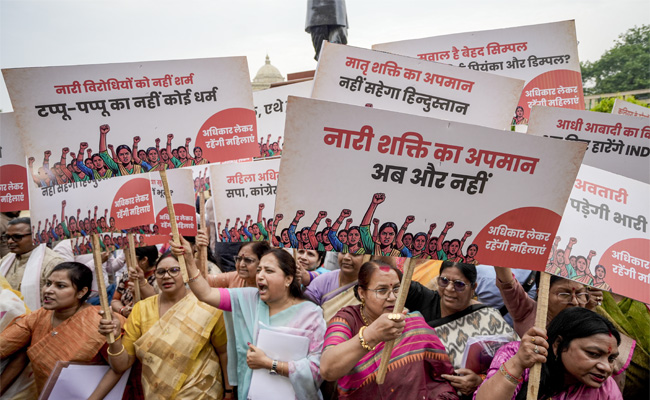
Lucknow (PTI): Women BJP MLAs held a protest in the Vidhan Bhawan complex before the one-day special session of Uttar Pradesh assembly, slamming the opposition for defeating the passage of a bill, which would have led to implementation of the Women's Reservation Law, in the Lok Sabha.
This followed another demonstration by Samajwadi Party MLAs, who alleged that the BJP was misleading public in the name of women's reservation.
The women BJP legislators assembled in front of Chaudhary Charan Singh's statue in the assembly premises, holding banners inscribed with the slogan "Insult to Matrushakti (women's power), India will not tolerate it". The protesting members entered the main hall of Vidhan Bhawan carrying the banners.
Participating in the protest, the state Minister for Women Welfare and Child Development, Baby Rani Maurya, told reporters that all opposition parties, including the Samajwadi Party and the Congress, had opposed the women's reservation, a stance for which they would have to pay a heavy political price.
"On this issue, all of us women stand united. We will ensure that we secure our reservation," she said.
BJP MLA Ketki Singh remarked that their protest represents the collective outrage of millions of women across the state.
Singh asserted that the opposition has betrayed women by creating hurdles in the path of women's reservation. The current demonstration is merely the beginning, and very soon, women from every street, intersection and household will join the protest movement, she said.
Minister Vijaylakshmi Gautam said, "We strongly condemn the despicable act committed by the Samajwadi Party and the Congress in an attempt to hold back 'half the population' (women). Their action was directed against the very bill that Prime Minister Narendra Modi had introduced to empower and strengthen Nari Shakti (women's power), and which he strived to pass expeditiously."
Uttar Pradesh assembly is holding a one-day special session on Thursday. During the session, the government is set to move a censure motion against the opposition parties over their failure to pass the Constitution Amendment Bill, which would have led to implementation of the Women's Reservation Act, in the Lok Sabha.