No 90m this time but Chopra beats Weber to win first Diamond League title in two years
_vb_02.jpeg)
Paris (PTI): Olympic medal-winning Indian javelin throw superstar Neeraj Chopra clinched his first Diamond League title in two years, upstaging German rival Julian Weber without having to hit the 90m mark in a strong field here.
The 27-year-old Chopra won the title late on Friday night with his first round throw of 88.16m in a star-studded field, which featured five from the coveted 90m club.
His second throw measured 85.10m and he then fouled his next three attempts before recording 82.89m in his sixth and final effort.
Weber was second with his opening throw of 87.88m, while Luiz Mauricio Da Silva of Brazil was third with his third round attempt of 86.62m.
"I am happy with my throw....My run-up was really fast today. I can't control my speed, but I'm happy with the result and with the first position," the Haryana-lad, who has a gold and silver in back-to-back Olympics, told the broadcaster.
Chopra had won his last DL title in Lausanne in June 2023 with a throw of 87.66m. After that, he finished second in six DL meetings.
This was his first win in the Paris leg of the prestigious series. He last competed in the Paris DL in 2017 as a junior world champion and finished fifth with a throw of 84.67m.
"I will compete in Ostrava (Golden Spike athletic meet) after four days on the 24th of June. So I need some recovery," he said of his upcoming schedule which also includes the inaugural Neeraj Chopra Classic in Bengaluru on July 5 -- a World Athletics category A event which he is hosting.
Chopra had breached the 90m mark in the Doha leg of the Diamond League on May 16 with a throw of 90.23m for a second place finish. Weber had won the title in Doha with his last round throw of 91.06m.
" I'm hoping for some 90 metre throws because I broke that barrier in Doha. So now I believe I can do it some more...But let's see, it depends on weather and good conditions, how the body feels, but maybe I will throw far in this season," he said.
The 31-year-old Weber had also beaten Chopra at the Janusz Kusocinski Memorial meet on May 23 in Poland where both performed below their best under chilly and overcast conditions.
Weber had produced 86.12m while Chopra could only come up 84.14m to finish second.
The Indian began the 2025 season with a title in an invitational meet at Potchefstroom, South Africa, which was a minor (category F) event with a throw of 84.52m.
In Paris, the three others, apart from Chopra and Weber, who had previously hit the 90m mark were Kenya's 2015 world champion Julius Yego, Trinidad and Tobago's 2012 Olympics gold-winner Keshorn Walcott and Grenada's Anderson Peters.
While Walcott (81.66m) finished fourth, Peters (80.29m) and Yego (80.26m) took the fifth and sixth spot respectively on Friday.
Let the Truth be known. If you read VB and like VB, please be a VB Supporter and Help us deliver the Truth to one and all.
Akash Singh says signature celebration fuels motivation, reinforces dominance
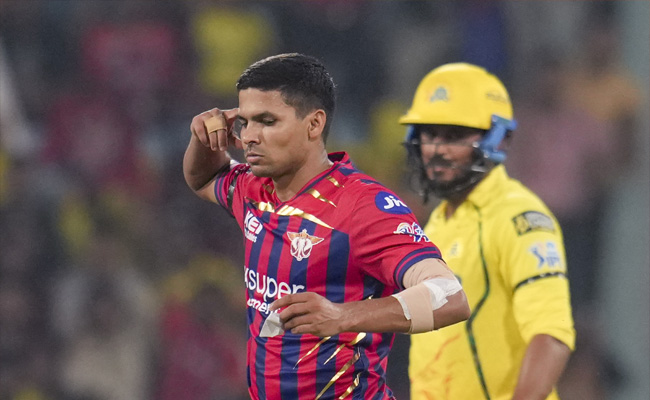
Lucknow (PTI): Pacer Akash Singh caught the eye with his unique celebration during Lucknow Super Giants' win over Chennai Super Kings, pulling out a piece of paper from his pocket after a wicket, a gesture he said was aimed at "motivating" himself and "asserting dominance" over batters.
The left-arm pacer pulled out a scrappy piece of paper after each of the three wickets he took in LSG seven-wicket win over CSK, with the message reading: "Akki on fire -- Akash knows how to take wickets in T20 cricket.
The 24-year-old, who began his IPL journey with Rajasthan Royals and was part of Chennai Super Kings’ title-winning campaign in 2023 before moving to Lucknow Super Giants, registered his best IPL figures with 3 for 26 on Friday.
"'Akki knows how to take wickets in T20 cricket', right?" Akash said when asked about the message on the piece of paper, adding that it serves as a source of motivation and helps him focus on dominating batters and delivering stronger performances for the team.
"Different things motivate different people. Some days I show the paper, some days I don't, but it reflects my mindset on that particular day. When you carry a piece of paper with something written on it, you manifest things and the most important part is when those manifestations actually materialise," he added.
Akash, who hails from Bharatpur in Rajasthan, said the strong backing from the Lucknow Super Giants support staff over the last two years had played a huge role in his growth as a cricketer.
"I've been with LSG for two years and the most important thing has been the backing from the coaches, even when I'm not in the playing XI. This year we have Bharat Arun sir, last year Zaheer sir was there...Tom Moody. The way they guide us, prepare us and keep us ready for opportunities is very important when there are 25 players in the squad," he said.
"When you are not playing, you naturally seek backing and every player wants to make the most of the opportunities he gets. The support from the captain also matters a lot and with Rishabh bhaiya backing you, the confidence grows and you are able to perform better," Akash said, referring to Rishabh Pant.
Akash said Pant had asked him to trust his strengths ahead of the clash against CSK.
"He told me that the new ball is my strength and that I can swing it both ways. So I just tried to make the best use of my skills. The wicket also had good bounce, so I focused on using the bouncer effectively,” added Akash.
On his success against CSK, Akash said his experience of playing in the IPL since 2020, including a stint with CSK, helped him understand the opposition batters better, while backing his own strengths with the ball also played a key role in his impressive spell.
"Obviously, when you play in the IPL and have shared the dressing room with some players, you understand their strengths and weaknesses. My focus was first to back my own strengths, then exploit their weaknesses and also make the best use of what the wicket was offering," Akash said.
Akash said he had sensed over the last two-three games that an opportunity could come his way after being repeatedly told to "be ready", though he admitted he was unfortunate not to get a chance earlier.
"Two days before the match, during practice, I was told to be ready," he said.
Clarifying that he had not been carrying the piece of paper in anticipation, Akash said he often notes down thoughts that could help improve his game..
"Whenever I’m alone or about to sleep, any thought that comes to my mind which can help my cricket, I write it down. The other night I got this thought and jotted it down on paper," he added.