Not Disappointed, But My Goal Was Better than Mohamed Salah's, Says Cristiano Ronaldo

Cristiano Ronaldo believes the overhead bicycle kick he scored for Real Madrid against his current club Juventus last season was better than Mohamed Salah's which won the FIFA goal of the year award.
"Salah deserved to win the Puskas award, it was a good goal. But let's be honest, let's not lie to ourselves, my goal was the best," Ronaldo told his 142 million Instagram followers.
The 33-year-old Portuguese star lost out to former Real Madrid teammate Luka Modric for the FIFA best player award and to Liverpool's Salah for the Puskas Award for the best goal.
Salah won the award for his curling strike against Everton in the Premier League in December.
"I'm not disappointed, life is like that, sometimes you win and others lose, what interests me is that in 15 years of career I managed to maintain the same levels of performance," Ronaldo said.
"Awards are awards... I already have a lot. I play to win and not to win awards." Five days after the awards ceremony in London -- which he did not attend -- five-time Ballon d'Or winner Ronaldo hailed his former Real teammate, saying: "Congratulations to everyone, to Modric, best player of the year according to FIFA." Ronaldo scored his acrobatic goal in the Champions League quarter-finals against Juventus before joining the Serie A champions just months later.
The reigning seven-time Italian champions take on Napoli in a top-of-the-table clash Saturday. Juventus lead Napoli by three points after six games.
"It will be a good game, we want to win against a great team, it's an important day," added Ronaldo.
Courtesy: www.news18.com
Let the Truth be known. If you read VB and like VB, please be a VB Supporter and Help us deliver the Truth to one and all.
BJP to retain Assam, win Bengal; NDA to emerge strong in TN, Kerala, Pondy: Pradhan
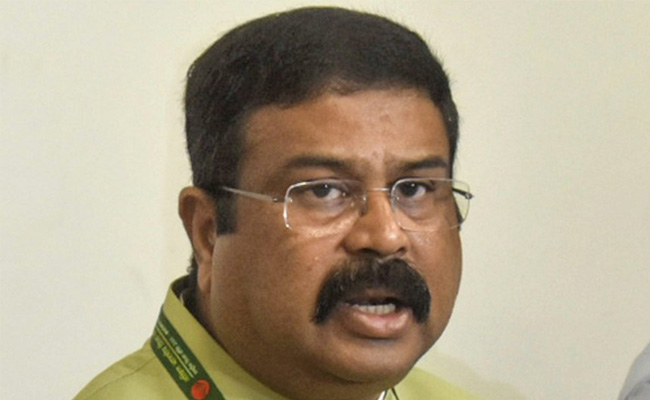
Bengaluru (PTI): Union Minister Dharmendra Pradhan on Thursday said the BJP would retain power in Assam, while expressing confidence that there would be a change of government in West Bengal, citing people’s continued faith in PM Narendra Modi and the party.
Asserting that NDA is likely to return to power in the union territory of Puducherry, he expressed confidence that the BJP-led alliance would emerge strongly in Kerala and Tamil Nadu.
The counting of votes for all five Assemblies—West Bengal, Tamil Nadu, Puducherry, Kerala, and Assam—will take place on May 4.
Polls were conducted in a single phase in Assam, Kerala, Puducherry, and Tamil Nadu, while West Bengal saw two phases of polling on April 23 and 29.
On April 9, Assam, Kerala, and Puducherry went to the polls, while Tamil Nadu voted on April 23.
“Beyond exit polls, all of us who worked in the election campaign this time in the five states (four states and one union territory) are confident that the BJP will retain power in Assam and that, for the first time in a long period, West Bengal is heading for a major change,” Pradhan said.
Speaking to reporters, the union education minister said there is significant anti-incumbency against the TMC government in West Bengal due to alleged misgovernance, appeasement politics, and corruption.
“The people of West Bengal are reposing their faith in the leadership of Prime Minister Narendra Modi, the policies of the BJP and the leadership of the state BJP. I am confident there will be a change of government in West Bengal,” he added.
Pradhan said that, in all probability, the NDA (All India N R Congress–BJP alliance) will retain power in Puducherry.
“In Kerala and Tamil Nadu, I think we are all confident that our alliance will emerge strongly,” he added.
Several exit polls on Wednesday predicted a thumping victory for the BJP in Assam and a clear edge for the party over the ruling TMC in West Bengal, while projecting a return of the DMK government in Tamil Nadu and a comeback by the Congress-led UDF in Kerala after 10 years.
However, some pollsters predicted a big win for the TMC in West Bengal and a hung House in Tamil Nadu, with actor-turned-politician Vijay’s TVK emerging as a spoiler for the DMK. Almost all forecasts indicated a return to power for the AINRC-led NDA government in Puducherry.