Rohit Sharma lifts Virat Kohli in joy after India beat Pakistan, video goes viral
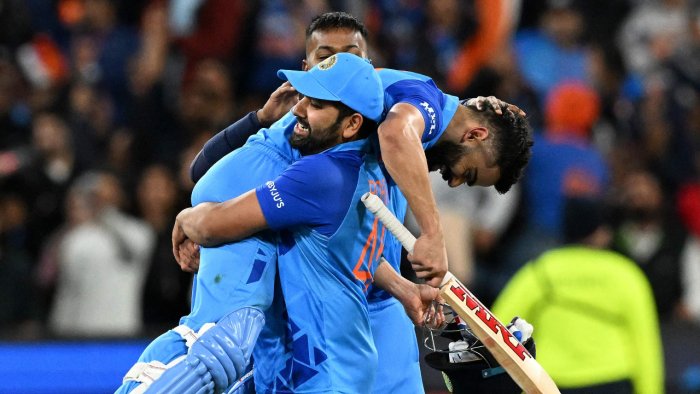
Melbourne, Oct 23: India captain Rohit Sharma didn't bat an eyelid before declaring Virat Kohli's 82 here on Sunday as not only his best but the most accomplished knock played in the country's T20 history.
Kohli has had his issues with form, but his skipper didn't count himself among the Doubting Thomases, who had termed him well past his sell-by-date.
"Yeah, I think it has to go -- definitely his best for sure, but I think from the situation we were in, and to come out with a victory, I think it has to be one of India's best knocks, not just his best knock," Rohit told mediapersons after India's T20 World Cup win against Pakistan.
He explained why he rated this innings as India's No. 1 T20 knock.
"Because until the 13th over (needing close to 100 runs), we were so behind in the game, and the required rate was just climbing up and up. But to come out and chase that score was an extremely brilliant effort from Virat, and then obviously Hardik (Pandya) played a role there, as well," the skipper didn't forget to praise his all-rounder.
Both Kohli and Pandya are veterans of many close T20 contests, which they had pulled off under pressure at the international as well as IPL level.
"I thought both of them, because these guys have played under pressure so many games for us, so they knew exactly how to handle that kind of situation, and they did pretty well in that situation," the skipper said.
While most of the cricket fans questioned whether Kohli's ability to win big games was on the wane, Rohit has been consistent that it was never the case.
"Speaking about Virat, I honestly don't think he was struggling with form or anything. He was batting as good as he was, but with him, the expectations are always so high that even if he gets a good 30 or 40, people tend to talk about it," Rohit reiterated the need to temper down expectations at times.
As a part of the team management, Rohit never felt the need to put pressure on Kohli.
"From the team management's perspective, I thought he was in good space right from the Asia Cup, where he got a month off and then he came back to Asia Cup. He was fresh, got a brilliant hundred there, got a couple of fifties if I'm not wrong.
"And then leading up to the World Cup, we know the quality that he has, and he's done so well in these type of conditions in all three forms."
All about using experience
Kohli had pulled off a similarly incredible chase six years ago in Mohali, during a knock-out T20 World Cup game against Australia.
"Obviously, he (Kohli) used his experience today more than anything else, staying calm under pressure, and we know how good he is when the score is in front of him. He's one of the best chasers in the world.
"I thought that partnership between both of these guys, the hundred-run partnership, was a game-changing moment."
Flicked six off Rauf made us believe we can do it
What had floored Rohit was how the duo (Kohli-Pandya) planned their 113-run stand. But when Haris Rauf was hit for two sixes, the skipper believed that they could just win this one.
"It was probably one of the best I've witnessed in a partnership, and then obviously Virat was brilliant. Those two successive sixes off Haris Rauf, I won't call it the turning point but would definitely say; this is where the game actually came towards us a little bit," he added.
"We always knew there was one over of spin bowling. So inside the dressing room we were thinking if we can keep about 15 to 18 runs in the last over, the guy is going to be under pressure to bowl that last over.
"He bowled that last over against us in Asia Cup and Hardik played some shots against him."
Rohit said he knew that once Mohammed Nawaz was hit for two sixes in his first over, he won't be given a ball. But as things panned out, the pacers finished their quota of overs and Babar Azam was forced to use his left-arm spinner.
"Obviously, it's not easy when you have to bowl the last over being a spinner and only 15 or 18 runs to defend. It's not easy."
Pressure is a two-way street for skipper
Everyone was talking about the pressure under which Pandya and Kohli were while batting but since these two were there in the middle, the Indian skipper felt that even the Pakistan bowlers were under the pump.
"It sometimes plays both ways. The pressure is always on the bowler, I believe, in that type of situation. Yeah, I think we held our own pretty well in the last three overs. That was good to watch."
Watch Rohit Sharma, Virat Kohli's celebration as India beat Pakistan:
The moment Rohit Sharma lifted Virat Kohli - The Best moment of this match. pic.twitter.com/bg0Sq8ZKp5
— CricketMAN2 (@ImTanujSingh) October 23, 2022
View this post on Instagram
Let the Truth be known. If you read VB and like VB, please be a VB Supporter and Help us deliver the Truth to one and all.
KKR defeat LSG via Super Over
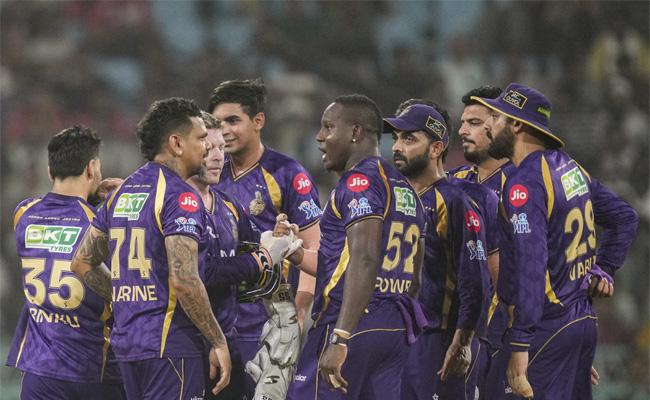
Lucknow (PTI): Kolkata Knight Riders edged Lucknow Super Giants via Super Overs in a battle between two bottom-placed teams in the IPL, here on Sunday.
Chasing a modest 156, LSG suffered a batting collapse and managed to tie the contest and take it to Super Over with No. 9 Mohammed Shami striking a last-ball six against a wayward Kartik Tyagi, who leaked 16 runs in the final over.
But Sunil Narine bowled a stunning Super Over conceding just one run and taking two wickets to give KKR an easy target.
Rinku Singh then finished the chase with a boundary off first ball from Prince Yadav.
Earlier the KKR were in deep trouble with 93/7 in 15 overs but Rinku smashed a sensational 83 not out from 51 balls including four sixes in a row in the final over to lift them to 155/7.
Cameron Green (34) was the only other batter to reach double-digit scores as KKR suffered a familiar batting meltdown with Mohsin taking his maiden fifer.
In reply, LSG continued their dismal show with the bat to succumb to their fifth loss in a row.
Brief Scores:
Kolkata Knight Riders 155/7; 20 overs (Rinku Singh 83 not out, Cameron Green 34; Mohsin Khan 5/23). Lucknow Super Giants 155/8; 20 overs (Rishabh Pant 42). KKR won via Super Over.