Novak Djokovic back in detention, continues to fight deportation
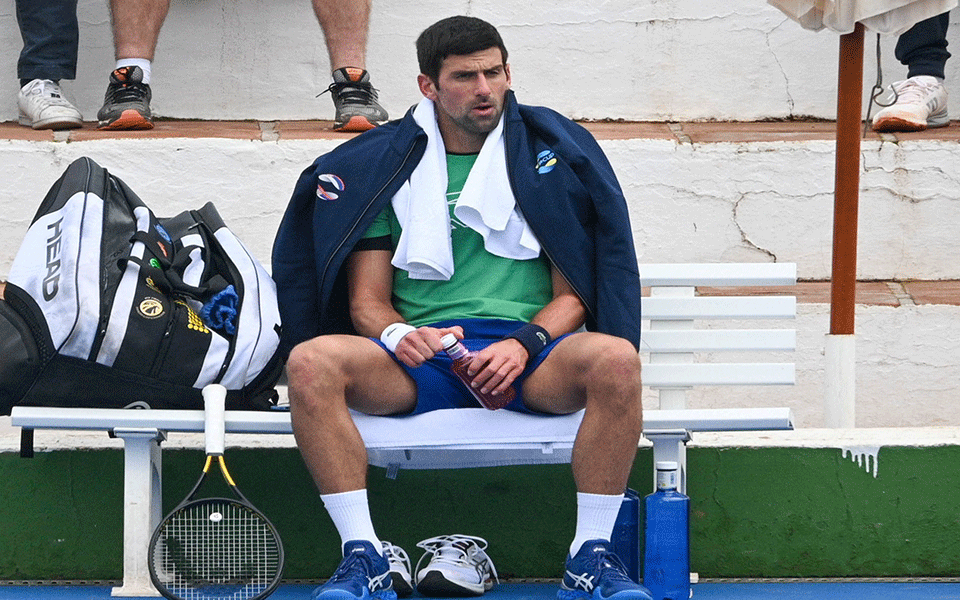
Melbourne (AP): Novak Djokovic was reported to be back in immigration detention Saturday after his legal challenge to avoid being deported from Australia for being unvaccinated for COVID-19 was moved to three judges of a higher court.
A Federal Court hearing has been scheduled for Sunday, a day before the men's No. 1-ranked tennis player and nine-time Australian Open champion was due to begin his title defense at the first Grand Slam tennis tournament of the year.
Police closed down a lane behind the building where Djokovic's lawyers are based and two vehicles exited the building mid-afternoon local time on Saturday. In television footage, Djokovic could be seen wearing a face mask in the back of a vehicle near an immigration detention hotel.
The Australian Associated Press reported that Djokovic was back in detention. He spent four nights confined to a hotel near downtown Melbourne before being released last Monday when he won a court challenge on procedural grounds against his first visa cancellation.
Immigration Minister Alex Hawke on Friday blocked the 34-year-old Serb's visa, which was originally revoked when he landed at a Melbourne airport on Jan. 5.
Deportation from Australia can lead to a three-year ban on returning to the country, although that may be waived, depending on the circumstances.
Djokovic has acknowledged that his travel declaration was incorrect because it failed to indicate that he had been in multiple countries over the two weeks before his arrival in Australia.
But the incorrect travel information is not why Hawke decided that deporting Djokovic was in the public interest.
His lawyers filed documents in court on Saturday that revealed Hawke had stated that Djokovic is perceived by some as a talisman of a community of anti-vaccination sentiment.
Australia is one of the most highly vaccinated populations in the world, with 89% of people aged 16 and older fully inoculated for COVID-19.
But the minister said that Djokovic's presence in Australia may be a risk to the health and good order of the Australian public. His presence may be counterproductive to efforts at vaccination by others in Australia, the minister said.
The Health Department advised that Djokovic was a low risk of transmitting COVID-19 and a very low risk of transmitting the disease at the Australian Open.
The minister cited comments Djokovic made in April 2020, before a COVID-19 vaccine was available, that he was opposed to vaccination.
Djokovic had previously stated he wouldn't want to be forced by someone to take a vaccine to compete in tournaments.
The evidence makes it clear that he has publicly expressed anti-vaccination sentiment, the minister wrote in his reasons for canceling Djokovic's visa.
Djokovic's lawyers argue that the minister had cited no evidence that Djokovic's presence in Australia may foster anti-vaccination sentiment.
Djokovic will be allowed out of hotel detention on Sunday to visit his lawyers' offices for the video court hearing.
On Saturday, Federal Chief Justice James Allsop announced that he would hear the case with Justices David O'Callaghan and Anthony Besanko.
The decision for three judges to hear the appeal instead of a single judge elevates the importance of the case from the judiciary's perspective and potentially gives Djokovic an advantage.
The trio are regarded as experienced judges who are more likely to find a government minister at fault than their more junior colleagues.
O'Callaghan had earlier suggested a full bench hear the case. A full bench is three or five judges.
A full bench means any verdict would be less likely to be appealed. The only avenue of appeal would be the High Court and there would be no guarantee that that court would even agree to hear such an appeal.
Djokovic's lawyer Paul Holdenson opted for a full bench while Hawke's lawyer Stephen Lloyd preferred a single judge.
"There's nothing special about the grounds, Lloyd argued, referring to Djokovic's argument that Hawke had made an irrational decision based on no evidence.
"They're not novel legally and we say there's no justification for stepping out of the ordinary by appointing three judges, Lloyd added.
Legal observers suspect Lloyd wanted to keep the option open of another Federal Court appeal because he thinks the minister can mount a stronger case without the rush to reach a verdict before Monday.
Djokovic has won the past three Australian Opens, part of his overall Grand Slam haul of 20 championships. He is tied with Rafael Nadal and Roger Federer for the most by a man in history.
In a post on social media Wednesday that constituted his most extensive public comments yet on the episode, Djokovic blamed his agent for checking the wrong box on the form, calling it a human error and certainly not deliberate.
In that same post, Djokovic said he went ahead with an interview and a photo shoot with a French newspaper in Serbia despite knowing he had tested positive for COVID-19 two days earlier.
Djokovic has been attempting to use what he says was a positive test taken on Dec. 16 to justify a medical exemption that would allow him to skirt the vaccine requirement on the grounds that he already had COVID-19.
In canceling Djokovic' visa, Hawke said that Prime Minister Scott Morrison's government is firmly committed to protecting Australia's borders, particularly in relation to the COVID-19 pandemic.
Morrison himself welcomed Djokovic's pending deportation. The episode has touched a nerve in Australia, and particularly in Victoria state, where locals went through hundreds of days of lockdowns during the worst of the pandemic.
Australia faces a massive surge in virus cases driven by the highly transmissible omicron variant. On Friday, the nation reported 130,000 new cases, including nearly 35,000 in Victoria state.
Although many infected people aren't getting as sick as they did in previous outbreaks, the surge is still putting severe strain on the health system, with more than 4,400 people hospitalized. It has also disrupted workplaces and supply chains.
Djokovic's supporters in Serbia have been dismayed by the visa cancellations. Serbian President Aleksandar Vucic on Friday accused the Australian government of harassing and maltreating Djokovic and asked whether it is just trying to score political points ahead of upcoming elections.
"Why didn't you return him back right away, or tell him it was impossible to get a visa? Vucic asked the Australian authorities in a social media address. Why are you harassing him and why are you maltreating not only him, but his family and an entire nation that is free and proud."
Everyone at the Australian Open including players, their support teams and spectators is required to be vaccinated.
According to Grand Slam rules, if Djokovic is forced to pull out of the tournament before the order of play for Day 1 is announced, No. 5 seed Andrey Rublev would move into Djokovic's spot in the bracket.
If Djokovic withdraws from the tournament after Monday's schedule is released, he would be replaced in the field by what's known as a lucky loser a player who loses in the qualifying tournament but gets into the main draw because of another player's exit before competition has started.
And if Djokovic plays in a match or more and then is told he can no longer participate in the tournament, his next opponent would simply advance to the following round and there would be no replacement.
Let the Truth be known. If you read VB and like VB, please be a VB Supporter and Help us deliver the Truth to one and all.
15 passengers sustain minor injuries after KSRTC bus overturns in Karnataka's Chitradurga district

Chitradurga (Karnataka) (PTI): Fifteen passengers sustained minor injuries after the KSRTC bus they were travelling in overturned after the driver allegedly lost control of the vehicle in this district on Tuesday morning, police said.
The accident occurred near Heggare in Challakere taluk of Chitradurga district at around 7 am, they said.
According to police, the bus was en route from Raichur to Bengaluru when the driver allegedly lost control of the vehicle, hit a divider and the bus overturned.
Fifteen passengers sustained minor injuries and were shifted to the Challakere Government Hospital, they said.
The accident is suspected to have occurred due to the driver losing control after falling asleep, police said.
Further investigation is underway, they added.