P V Sindhu storms into third successive finals at BWF World Championships
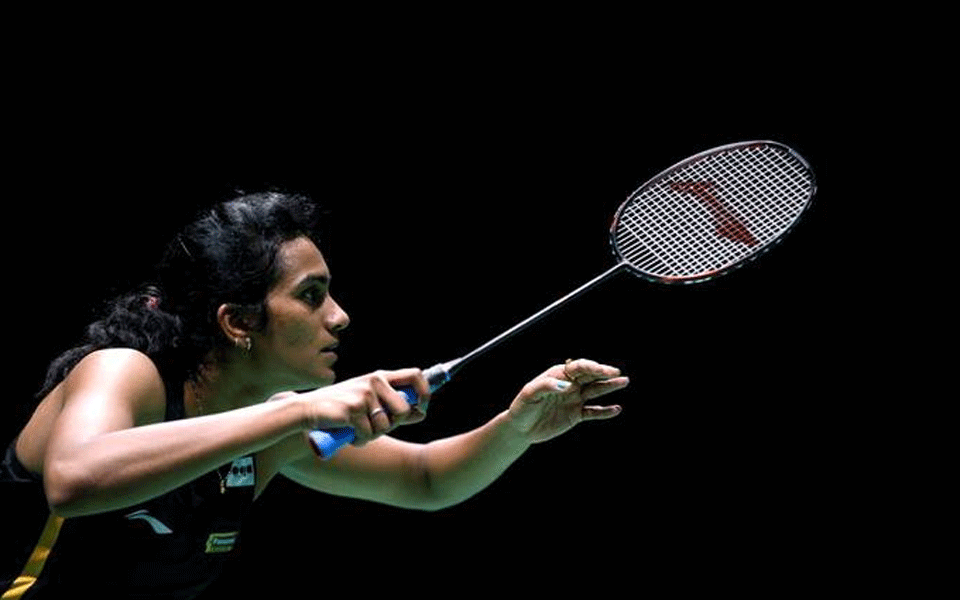
Basel (Switzerland): India's P V Sindhu stood one win away from an elusive World Championships gold medal after storming into her third successive final with a straight-game win over All England champion Chen Yu Fei here on Saturday.
Sindhu, who had claimed successive silver in the last two editions of the prestigious tournament beside two bronze, was a picture of perfection as she outclassed World No. 3 Chen of China 21-7 21-14 in a 40-minute semifinal.
The 24 year old from Hyderabad will face either 2013 world champion Ratchanok Intanon of Thailand or 2017 winner Nozomi Okuhara of Japan in the summit clash on Sunday.
Olympic silver medallist Sindhu, who came into the match with a 5-3 head-to-head record against Chen, grabbed the initiative quickly.
The Indian dished out a compact game, producing angled returns to push Chen to the corners. Sindhu retrieved well and punished any weak return from her rival to dominate the rallies.
Sindhu entered the first break with a 11-3 lead after the Chinese went wide. Chen continued to find the going tough as she missed the lines, allowing the indian to gather points at will. Another weak return at the net by Chen gave Sindhu as many as 14 game points. The Indian then sealed the opening game in her second attempt.
Chen made a better start in the second game and was neck-and-neck at 3-3 with Sindhu, but the errors again crept in her game as Sindhu moved to a 10-6 lead. Sindhu exploited a weakness in the backhand side of Chen to lead 11-7 at the breather.
The Indian worked hard during the rallies, not giving an inch to her Chinese rival and was rewarded for her effort. Chen committed too many unforced errors in her desperation as Sindhu jumped to a 17-9 lead in a jiffy.
The Indian eventually grabbed eight match points with a cross court smash. Chen saved a couple before hitting long again as Sindhu celebrated.
Let the Truth be known. If you read VB and like VB, please be a VB Supporter and Help us deliver the Truth to one and all.
Rickelton's ton in vain as SRH beat MI by 6 wickets

Mumbai (PTI): Ryan Rickelton's whirlwind unbeaten ton was overshadowed by Heinrich Klaasen's unbeaten 65 as Sunrisers Hyderabad defeated Mumbai Indians by six wickets in an IPL match here on Wednesday.
Chasing an imposing 244-run target, Travis Head (76 off 30) and Abhishek Sharma (45 off 24) shared 129 runs for the opening wicket to set the platform for SRH.
Klaasen (65 not out off 30 balls) then displayed his all-round hitting abilities to guide SRH home with the help of Nitish Kumar Reddy (21) and Salil Arora (30 not out off 10) in 18.4 overs.
Earlier, Rickelton's knock powered MI to 243 for five.
MI rode on a 93-run stand between Rickelton (123 not out off 55 balls) and Will Jacks (46 off 22) in 7.1 overs for the opening stand to power the side.
MI skipper Hardik Pandya scored a valuable 31 off 15 balls before being dismissed.
Praful Hinge (2/54), Eshan Malinga (1/29), Sakib Hasan (1/39) and Nitish Kumar Reddy (1/31) were the wicket-takers for SRH.
Brief Scores:
Mumbai Indian: 243 for 5 in 20 overs (Ryan Rickelton 123 not out; Praful Hinge 2/54).
Sunrisers Hyderabad: 249 for 4 in 18.4 overs (Travis Head 76, Heinrich Klaasen 65 not out; AM Ghazanfar 2/51).