Pacers, Root set up England's overwhelming eight-wicket win over West Indies
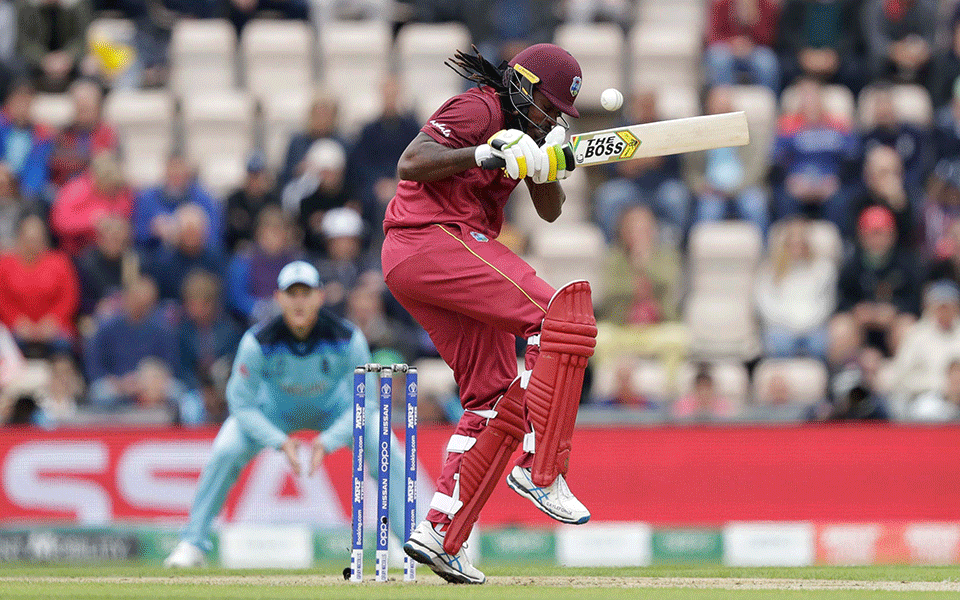
Southampton, June 14: Joe Root hit his second century of the tournament after England pace battery tormented the West Indies batsmen to set up a thumping eight-wicket win in their World Cup match here Friday.
West Indies got a taste of their own medicine -- they had troubled the Pakistanis with bouncers in their only win thus far as the England pace battery unleashed fiery spells to bundle them out for 212 in 44.4 overs.
England overhauled the target with remarkable ease, completing the win in 33.1 overs as Root remained unbeaten on 100, which came off 94 balls.
In his 16th ODI hundred, Root found the boundary rope 11 times.
West Indies owed their total to Nicholas Pooran (63), who chose the biggest stage to strike his maiden ODI fifty, and Shimron Hetmyer's (39) sensible batting on a pitch which had no demons.
They added 89 runs for the fourth wicket but West Indies' big guns failed to fire.
Extravagance, when the situation demanded patience, resulted in Chris Gayle (36) and Andre Russell (21) throwing their wickets away. The T20 style batting in the longer format cost their side dear.
Young pacer Archer (3/30) had the West Indies batsmen dancing on the pitch, troubling them with the steep bounce.
Archer, Mark Wood (3/18), Chris Woakes (1/16) and Liam Plunkket (1/30) delivered the goods for the home favourites after home skipper Eoin Morgan opted to field.
For defending 212, West Indies needed early wickets but openers Root and Jonny Bairstow (45) punctured all their hopes with a commanding 91-run stand.
It seemed the two batsmen were competing to hit most the elegant shots one can hit. Their cover and straight drives were like unrestrained stream of a river.
Left-arm pacer Sheldon Cottrell did ask a few tough questions to the English duo but Root and Bairstow were up for the task.
Bairstow departed when his square cut off Shannon Gabriel landed straight into the big hands of Carlos Brathwaite.
Root and Woakes (40), promoted to number three, then added 104 runs for the second wicket to push the side to the doorstep of a comfortable win.
The result catapulted England (6) to the second spot in the table behind New Zealand (7).
Earlier, the ball was hurrying on to the batsmen and whether it was a Shai Hope (11) or the big-hitting Gayle, the Caribbeans found the going tough as timing the ball was a challenge. They had already lost Evin Lewis (0), bowled by Woakes off a yorker.
Gayle, out of frustration, pulled one from Woakes, just managed an edge but escaped as Wood grassed a sitter. The marauding batter did hit a few big shots, including a massive straight six off Woakes, but did not last long, edging one straight to Jonny Bairstow off Plunkett.
Hope's torturous stay was ended by Wood when he had him trapped after reviewing the umpire's not out decision.
Pooran and Hetmyer then chose restrain over flamboyance, steading the innings.
The duo did all the hard work, working the ball around to keep the scoreboard going in their partnership, which got broken when Joe Root had Hetmyer caught off his own bowling.
The part-time off-spinner struck in his next over too, dismissing the rival captain Jason Holder (9) in similar fashion.
In came Russell and the ball was soon flying into the stands. He twice dispatched leg-spinner Adil Rashid into the crowd after being dropped but was dismissed, attempting another big shot off Wood.
Let the Truth be known. If you read VB and like VB, please be a VB Supporter and Help us deliver the Truth to one and all.
Rajnath to top commanders: Outmaneuver adversaries with strategic surprise
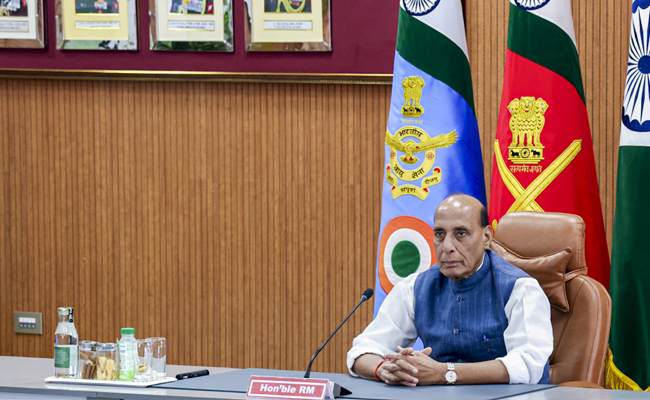
Jaipur/New Delhi (PTI): Defence Minister Rajnath Singh on Friday directed the top military commanders of the three services to integrate an "element of surprise" into modern warfare to outmaneuver India's adversaries and bolster strategic posture.
In his address at the joint commanders conference in Jaipur, Singh also described the Operation Sindoor as a testament to the "swift, precise, and joint response" of the Indian armed forces to safeguard national interests and called upon the military to remain ready to deal with any security challenges.
In their two-day deliberations, the commanders carried out a comprehensive review of the combat preparedness of the military in the wake of the evolving regional security situation.
Operation Sindoor was a demonstration of India's growing capabilities and a symbol of the nation's collective resolve and new military ethos, Singh said, a day after the first anniversary of Operation Sindoor.
He also unveiled a 'Joint Doctrine for Integrated Communication Architecture' that is aimed at strengthening doctrinal clarity, interoperability and integrated communications across the armed forces in future multidomain operations.
The joint commanders' conference, themed 'Military Capability in New Domains', brought together the top leadership of the defence ministry and the three services to deliberate on emerging security challenges and future readiness.
Comprehensive deliberations were held on future warfare, multidomain operations, technological transformation and joint capability development.
The conference witnessed extensive discussions on cognitive warfare, cyber resilience against evolving quantum and AI-enabled threats, military capability development in emerging domains, indigenous innovation and AI-enabled warfighting concepts.
It was attended by Chief of Defence Staff Gen Anil Chauhan, Chief of the Naval Staff Admiral Dinesh Kumar Tripathi, Chief of the Army Staff Gen Upendra Dwivedi, Chief of the Air Staff Air Chief Marshal AP Singh and Defence Secretary Rajesh Kumar Singh among others.
In his remarks, Singh asked the commanders to remain "future-ready" by learning from the operation as well as the current global security landscape.
He underscored the need to strengthen capabilities in artificial intelligence, autonomous systems, data analytics and secure communication networks to stay prepared in the rapidly evolving geopolitical security scenario. He emphasised that future conflicts will increasingly be shaped by hybrid threats, information dominance and operations conducted simultaneously across cyber, space, electromagnetic and cognitive domains, according to an official readout.
Highlighting the transformative impact of emerging technologies, Singh stressed on the importance of ensuring integrated national preparedness across all spectrums of conflict, it said.
Singh's remarks at the conference came a day after the first anniversary of Operation Sindoor.
The defence minister appreciated the progress achieved in enhancing jointness, integration and technological adoption across the three services, the readout noted.
Singh said that jointness constitutes a pivotal dimension within the transformative changes sweeping across the global defence sector.
"Future wars will not be won solely through weaponry, but through innovative thinking and enhanced synergy," he said.
The defence minister exhorted the commanders to cultivate the "element of surprise" to remain unpredictable to the nation's adversaries and secure a strategic edge in any given situation.
He, however, urged them to remain vigilant of the element of surprise of the enemy and always stay two steps ahead.
Singh also reiterated the Narendra Modi government's commitment to enhancing the capabilities of the defence forces through state-of-the-art weapons and platforms. He added that special focus is being laid on research in niche domains.
During the conference, he released a documentary film on Operation Sindoor.
The film reaffirms the nation's and defence forces' commitment to operational preparedness and decisive national response capabilities.
Demonstrations of advanced systems and platforms developed for intelligence fusion, operational planning and information management were also showcased during the conference reflecting growing integration of cutting-edge technologies into joint operational structures, according to the defence ministry.
The discussions will contribute significantly towards shaping India's future military transformation and integrated operational preparedness, it said.