Paddlers bag six medals in team events at Jordan Junior and Cadet open
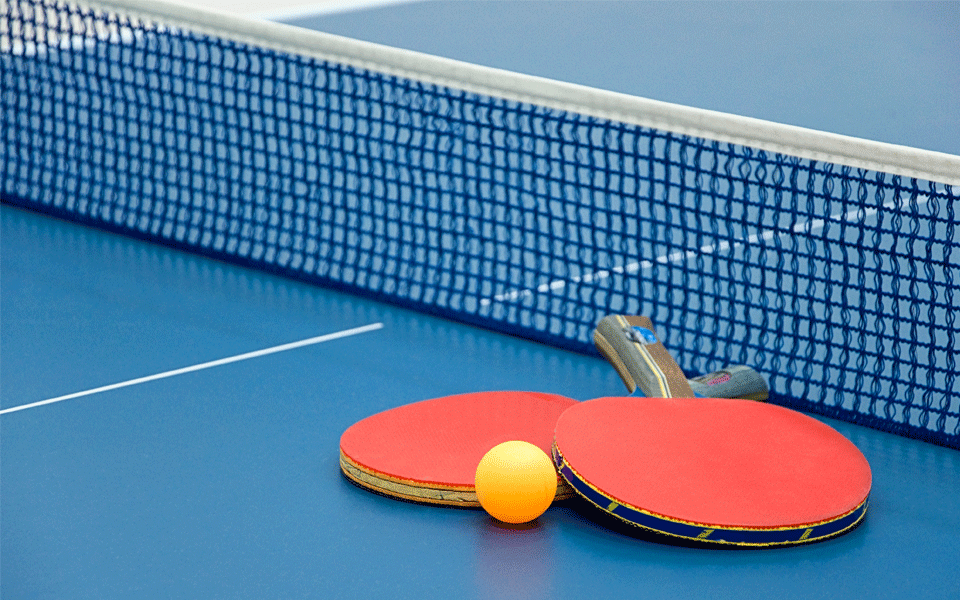
New Delhi, July 30 : Indian junior paddlers, who put up a dominating show in the individual events of the Jordan Junior and Cadet Open, turned in yet another sterling display in the team events and clinched six medals -- one gold, three silver and two bronze.
In the all-India final of the junior girls' category on Sunday, India 2 team comprising Prapti Sen, Swastika Ghosh and Surbhi Patwari prevailed over the India 1 team of Selena Selvakumar and Yashini Sivasankar 3-1 to annexe the gold, according to the statement.
In the junior boys' category, India 1 team consisting of Jeet Chandra, Manush Shah and Snehit Suravajjula went down fighting to the formidable Chinese Taipei team 1-3 to return with a silver medal.
The India 2 squad consisting of Ankuram Jain, Parth Virmani and Sarthak who had qualified for the semifinals, also lost to the eventual winners Chinese Taipei to finish their campaign with a bronze medal in the junior boys' event.
In the cadet girls' competition, the pair of Diya Chitale and Trisha Gogoi put up a valiant fight against the formidable Chinese team before going down with a narrow margin of 2-3 to settle for the silver.
Guining Wang and Sui Xiaoran won their respective matches against Diya Chitale (3-0) and Trisha (3-1) to give China a healthy 2-0 lead.
But the Indians came back stronger to win their next two matches to take the tie into the decider. Diya and Trisha won their doubles encounter 3-1 against Sui Xiaoran and Yulei Zhang, while Diya won her second singles of the night with a formidable 3-0 victory over Sui Xiaoran.
With the scores levelled, it was down to Trisha to steer India towards the finish line but she came up short against Guining Wang and lost 0-3. The team finished with a silver.
In the Cadet boys' team category, Payas Jain and H. Jeho representing India 1 after their brilliant show against Sweden 3 and Iran 2 in their round of 16 clash and quarterfinal clash respectively eventually lost 0-3 against Chinese Taipei in the semifinals to bow out of the tournament with a bronze medal.
Let the Truth be known. If you read VB and like VB, please be a VB Supporter and Help us deliver the Truth to one and all.
Rickelton's ton in vain as SRH beat MI by 6 wickets
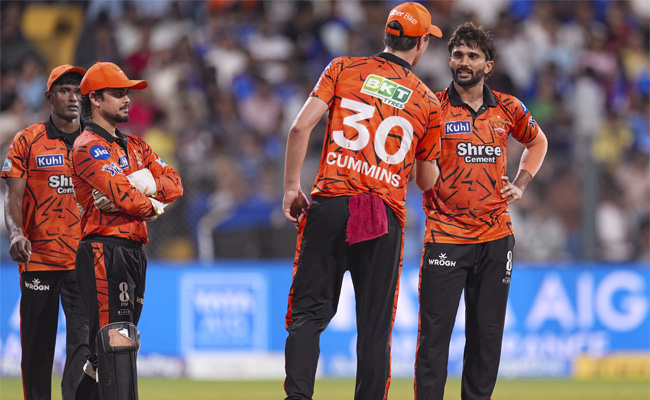
Mumbai (PTI): Ryan Rickelton's whirlwind unbeaten ton was overshadowed by Heinrich Klaasen's unbeaten 65 as Sunrisers Hyderabad defeated Mumbai Indians by six wickets in an IPL match here on Wednesday.
Chasing an imposing 244-run target, Travis Head (76 off 30) and Abhishek Sharma (45 off 24) shared 129 runs for the opening wicket to set the platform for SRH.
Klaasen (65 not out off 30 balls) then displayed his all-round hitting abilities to guide SRH home with the help of Nitish Kumar Reddy (21) and Salil Arora (30 not out off 10) in 18.4 overs.
Earlier, Rickelton's knock powered MI to 243 for five.
MI rode on a 93-run stand between Rickelton (123 not out off 55 balls) and Will Jacks (46 off 22) in 7.1 overs for the opening stand to power the side.
MI skipper Hardik Pandya scored a valuable 31 off 15 balls before being dismissed.
Praful Hinge (2/54), Eshan Malinga (1/29), Sakib Hasan (1/39) and Nitish Kumar Reddy (1/31) were the wicket-takers for SRH.
Brief Scores:
Mumbai Indian: 243 for 5 in 20 overs (Ryan Rickelton 123 not out; Praful Hinge 2/54).
Sunrisers Hyderabad: 249 for 4 in 18.4 overs (Travis Head 76, Heinrich Klaasen 65 not out; AM Ghazanfar 2/51).