Pandya''s blazing fifty, ruthless bowlers earn India 101-run win over SA
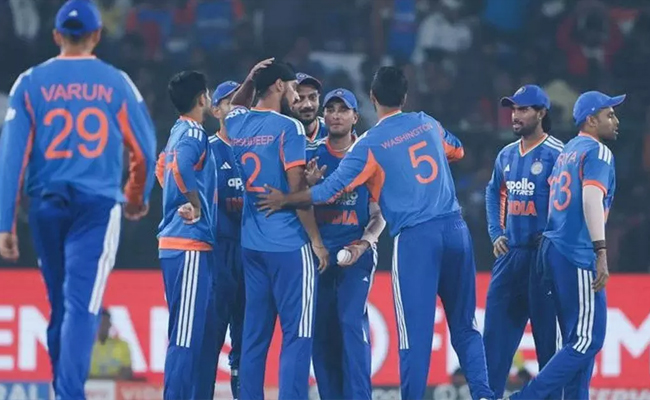
Cuttack (PTI): Hardik Pandya made a memorable comeback to competitive cricket, striking a mood-lifting unbeaten fifty and then took a key wicket as India etched a dominant 101-run win over South Africa in the opening match of the five-match series here on Tuesday.
The victory helped India take a 1-0 lead in the rubber and it also pushed South Africa to their lowest-ever T20I total. Their previous lowest was also against India -- 87 all out in Rajkot in 2022.
India had been pushed onto the back-foot after SA asked them to bat first on a tacky red-soil surface, but Pandya’s commanding 59 not out off 28 balls rescued them from early turbulence. India posted a competitive 175/6.
On a pitch that demanded discipline, South Africa showed none, to be all out for a mere 74 in 12.3 overs, as the hosts’ bowlers ran through them with relentless accuracy.
Arshdeep Singh, Jasprit Bumrah, Varun Chakravarthy and Axar Patel grabbed two wickets each, while Pandya fittingly chipped in with the prized scalp of David Miller.
It was also South Africa’s first defeat in three T20Is in Cuttack, and if India had started shakily, South Africa began disastrously.
Arshdeep set the tone with a superb away-swinger that kissed past Quinton de Kock’s tentative prod for a two-ball duck.
In his next over, Arshdeep produced another beauty -- a length ball that jagged back into the in-form Tristan Stubbs (14).
India went upstairs for the review, and UltraEdge confirmed a thick inside edge onto the elbow before Jitesh Sharma completed a sharp take as South Africa were 18/2 inside four overs.
Axar was introduced in the final over of the powerplay and struck immediately.
Aiden Markram, shuffling back to work a skiddy, straight delivery, was beaten on the inside edge to get bowled. At 28/3 in six overs, South Africa were already in a hole.
Pandya then added to their misery, dismissing Miller.
Chakravarthy, operating with sharp drift and deceptive pace, got into action after the powerplay. Donovan Ferreira was late to react to a delivery that held back, and could only nick behind to Jitesh.
Marco Jansen, who had fielded brilliantly earlier, was undone by Chakravarthy’s googly as South Africa slid to 68/6.
The end arrived quickly thereafter with Bumrah cleaning up Dewald Brevis and Keshav Maharaj in the space of four deliveries.
Earlier, coming back after 74 days following a left quadricep injury that forced him out of the Asia Cup, Pandya walked in at No. 6 and immediately changed the tempo of the match.
India had slipped in both the power play and middle overs losing six wickets, but Pandya, who had proved his fitness at the Syed Mushtaq Ali Trophy for Baroda with a 42-ball 77 not out, counter-attacked with clean, fearless hitting to finish en route his sixth T20I fifty.
He began with two towering sixes against Maharaj just after a well-set Tilak Varma (26) fell. Pandya then ripped into Anrich Nortje with a 17-run over, even stepping out to a 149kph thunderbolt to punch it for four.
Jansen tried to rush him with short balls, but Pandya pulled one with vengeance before racing towards fifty that lifted the mood in the stadium.
He struck a six and four off Lutho Sipamla (2/38) in the 19th over, and reached his half-century in 25 balls with a ramped six over third man off Nortje in the final over, celebrating it with a muted raise of the bat.
Pandya's late fireworks helped India add 71 runs in the last six overs.
But on a fresh red-soil surface offering two-paced bounce, India struggled early.
Abhishek Sharma (17), Shubman Gill (4) and Suryakumar Yadav (12) all fell inside seven overs as Lungi Ngidi (3/31) exploited the conditions superbly with clever variations.
He removed Gill early as the batter chipped to Jansen at mid-off, and later had skipper Suryakumar holding out to Markram to have India 17/2.
Abhishek tried to force the pace after the field restrictions lifted, but fell to Sipamla, thanks to a stunning sliding catch by the 2.06m Jansen sprinting across from long leg to fine leg.
His brief stay of 17 off 12 balls ended just as he began to find rhythm with back-to-back boundaries as India soon slipped to 48/3 in 6.3 overs.
Varma looked set while smashing a towering six off Nortje and with two fours in his 32-ball 26 but the Indian innings started to wobble again with him and Axar (23) dismissed by Ngidi and Sipamla respectively.
Let the Truth be known. If you read VB and like VB, please be a VB Supporter and Help us deliver the Truth to one and all.
Meet Kerala's Dr. Santosh Kumar who has served in various warzones; latest in Gaza
Read his experiences from Gaza, in Vartha Bharati's interview
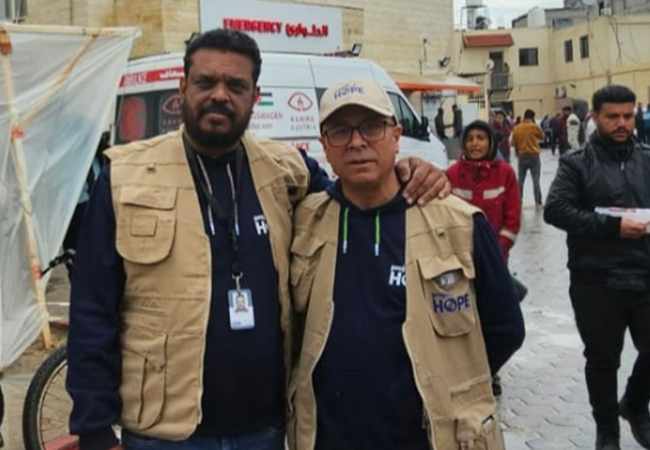
He has walked through some of the world’s most dangerous places, not as a witness, but as a doctor treating people when everything around them is falling apart. Dr. Santhosh Kumar from Kerala has spent years working in war zones and crisis-hit regions with Doctors Without Borders, often stepping in where medical systems no longer exist.
Most recently, he served in Gaza, where large-scale violence has left thousands struggling for basic medical care. Even after returning, his work there is not over. He is preparing to head back to Gaza later this month, continuing his role on the frontlines of a humanitarian crisis.
In this interview, he speaks about what he has seen, the challenges of working in conflict zones, and what it means to be a doctor when survival itself becomes uncertain.
Excerpts from the interview below:
Question: You had just come back from Ukraine after a long stretch of work. What made you say yes again, this time for Gaza, without even taking a break?
Dr. Santosh Kumar: I had just returned from Ukraine, and physically, yes, I was tired. But when the call came for Gaza, it didn’t feel like something I could say no to. Situations like these don’t wait for you to rest. When there is such a large-scale humanitarian crisis unfolding, you don’t think in terms of convenience. You think about where you are needed the most. For me, the decision was simple, if I have the skills and the experience, I have to be there.
Question: Do you remember your first night in Egypt before entering Gaza? What was going on in your mind at that moment?
Dr. Santosh Kumar: That night was very heavy. You are standing at the edge of something you already know is going to be intense, but you still don’t know what exactly you are walking into. There is always a mix of thoughts about the people inside, about what kind of medical situation you will face, and whether the system there is even functioning. At the same time, you prepare yourself mentally to adapt quickly. You try to stay calm, because once you cross over, there is no time to process emotions.
Question: When you finally reached Gaza, what was the first thing that told you this was going to be very different from any other place you’ve worked in?
Dr. Santosh Kumar: It is very important to understand what is happening there. This is not a war. This is a genocide. When you see the scale of destruction, the number of civilians affected, and the complete breakdown of basic systems, it becomes very clear that this is different. As doctors, we are trained to respond to emergencies, but here, the situation goes beyond a typical conflict setting. Understanding that reality is important before you even begin your work.
Question: You’ve spoken about that smell when you entered Gaza. It’s something people don’t usually talk about. What did that moment feel like for you?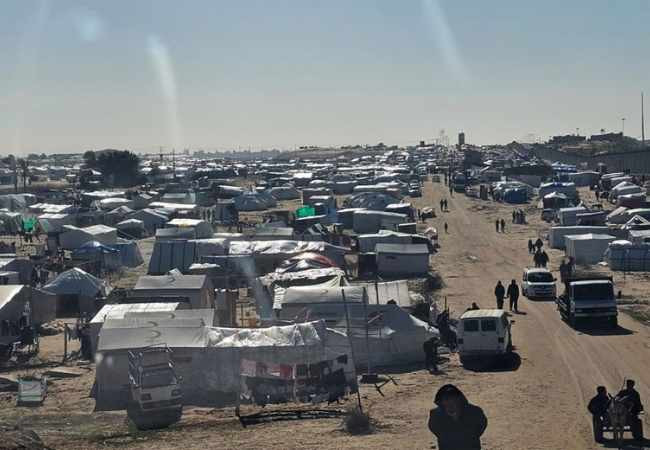
Dr Santosh Kumar from the Gaza war front.
Dr. Santosh Kumar: The first thing that hits you is not what you see, but what you smell. It’s very difficult to explain, but it stays with you. There is this constant mix in the air the smell of medicines, of wounds, of poor sanitation, and something deeper that comes from a complete breakdown of systems. You can feel the suffocation almost immediately.
The healthcare system has collapsed. Sanitation has collapsed. People don’t even have access to basic facilities. When all of that comes together, it creates an environment where the air itself feels heavy. It is not something you experience in a typical conflict zone.
Question: When you saw people living in tents, without even basic dignity, did it hit you immediately, or did it take time to sink in?
Dr. Santosh Kumar: It hits you almost instantly, but at the same time, the full reality takes time to process. You see thousands of people living in makeshift tents, without proper water, sanitation, or healthcare. The system is completely broken.
If people are not dying from bombs or bullets, they are dying from diseases. There are very limited places for basic human needs like excretion, and the queues are so long that people are forced to wait for hours. In some cases, people are collapsing or dying while waiting..jpg)
Photograph by Dr. Santosh Kumar
This is not just about displacement. It is about the loss of dignity at every level. As a doctor, you are trained to deal with emergencies, but here, the scale and the nature of suffering are very different. It takes time for that to fully sink in, even if the shock is immediate.
Question: You’ve seen many war zones. What was it about Gaza that disturbed you the most compared to others?
Dr. Santosh Kumar: In most conflict zones, even if the situation is bad, some systems still function at some level. In Gaza, what I saw was a complete collapse. There is no proper healthcare system, no sanitation, nothing functioning the way it should. The scale is also very different. The number of people affected, and the intensity of the situation, makes it much more disturbing than many other places I have worked in.
Question: Can you describe one scene that still hasn’t left your mind?
Answer: There is no one single scene. That’s the reality. Every day, things are happening around you. People keep coming in with injuries. Families bring their relatives, sometimes in critical condition, sometimes already gone. It becomes a continuous cycle. There is no one moment you can isolate, because the entire environment is like that all the time.
Question: When you saw children coming in injured… or sometimes not even making it… how do you process that as a doctor and as a human being?
Dr. Santosh Kumar: As a doctor, you focus on what you can do in that moment. You don’t have the luxury to process everything emotionally when you are working. You have to keep going, patient after patient. But as a human being, it does affect you. You see children, you see families, and you understand what they are going through. Still, during work, you have to stay focused on treatment.
Question: There’s a part where you mentioned people losing even their basic dignity. How difficult is it to witness that, knowing you can’t fix it immediately?
Dr. Santosh Kumar: It is difficult, but we have to be clear about our role. We are not there to fix everything. We are there to treat patients. The situation around us may be chaotic. When patients die, sometimes people even blame us. But in that environment, you have to stay focused on your responsibility. Treating people remains our priority.
Question: When you have more patients than you can treat, how do you decide who gets treated first? How do you live with those decisions?
Dr. Santosh Kumar: Like I said, the number of patients is always more than what the system can handle. In such situations, you follow basic medical priorities. You treat those who can be saved with immediate intervention. It is not an easy decision, but in these environments, you have to be practical.
You don’t have the luxury to think too much about each decision at that moment. You focus on doing the maximum possible with the limited resources you have. That becomes your approach.
Question: There are moments where you know someone could have survived if there were proper resources. How do you carry that weight?
Dr. Santosh Kumar: That is something you are aware of all the time. You know that with better facilities, better access, some of these lives could have been saved. But like I said earlier, we are not there to fix the entire system. We are there to treat with what we have.
You cannot carry every single outcome with you while you are working. If you do that, you won’t be able to continue. You accept the limitations and focus on the patients you can help.
Question: After coming back, do these memories stay with you? Or do you learn to switch off?
Dr. Santosh: The memories stay. You don’t completely switch off from something like this. What you see there, it stays with you in some form.
But over time, you learn how to manage it. Because if you keep holding on to everything, it becomes very difficult to continue this kind of work. So you carry it, but you also learn how to move forward.
Question: A lot of young people today see such things only through social media. What do you think they are missing?
Dr. Santosh Kumar: What you see on social media is only a small part of the reality. It doesn’t show you the full picture. It doesn’t show the scale, the continuous nature of the suffering, or what people are going through every single day.
Like I said, when you are physically present there, you understand how different it is. Social media can inform you, but it cannot make you fully understand the situation.
Question: How can youngsters build real empathy, not just momentary sympathy that fades after scrolling?
Dr. Santosh Kumar: Empathy comes from understanding and consistency. It is not about reacting to one post or one video. It is about staying aware, learning more about the situation, and trying to understand what people are going through.
It also means thinking beyond immediate reactions. If you want to build real empathy, you have to stay connected to the issue, not just for a moment, but over time.
Question: For someone who genuinely wants to help, where do they even begin?
Dr. Santosh Kumar: You don’t have to start with something big. You can begin by educating yourself, understanding the ground realities, and supporting credible organisations that are working in these areas.
Helping is not always about being physically present in a conflict zone. There are many ways to contribute, even from where you are.
Question: Do you think you need to be a doctor or specialist to make a difference in such situations?
Dr. Santosh Kumar: No, not at all. Of course, medical professionals have a specific role, but these situations require support in many forms. There are people working in logistics, coordination, communication, and many other areas.
Everyone has a role to play depending on their skills.
Question: What role can students or young professionals play from where they are?
Dr. Santosh Kumar: They can start by being informed and responsible. They can support the right initiatives, raise awareness in a meaningful way, and contribute in whatever capacity they can.
Like I said, you don’t have to be on the ground to make a difference. What matters is how consistently and responsibly you engage with the issue.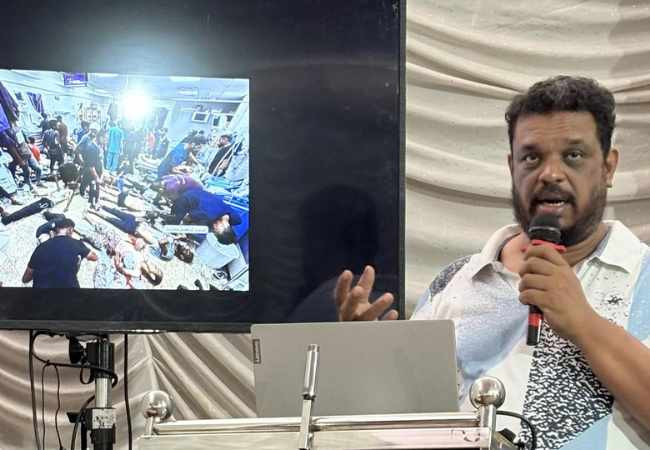
Dr. Santhosh Kumar recounts his experience in Gaza at the Quantum Century exhibition in February 2026. (Courtesy: The Hindu)
Question: After everything you’ve seen in Gaza, has it changed how you look at life?
Dr. Santosh Kumar: It does change you in some ways. When you see people struggling for the most basic things, food, water, safety, you start looking at life a little differently. Things we often take for granted become much more real.
At the same time, like I said, you learn to keep moving forward. You cannot keep thinking about everything all the time. You take what you have seen, and you continue with your work.
Question: If there’s one thing you want people to understand about Gaza beyond headlines and politics, what would that be?
Dr. Santosh Kumar: The most important thing is to understand the reality on the ground. This is not just about headlines or numbers. These are real people, living in extremely difficult conditions.
And like I said earlier, it is important to understand that what is happening there is not a war. It is a genocide. Unless people understand that, they won’t fully understand the situation.
Question: And finally, what keeps you going? What makes you still say yes, even after seeing so much pain?
Dr. Santosh Kumar: Like I said, this is something I chose a long time ago. From my early years, I have been involved in this kind of work. So for me, it is a commitment.
You don’t think about it every time as a new decision. You just continue doing what you believe is your responsibility. That is what keeps me going.