Pant was on his way to surprise his mother when he met car accident
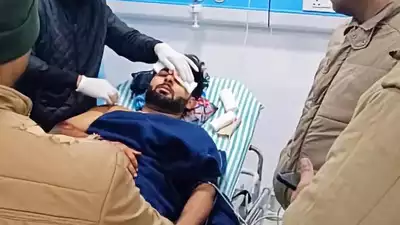
New Delhi, Dec 30: Rishabh Pant's plan to surprise his mother ahead of the new year turned into a horrific accident after his car collided with a road divider on the Delhi-Dehradun highway in the wee hours on Friday.
The star India wicket-keeper batter was lucky to survive serious injuries due to his alertness, jumping off his Mercedes in the nick of time as the car went up in flames after hitting the divider.
Dr. Sushil Nagar, who was the first to attend to Pant in the emergency ward of Saksham Hospital near Roorkee, said the cricketer didn't suffer any fracture but there was a ligament injury on his knee which would require further investigation.
"When he was brought to our hospital, he was fully conscious and I spoke to him. He wanted to surprise his mother and was going back home," Nagar told PTI.
He suffered big bruises on his back but Nagar said those are not burn injuries.
"The injuries happened because he jumped out of car by breaking the window of his car as soon as it caught fire. As he landed on the side of the road on his rear, the skin peeled off. But those are not burn injuries and not very serious."
The 25-year-old dozed off and lost control of his Mercedes early morning on Friday en route to his home in Roorkee. He was alone in the car.
The accident happened at Mohammadpur Jat in Manglaur town of Haridwar district.
He suffered injuries on his head, back and feet but is in a stable condition.
"He had two lacerations (blunt trauma) on his head but I didn't put stitches. I have recommended him to Max Hospital where a plastic surgeon might see him," Nagar said.
The doctor, however, said Pant suffered a ligament tear on his right knee and the extent of that injury can only be ascertained after an MRI scan.
"However reports of X Rays conducted at our hospital suggest that there are no bone injuries. Yes, there is a ligament tear on his right knee. How serious it is can only be detected after further investigation and detailed MRI," he said.
Ligament injuries have various grades and it can take 2 to 6 months to regain full fitness, which puts a serious question mark over Pant's availability for the home Test series against Australia, starting February 9.
Pant was not part of the upcoming white-ball series against Sri Lanka beginning on January 3. He was supposed to join the National Cricket Academy (NCA) in Bengaluru for a strength and conditioning programme ahead of February's Border Gavaskar Trophy.
The explosive left-handed wicket-keeper batter has scored 2,271 runs in 33 Tests so far with the help of five hundreds and 11 half-centuries. He has also represented the country in 30 ODIs and 66 T20Is, scoring 865 and 987 runs respectively.
Let the Truth be known. If you read VB and like VB, please be a VB Supporter and Help us deliver the Truth to one and all.
Explosive device kills 13, injures 38 on bus in southwestern Colombia as violence persists
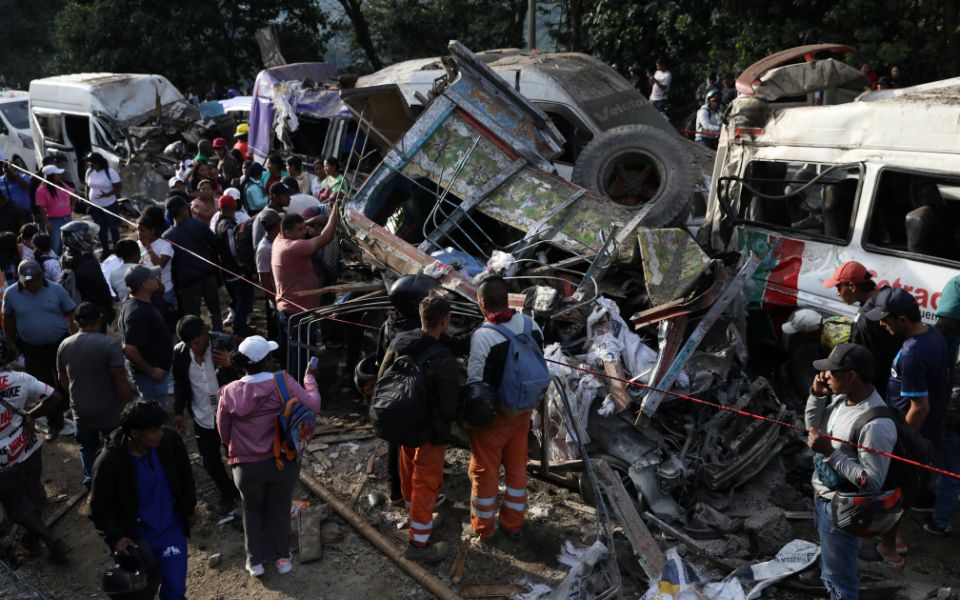
Bogota (Colombia) (PTI): An explosive device killed 13 people travelling on a bus in southwestern Colombia on Saturday, an attack the country's army chief described as a “terrorist act" that also left at least 38 injured as violence linked to drug trafficking in the region escalates.
Octavio Guzman, the governor of the region of Cauca, said on X that the device was set off while the bus was travelling along the Panamerican Highway in the municipality of Cajibio. Five children were among the injured, Cauca Health Secretary Carolina Camargo told Noticias Caracol, a TV news program.
Gen. Hugo Lopez, commander of Colombia's Armed Forces, told a news conference that it was a “terrorist act" and blamed the network of a man known as “Ivan Mordisco” — one of Colombia's most wanted figures — and the Jaime Martínez faction. Both are dissidents of the now-defunct Revolutionary Armed Forces of Colombia that operate in the region.
Neither Ivan Mordisco nor the Jaime Martínez faction abide by the peace agreement signed with the state in 2016.
Colombian President Gustavo Petro condemned the attack on X.
“Those who carried out the attack and killed seven civilians — and wounded 17 others — in Cajibío — many of them Indigenous people — are terrorists, fascists, and drug traffickers,” he wrote.
The attack is the latest in a spate of explosions that have attempted to target public infrastructure. At least 26 incidents have taken place in the past two days in southwestern Colombia, which Lopez said have only affected civilians.
They included a shooting at a police station in the rural area of Jamundi, and an attack on a Civil Aviation radar facility in El Tambo, where authorities took down three explosives-laden drones earlier on Saturday. No one was hurt.
On Friday, two vehicles rigged with explosives were detonated near military units in Cali and Palmira, causing material damage.
The escalation of violence in that region — a territory contested by illegal armed groups linked to drug trafficking — prompted the mobilisation of high-ranking officials on Saturday. Led by Defence Minister Pedro Sanchez, the delegation that includes regional governors and local authorities, was meeting in Palmira when the deadly explosion occurred.
“These criminals seek to instil fear, but we will respond with firmness,” Sanchez said on X.
Meanwhile, Francisca Toro, governor of Valle del Cauca, has called upon the national government to provide “immediate support.” In a message on X, Toro called for a reinforcement of public security forces, enhanced intelligence operations and “decisive actions” against crime in the face of a “terrorist-level escalation.”
According to authorities, Cauca and Valle del Cauca serve as a critical hub for illicit activities of illegal armed groups vying for control over sea and river access routes leading to the port of Buenaventura — a key transit point used to traffic drugs to Central America and Europe.
The government has also offered a reward of more than 1 million dollars for information leading to the capture of “Marlon,” who is identified as the leader of the region's dissident group. On Friday, local authorities offered more than USD 14,000 for information leading to the identification and location of those behind the attacks in Cali and Palmira.