Paris Olympics 2024: Nita Ambani re-elected unanimously as IOC member

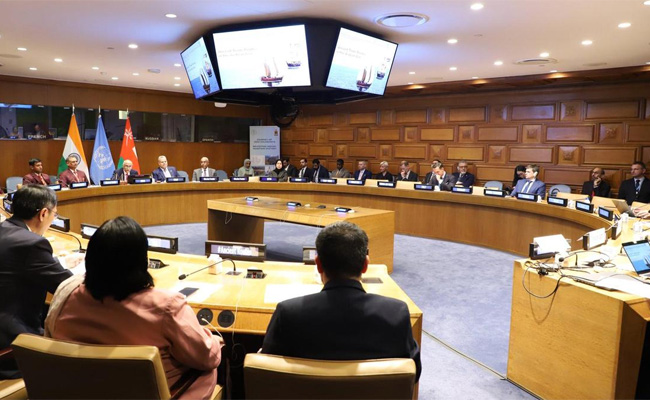
Paris (PTI): Indian sports administrator Nita Amabani was on Wednesday re-elected unanimously as member of the International Olympic Committee (IOC), ahead of the Paris Olympics.
Ambani won unanimously with 100 per cent of vote at the 142nd IOC session here.
"I am deeply honoured to be re-elected as a member of the International Olympic Committee. I would like to thank President (Thomas) Bach and all my colleagues in the IOC for their faith and trust in me," Ambani said.
"This re-election is not just a personal milestone but also a recognition of India's growing influence in the global sporting arena. I share this moment of joy and pride with every Indian and look forward to continuing our efforts to strengthen the Olympic Movement in India and around the world," she added.
Ambani was first appointed to join the prestigious body in 2016 at the Rio Olympic Games. Since then, as India's first woman to join the IOC, Ambani has already made great strives for the association, whilst also championing India's sporting ambitions and Olympic vision.
This includes recently hosting the first IOC session in Mumbai in 40 years in October 2023.
As founder and chairperson of the Reliance Foundation, Ambani seeks to empower millions of Indians with resources and opportunities.
She drives various initiatives across sport, education, health, art and culture -- all aimed at improving the lives of people across the country.
As part of a long-term partnership with the Indian Olympic Association (IOA), Reliance Foundation has opened the first-ever India House at the Paris Olympics.
India House will be a "home away from home" for athletes, a place to celebrate wins, and share India's Olympic journey with the world.
It demonstrates India's ambitions to become a dominant force in global sports, fostering greater success at the Olympics and charting a course towards hosting the Games in the future.
Let the Truth be known. If you read VB and like VB, please be a VB Supporter and Help us deliver the Truth to one and all.
SC to hear pleas for reviewing wages of priests, temple staff
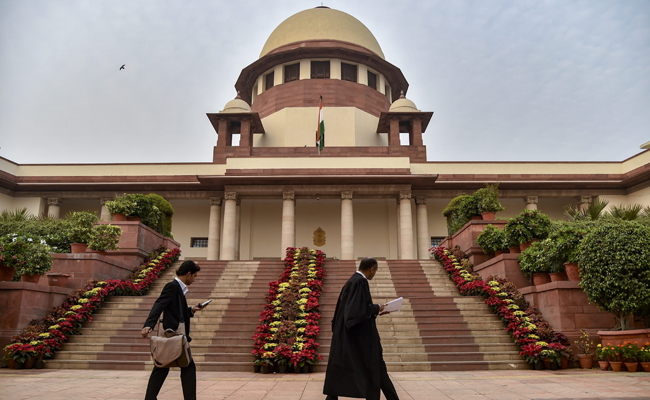
New Delhi (PTI): The Supreme Court is scheduled to hear on Monday a plea to constitute a judicial commission or an expert committee to review the wages and other benefits given to priests, 'sevadars' and temple staff in state-controlled temples.
A bench of Justices Vikram Nath and Sandeep Mehta is likely to hear the PIL filed by advocate Ashwini Upadhyay.
The plea, filed through advocate Ashwani Dubey, seeks directions to the Centre and states to constitute a judicial commission or an expert committee to review the remuneration and other benefits given to the priests and temple staff in state-controlled temples.
"Petitioner also seeks a declaration that priests and temple staff are employee' under Section 2(k) of the Code on Wages, 2019. Petitioner submits that once the State assumes the administrative, economic and financial control over temples, an employer-employee relationship arises and denial of dignified wages to priests and temple staff violates the right to livelihood guaranteed under Article 21," it said.
Upadhyay said the cause of action accrued on April 4, when he went to Varanasi to attend a public programme and after performing 'Rudrabhishek' in the Kashi Vishwanath temple, which is controlled by the state, he came to know that even the minimum wages to live with dignity are not given to the priests and temple staff.
"Recently, in Andhra Pradesh and Telangana, priests and temple staff organised a large-scale protest demanding the minimum wages. Priests and temple staff are not getting even the minimum wage prescribed by the State for unskilled and semi-skilled workers. This is a systemic exploitation. State is acting as a model employer through the endowments department, but violating the minimum wages Act and the directive principles of state policy (Article 43)," it said.
The plea further said the continued refusal to meet the minimum wages with the 2026 inflation-adjusted cost of living index has forced the petitioner to seek judicial intervention to prevent the further marginalisation of priests and temple staff.
Upadhyay further said the precarious nature of livelihood was starkly exposed on February 7, 2025, when a Tamil Nadu department issued a circular at the 'Dandayuthapani Swami Temple' in Madurai, strictly prohibiting priests from accepting 'dakshina' in 'aarti plates'.
"It is necessary to state that priests in such temples often receive no formal salary from the State and rely entirely on 'Dakshina'; the State's administrative order directly threatened them with starvation. Although withdrawn due to public outrage, the incident highlights the State's arbitrary power over the survival of the priests. This is also a bitter truth that States are controlling lakhs of temples but not a single mosque or church," the PIL claimed.
The petition, alternatively, sought direction to the Centre and states to take appropriate steps for the welfare of priests, sevadars and other temple staff in the spirit of the Allahabad High Court's earlier judgments.