Paris Olympics: Bengaluru swimmer Dhinidhi Desinghu to represent India
I am going to Olympics at 14, all sacrifices were worth it: swimmer Dhinidhi
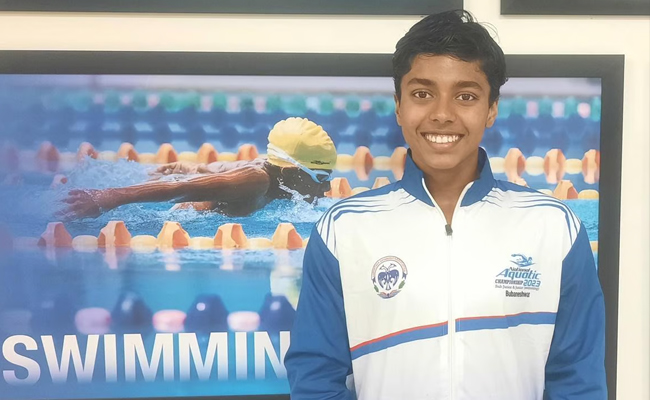
Bengaluru (PTI): At times, she misses the carefree pleasures her peers enjoy and occasionally experiences a sense of solitude, but all of that has been worth it for 14-year-old swimmer Dhinidhi Desinghu, who is gearing up to fulfil her dream of competing at the Olympics later this month.
The Bengaluru swimmer, who studies in class ninth, is set to be the youngest member of the Indian contingent at the Paris Olympics.
"Sometimes I miss the fun generally kids of my age have. I do not go out much with friends and feel lonely. But then I wanted to swim and I wanted to go to the Olympics," Dhinidhi told PTI Bhasha in an exclusive interview at her residence.
"I am the one who chose this path for me. With that comes a lot of sacrifices but I do feel different, extraordinary and proud. At 14, I am going to the Olympics, so all the sacrifices are worth it," she added.
The Olympic cycle has been an underwhelming one for Indian swimming as none of the swimmers were able to breach either the 'A' or 'B' qualification time. But Dhinidhi has been on a roll, winning medals at the National Games and the senior National championships last year.
Her performances this season made her the top-ranked Indian female swimmer with the Swimming Federation of India handing her one of the two Universality places and an opportunity of a lifetime.
"I knew that I had a chance (of making the Olympics) because I have been working really very hard but it was surprising that I got this chance so early in my career. Being the youngest one in the Indian contingent is a big honour."
"I am super excited to be a part of the Indian Olympic contingent as I will get a chance to meet the greatest athletes," said Dhinidhi, who will compete in the women's 200m freestyle event.
Having got the opportunity to compete at the Olympics at such a young age, Dhinidhi wants to soak in everything and gain experience.
"This is just the beginning and I have a long long way to go. I am really excited to know what more I can do in 2028 and 2032.
"I want to experience the feeling of staying at the Olympic village. What kind of races are being held there as the competition in India is totally different from what we get at international level. I want to see the dedication, the focus and the preparation of world class athletes.
"I am not thinking about performance as it is just about learning this time. I am sure whatever learnings I have here, that will make me a better athlete."
She is excited to meet her idol -- seven-time Olympic gold medallist swimmer Katie Ledecky.
"I made a greeting card last year for her. I used to think that whenever I get a chance to meet her, I will give this to her. I looked up at her from a very young age and luckily, I got this chance. Hopefully I can give it to her in Paris. I will be on the seventh moon if I get a chance to even see her," she said.
Let the Truth be known. If you read VB and like VB, please be a VB Supporter and Help us deliver the Truth to one and all.
Climate Change crisis: IMD to change parameters to declare heatwaves
Thiruvananthapuram (PTI): The IMD, along with its technical partners, will soon revise the criteria for declaring heatwave conditions in the country, as the present parameters do not suit India’s geographical conditions, according to official sources here.
Kerala, in particular, has faced difficulties in issuing heatwave warnings because of the limitations of the existing parameters.
Sources in the India Meteorological Department said the state experienced severe heat and humidity this summer and, for the first time, weather forecasts were made based on the anti-cyclone system that formed near the Karnataka–Maharashtra coast.
"We have never had an anti-cyclone system form closer to the South before, and this time we had to predict the weather based on it," a senior IMD official told PTI.
Anti-cyclonic systems are common over north-western parts of India, but this year one formed near the southern region, leading to unusually hot nights.
The anti-cyclone caused downward air movement, which pushed warm air towards the surface and prevented it from dispersing at night, the official added. As a result, Kerala recorded night temperatures 3 to 4 degrees Celsius above normal.
Because Kerala has experienced a steady temperature increase during the summer months for the last few years, changing the parameters for declaring heat waves would benefit the state, enabling the authorities to issue warnings more efficiently, the official added.
The IMD currently issues hot and humid weather warnings, although the situation warrants a heatwave warning, as the existing parameters do not allow the department to issue one.
At present, the IMD issues a heat wave warning in coastal areas when the maximum temperature reaches 37 degree Celsius or more with a temperature departure of 4.5 degree Celsius over the recorded maximum temperature.
For plains, the threshold is 40 degrees Celsius with a departure of 4.5 degrees Celsius or more from normal, while for hilly regions it is 30 degrees Celsius with a departure of 4.5 degrees Celsius or more.
Officials said the current heatwave declaration parameters also require these conditions to be recorded at two stations in the state to issue the warnings.
"In Kerala, we hardly get to record these conditions in two areas; moreover, we have severe heat stress that can easily cause a heat stroke. So we have decided to rework the heatwave declaration parameters and the changes will be implemented shortly. There will be a consultation with the Disaster Management Authority also before finalising the parameters," the official said.
Throughout Kerala, temperatures recorded this summer were three to four degrees Celsius higher than usual. The state also reported multiple cases of heatstroke despite regular warnings issued by the IMD and the state disaster management authority.
According to experts, Kerala has become a climate change hotspot, with a steady increase in atmospheric temperatures and erratic monsoons.
The IMD has also predicted a below-normal monsoon this year, as this is the first time two consecutive El Nino years are being witnessed.