Pink Test Day 1: Australia restrict India to 233/6 after Kohli run-out
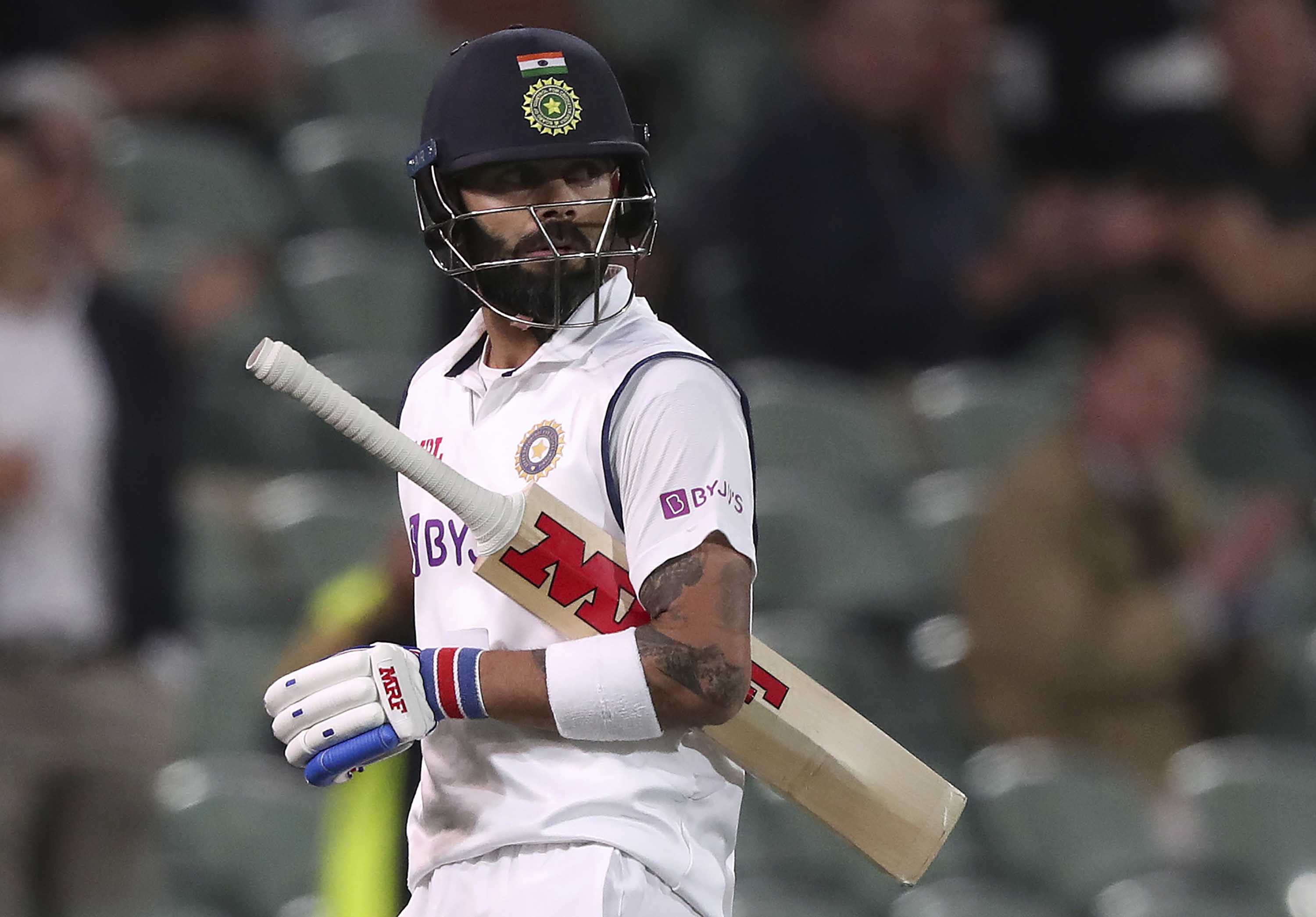
Adelaide, Dec 17: Virat Kohli's enduring love affair with Adelaide Oval resulted in a classy 74 but his untimely run-out triggered a batting collapse as India ended the opening day at 233 for 6 against Australia in the first Day/Night Test here on Thursday
Kohli, who looked in complete command, was run out when his deputy Ajinkya Rahane backed out after calling for a single and it happened just before the second new ball was taken.
From a comfortable 188 for 3, India slumped to 206 for 6 as Rahane and Hanuma Vihari (16) found the pace and swing generated by the pink ball under lights too hot to handle.
Ravichandran Ashwin (15 batting) and Wriddhiman saha (9 batting) saw off the final few overs and also got a few runs.
In conditions, which can't exactly be called batting friendly, Kohli blended the right amount of caution and aggression in his 180-ball innings, showing one and all that he is a few lightyears ahead of his peers when it comes to quality batsmanship.
If Cheteshwar Pujara (43 off 160 balls) let bowlers dictate terms with an ultra-defensive approach, his skipper gave opposition the respect it deserved but also from time to time, played those shots to drive home a point.
His 88-run partnership with Rahane (42 off 91 balls) during the final session nearly put India on even keel but fortunes tilted once Kohli was back in the pavilion.
Rahane was soon snapped with the second new ball by Mitchell Starc (2/49), easily the best bowler in action.
The knock will certainly be among the Indian captain's favourites as he hit three kinds of pull-shots to the pacers -- two off Starc and one off Josh Hazlewood.
One of the pulls off Starc was a check shot for which just rolled his wrists to the ball to the square leg boundary.
Then there was one off Hazlewood where he again rolled his wrists but the ball went to the front of square.
Another pull was where he got under the ball and hit it to the mid-wicket fence. There was a classical cover-drive that brought his half-century.
Earlier, Pujara's ultra-defensive approach became his own undoing as India literally crawled during the first two sessions.
So intent was Pujara on blocking anything and leaving everything for the better part of his innings, that a 68-run stand for the third wicket with Kohli couldn't release pressure going into the second break of the evening.
Not often does one find a batsman take 148 balls to score a boundary and it became a battle of attrition between Pujara and star spinner Nathan Lyon (1/68 in 21 overs) during the post-dinner session.
It made for a fascinating hour of Test cricket, a throwback to the good old days when batsmen would plonk their front-foot with a big stride forward and use their pads as the first line of defence.
He did hit Lyon for a couple of boundaries trying to break the shackles but then came a classical off-break which had both turn and bounce and the bat-pad fielder Marnus Labuschagne, at leg-gully, lunged forward to take an easy catch.
While the art of defensive batting was a fantastic advertisement of top quality Test cricket, it can't be denied that Pujara's dogged approach did make Kohli also go into his shell before he and Rahane showed lot of intent in the final session.
When Pujara used more pads against Lyon, Kohli played the copybook forward defence, presenting his bat first.
When an opportunity came along, he punched over Lyon's head for a boundary.
In the morning, Prithvi Shaw's (0) poor technique was once again exposed by Starc while Mayank Agarwal (17) got a beauty from Pat Cummins.
The Australian pace troika of Starc (2/49 in 19 overs), Josh Hazlewood (1/47 in 20 overs) and Pat Cummins (1/42 in 19 overs) bowled a very steady line comprising mostly of fuller deliveries.
At the start, it was another disappointing mode of dismissal for Shaw, who according to many, was a rather surprising selection over an in-form Shubman Gill.
Starc kept a full delivery, which slightly shaped in, and the opener, having faced one delivery, went for an expansive drive, playing away from his body only to drag it back onto the stumps.
Agarwal was a bit adventurous as he found India's first boundary with a cover drive off Hazlewood. An uppish square drive off Starc got him a second one.
But Cummins produced one that was fast and moved off the track and Agarwal was beaten for pace as replays showed that he couldn't even complete landing on his front-foot.
Let the Truth be known. If you read VB and like VB, please be a VB Supporter and Help us deliver the Truth to one and all.
Seven killed, three injured in separate road accidents in UP

Mainpuri/Muzaffarnagar/Deoria (UP) (PTI): Seven people were killed and three others injured in separate road accidents in Mainpuri, Muzaffarnagar and Deoria districts of Uttar Pradesh, police said on Wednesday.
All incidents took place on Tuesday night.
In Mainpuri, three persons, including a couple, were killed near the Shitala Devi Temple on Devi Road under Kotwali police circle when a pickup vehicle hit a motorcycle head-on, Superintendent of Police Ganesh Saha said.
The victims, Dharmendra Singh (50), his wife Baby (48), both residents of Ferozabad, and Sanjay Singh (40) of Tavepur village, were on the two-wheeler and were on their way to attend the cremation of a relative when the incident took place.
According to police, the pickup and a Wagon R car were attempting to overtake each other when the former went out of control and rammed into the motorcycle, killing all three riders on the spot. Police rushed to the scene and sent the bodies for post-mortem examination, Saha added.
In Muzaffarnagar's Charthawal town, a 30-year-old woman, identified as Imrana, was killed while another woman was injured after a speeding car hit them on Rajbaha Road.
Circle Officer Ravishankar said the victims were walking when the car struck them, throwing Imrana into a canal. She was declared dead by the doctors.
Following the incident, villagers staged a protest demanding action against the driver, who fled the spot without the vehicle. Police said efforts are underway to trace and arrest the accused.
In another incident in Deoria district, three persons were killed, and two others seriously injured when a car crashed into a tree in the Baghochghat area late Tuesday night, police said.
The accident occurred near Haji Market when a Bihar-registered Swift car coming from Pakaha went out of control and rammed into a roadside tree, leaving the vehicle badly mangled.
Police said five people were travelling in the car. Three of them died on the spot, while two injured persons were admitted to Maharshi Devaraha Baba Medical College in Deoria.
The deceased have been identified as Karan Kushwaha, a resident of Gopalganj district in Bihar, and Pintu Kumar of Dulharpur village under Phulwaria police station. The identity of the third deceased is yet to be established.
The injured have been identified as Govind Kushwaha (18) of Sisai village in Kushinagar and Bhola Srivastava alias Sonu (22). Police said the occupants had visited a relative's place in Kushinagar and were returning after attending a wedding function when the accident occurred.
Station House Officer Anil Tiwari said police had to use a gas cutter to rescue the victims trapped inside the vehicle.
The bodies have been sent for post-mortem examination, and further legal proceedings are underway, he added.