Poland's Iga Swiatek beats Sofia Kenin for French Open title

Paris: With the poise of a veteran and the shots of a champion, 19-year-old Iga Swiatek picked the perfect place for her first tour-level title: the French Open.
Unseeded and ranked merely 54th, Swiatek grabbed the last six games to beat Sofia Kenin 6-4, 6-1 in the final at Roland Garros on Saturday, becoming the first Polish tennis player to win a Grand Slam singles trophy.
When she smacked one last forehand winner to the corner to end things, Swiatek placed her right hand over her mouth then crouched, shaking her head.
"It's crazy. Two years ago, I won a junior Grand Slam, and right now I'm here. It feels like such a short time," Swiatek said, her voice cracking. "I'm just overwhelmed."
Hard to believe? Maybe. This was, after all, only her seventh major tournament; she'd never been past the fourth round.
But the way she played these two weeks made this outcome less of a surprise.
Swiatek is the first woman to triumph in Paris without ceding a set since Justine Henin in 2007. She lost only 28 games across seven matches, too.
She is the first teen to win the women's title at the French Open since Iva Majoli in 1997.
And Swiatek did it with victories over such opponents as 2018 champion Simona Halep and 2019 runner-up Marketa Vondrousova, both by scores of 6-1, 6-2.
So it made sense that Swiatek would be able to get past Kenin, a 21-year-old American who was trying to claim her second major title of 2020 after winning the Australian Open in February.
"A great tournament. A great match," Kenin told Swiatek during the trophy ceremony.
Kenin was 16-1 in Grand Slam matches until Saturday. But she dealt with a leg issue in the second set and showed frustration by kicking her red-white-and-blue racket after lost points.
And then there was this: She ran into the composed Swiatek, who only recently completed her high school studies, listens to Welcome to the Jungle by Guns N' Roses before walking on court, travels with a sports psychologist and meditates during changeovers, breathing slowly with her eyes closed.
"I was just mentally consistent, Swiatek said. I felt like today was really stressful for me, so it was kind of hard. This weekend is the culmination of an unusual two weeks, to say the least.
The tournament was postponed form May-June to September-October because of the coronavirus pandemic; the recently rising number of COVID-19 cases in France led the government to limit the number of spectators allowed on the grounds to 1,000 each day.
Some top women, including 2019 champion Ash Barty and three-time major champ Naomi Osaka didn't enter the event; 23-time Slam winner Serena Williams withdrew before the second round with an injury.
The temperature was in the mid-50s (low teens Celsius), with a slight breeze, and the hundreds of fans scattered in Court Philippe Chatrier were mostly subdued other than a group that would shout out Swiatek's first name, stretching it out over several seconds each time to sound like Eeeeeeeeeee-gah.
At the changeover after the third game of the second set, Kenin was visited by a trainer and went off the court for a medical timeout, then returned with her left thigh wrapped.
Kenin said after her fourth-round match Monday that she had slipped and maybe pulled something during practice the day before.
While Kenin was gone, Swiatek tried to stay warm by pulling on a white jacket and hitting some serves, earning applause from spectators. When play resumed, Swiatek needed only 12 more minutes to wrap up the victory, finishing with a 25-10 edge in winners.
Let the Truth be known. If you read VB and like VB, please be a VB Supporter and Help us deliver the Truth to one and all.
Karnataka School Edu Dept prohibits children from being made to dance to obscene songs
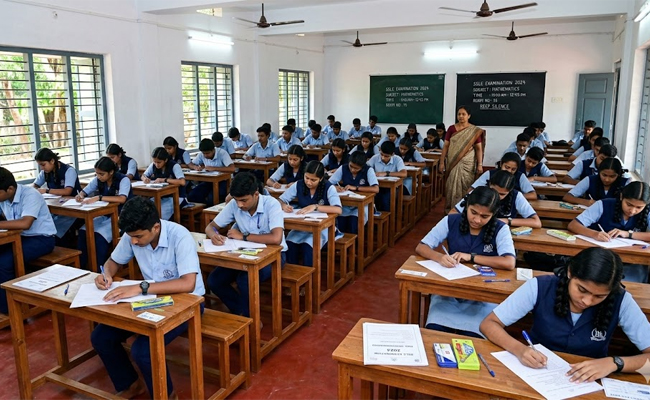
Bengaluru (PTI): The Karnataka School Education Department has issued a circular strictly prohibiting children from being made to dance to obscene songs in educational and cultural programmes.
It stated that such dances would negatively impact students' mental health and moral values. It will create indiscipline and harm the sanctity of education.
"All the Deputy Directors (Administration) of the state's School Education Department have been asked to take strict measures to prevent children or students from dancing to obscene songs in all government, aided and unaided schools in the state," the office of the commissioner of the School Education Department said in a recent circular.
"If it is found that children are being made to dance to obscene songs, appropriate action will be taken against the headmaster or management of such school," it added.
The department also listed certain measures in this regard, which include: strictly prohibiting children from being made to dance to obscene songs during educational and cultural programmes; selecting songs that are inspiring, positive, instilling national pride in children and reflecting the greatness, dignity, values, culture, and morality of the state.
Stating that the school headmaster and management are responsible for selecting songs and dances for cultural programmes, it said, they should also ensure that students wear decent clothes in dance or cultural programmes.