Praful Patel elected as FIFA Council member, first from India
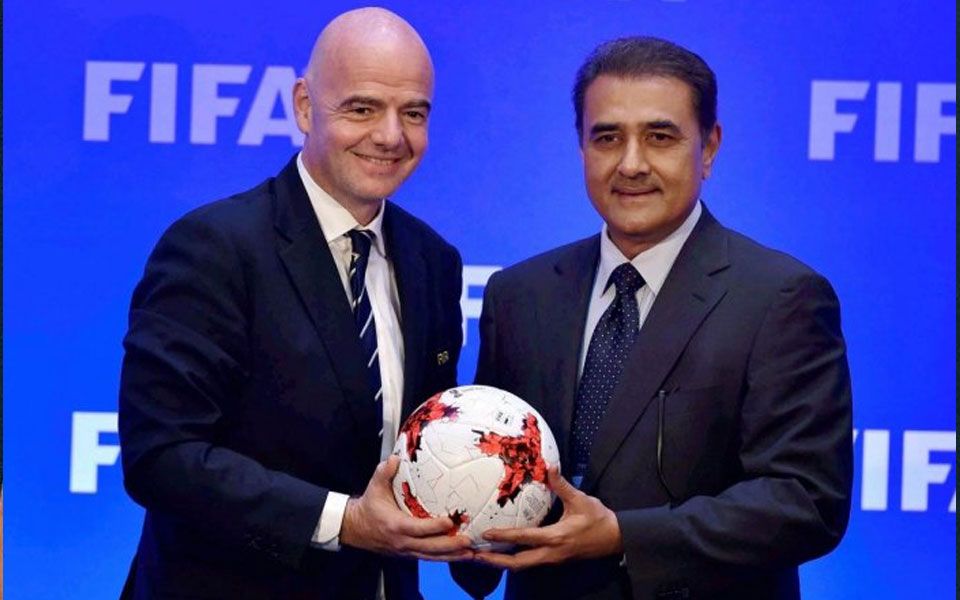
Kuala Lumpur: All India Football Federation president Praful Patel was Saturday elected as a FIFA Council member, becoming the first Indian to enter the prestigious panel in a landmark development.
Patel got 38 out of 46 votes.
The AIFF chief was one of the eight candidates vying for the spot in the election which was held during the 29th AFC (Asian Football Confederations) Congress in the Malaysian capital.
A total of five candidates, including Patel, was elected in addition to the AFC president, and one female member for the term 2019-2013.
"I am extremely humbled. I express my gratitude to all the members of the AFC who felt me suitable for the post. The responsibility as a FIFA Council member is huge. I would not only be representing my own country but the entire continent. Thank you all for your confidence for rapid progress of football in Asia," Patel stated.
Patel was accompanied by AIFF general secretary Kushal Das and senior vice-president Subrata Datta.
"Mr. Patel's victory is a "landmark for Indian football". Congratulations to Mr. Patel. He fully deserves this honour. His leadership has taken Indian football to greater heights. Asian football will immensely benefit from his presence as a FIFA Council member," Datta told PTI.
The AFC Electoral committee and the FIFA Review Committee conducted the eligibility review of the candidates.
Das said, "We at AIFF are extremely proud of him. This is a major development for India's football fraternity. Best wishes on his new endeavour."
Under Patel's leadership, AIFF has been awarded with the AFC's President Recognition award for grassroots at the AFC Annual Awards in 2014 in Manila, and was given an award for the AFC Best Developing Member Association at the in 2016.
The successful hosting of the FIFA U-17 World Cup drew lavish praise from all quarters, and India have also won the bid to host the FIFA U-17 Women's World Cup in 2020. The Indian Club Licensing system has also been dubbed as one of the best in Asia.
A Al- Mohannadi (Qatar), Khalid Awad A. Althebity (Saudi Arabia), Mariano V. Araneta, Jr. (Philippines), Chung Mong Gyu (Korea Republic), Du Zhaocai (China PR), Mehdi Taj (IR Iran) and Kohzo Tashima (Japan) were the others who contested for the five available spots in the council.
Earlier in the day, the congress re-elected Shaikh Salman bin Ebrahim Al Khalifa by acclamation as AFC president for a second four-year term until 2023.
Shaikh Salman, whose presidency began in May 2013, was the only candidate for the position.
There were initially three candidates confirmed by the AFC Electoral Committee following the completion of the eligibility checks on March 1. The number was reduced following the withdrawals of Mohamed Khalfan Matar Saeed Al-Romaithi (UAE) and Saoud A. Aziz M A Al-Mohannadi (Qatar) both of whom threw their full support behind Shaikh Salman.
Let the Truth be known. If you read VB and like VB, please be a VB Supporter and Help us deliver the Truth to one and all.
Rickelton's ton in vain as SRH beat MI by 6 wickets
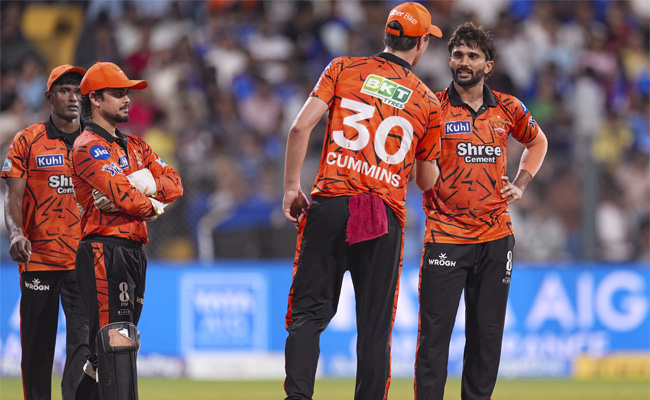
Mumbai (PTI): Ryan Rickelton's whirlwind unbeaten ton was overshadowed by Heinrich Klaasen's unbeaten 65 as Sunrisers Hyderabad defeated Mumbai Indians by six wickets in an IPL match here on Wednesday.
Chasing an imposing 244-run target, Travis Head (76 off 30) and Abhishek Sharma (45 off 24) shared 129 runs for the opening wicket to set the platform for SRH.
Klaasen (65 not out off 30 balls) then displayed his all-round hitting abilities to guide SRH home with the help of Nitish Kumar Reddy (21) and Salil Arora (30 not out off 10) in 18.4 overs.
Earlier, Rickelton's knock powered MI to 243 for five.
MI rode on a 93-run stand between Rickelton (123 not out off 55 balls) and Will Jacks (46 off 22) in 7.1 overs for the opening stand to power the side.
MI skipper Hardik Pandya scored a valuable 31 off 15 balls before being dismissed.
Praful Hinge (2/54), Eshan Malinga (1/29), Sakib Hasan (1/39) and Nitish Kumar Reddy (1/31) were the wicket-takers for SRH.
Brief Scores:
Mumbai Indian: 243 for 5 in 20 overs (Ryan Rickelton 123 not out; Praful Hinge 2/54).
Sunrisers Hyderabad: 249 for 4 in 18.4 overs (Travis Head 76, Heinrich Klaasen 65 not out; AM Ghazanfar 2/51).