Puja Tomar becomes first Indian to win in UFC

Kentucky, Jun 9: India's Puja Tomar scripted history as she became the first mixed martial arts fighter from the country to win a bout at the Ultimate Fighting Championship (UFC) in UFC Louisville here.
Debutant Tomar eked out a 30-27, 27-30, 29-28 split-decision win over Brazil's Rayanne dos Santos in the straw-weight (52kg) bout on Saturday.
"This win is not my win. This win is for all Indian fans and all Indian fighters. before everyone thought that Indian fighters did not stand anywhere. I only thought I have to win and show the world that Indian fighters are not losers," Tomar told Sony Sport Network after her win.
The 30-year-old, known as "cyclone", signed a contract with the UFC last year in October to become the first woman from India to compete in the biggest Mixed Martial Arts promotion.
Anshul Jubli and Bharat Kandare have represented India on the world stage in the UFC, as has Canada-based Arjan Singh Bhullar.
"I feel great, I had come from home thinking that I will win. I have worked really hard that's why I am here and the crowd is cheering me. I was very strong and motivated so that's why I won."
Born in Budhana village of Uttar Pradesh's Muzaffarnagar, Tomar is a five-time national wushu champion and also has a background in karate and taekwondo.
"I was confident of winning, I attacked a lot. But I wasn't able to give my 100 percent. I felt pressured in the second round. I need to improve on a lot of skills like take downs.
"My MMA journey was not easy, this win is for my mother, she has fought with the world for me. So this win is for her."
She has competed in other tournaments including Matrix Fight Night, where she won the straw-weight title twice.
MMA is a full-contact combat sport based on striking, grappling and ground fighting, incorporating techniques from various combat sports from around the world
Ultimate Fighting Championship is an American mixed martial arts promotion company.
Let the Truth be known. If you read VB and like VB, please be a VB Supporter and Help us deliver the Truth to one and all.
Xi, Trump reach series of new common understandings: China's foreign ministry
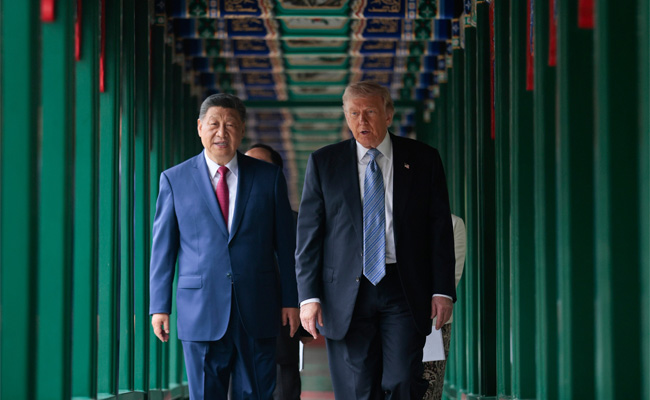
Beijing (PTI): Chinese President Xi Jinping and his US counterpart Donald Trump had an in-depth exchange of views on major issues concerning the two countries and the world, and reached a series of new common understandings, a Chinese foreign ministry spokesperson said Friday.
Xi and Trump, who is on a three-day visit to China, met twice on Thursday and discussed a range of bilateral and global issues.
Trump is due to leave on Friday after a luncheon meeting with Xi.
Summing up the outcomes of Trump’s visit to Beijing, a Chinese Foreign Ministry spokesperson said the two presidents had an in-depth exchange of views on major issues concerning the two countries and the world and reached a series of new common understandings.
They agreed on a new vision of building a constructive China-US relationship of strategic stability to provide strategic guidance for bilateral relations over the next three years and beyond.
The two presidents also agreed to promote the steady, sound and sustainable development of China-US relations, and bring more peace, prosperity and progress to the world, said a statement by the ministry’s spokesperson.
Trump visited China at the invitation of Xi.
The two presidents are meeting in person again for the first time since their Busan meeting last October, and it is the first visit to China by a US president in nine years, the statement said.
On Thursday, President Xi held a welcome ceremony and a banquet for Trump, held talks and visited the Temple of Heaven with him.
VIDEO | Beijing: On second day of bilateral talks, US President Donald Trump (@POTUS) thanks Chinese President Xi Jinping for 'incredible' China trip.
— Press Trust of India (@PTI_News) May 15, 2026
Trump says, "Thank you very much. This has been an incredible visit. I think a lot of good has come of it. We've made some… pic.twitter.com/7A7lbEzLdC