Pujara moves up to third spot in ICC rankings, Pant jumps 21 places
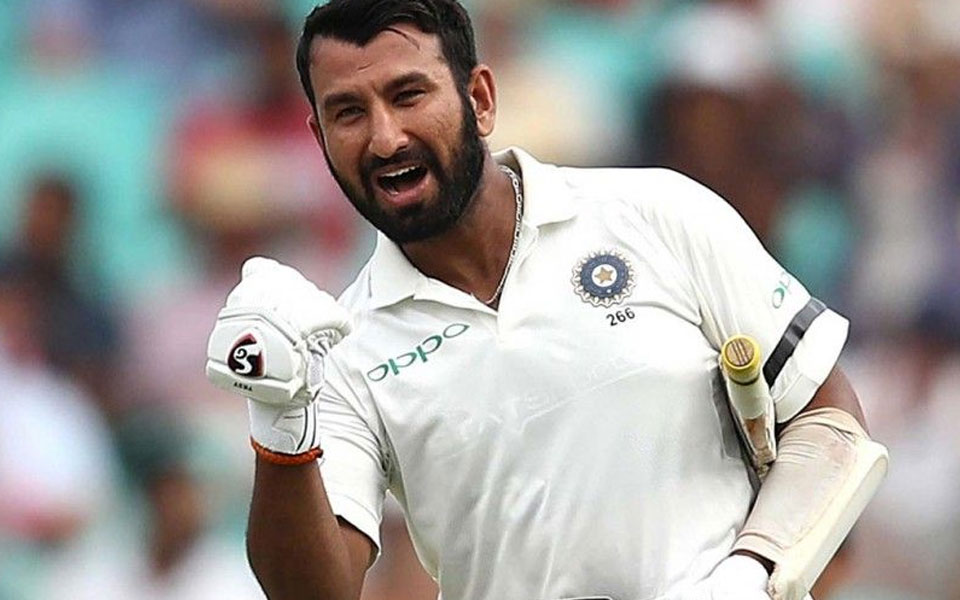
Dubai, Jan 8: Cheteshwar Pujara has gained a spot to be third in the latest ICC batsmen rankings, following his man of the series performance in India's maiden Test series win in Australia.
Wicket-keeper batsman Rishabh Pant has jumped as many as 21 places to be 17th, the joint-highest by a specialist India wicketkeeper along with Farokh Engineer, who did so in January 1973. M S Dhoni's highest Test ranking was 19th.
India captain Virat Kohli has maintained his number one position in the batsmen rankings.
Pant, a star at the ICC U19 Cricket World Cup in 2016 when he scored an 18-ball half-century against Nepal, has moved into the top-20 after only his ninth Test with an unbeaten 159. Pant had started the Australia tour in 59th place and made rapid progress, scoring 350 runs in a series that also saw him take 20 catches.
Pujara, who scored 521 runs to help beat Australia 2-1, is another batsman to gain in the latest rankings update, which also takes into account performances in the second Test between South Africa and Pakistan in Cape Town.
Pujara has gained one slot to reach third position while all-rounder Ravindra Jadeja (up six places to 57th) and rookie opener Mayank Agarwal (up five places to 62nd) are the others from his team to advance at the end of a historic series win.
Spinner Kuldeep Yadav has gained seven slots to reach a career-best 45th position after his figures of five for 99 in Australia's first innings even as Jasprit Bumrah has held on to 16th position and Mohammed Shami has gained one place to take the 22nd slot. Jadeja has gained one place to reach fifth among bowlers and has also leapfrogged Windies captain Jason Holder into second place among all-rounders.
South Africa's Aiden Markram has moved back into the top 10 after his knock of 78 at Cape Town, gaining seven slots to reach 10th position. Temba Bavuma has moved into the top 30 for the first time (up five places to 26th) after his score of 75 while captain Faf du Plessis's first-innings century has lifted him six places to 16th position.
Among their bowlers, Vernon Philander has gained one slot to reach third position while Duanne Olivier has continued his surge to move up to 32nd place from 36th.
There has been no change in position or points for leaders India in the team rankings, while Australia have lost one point but remain in fifth position.
Let the Truth be known. If you read VB and like VB, please be a VB Supporter and Help us deliver the Truth to one and all.
Rickelton's ton in vain as SRH beat MI by 6 wickets
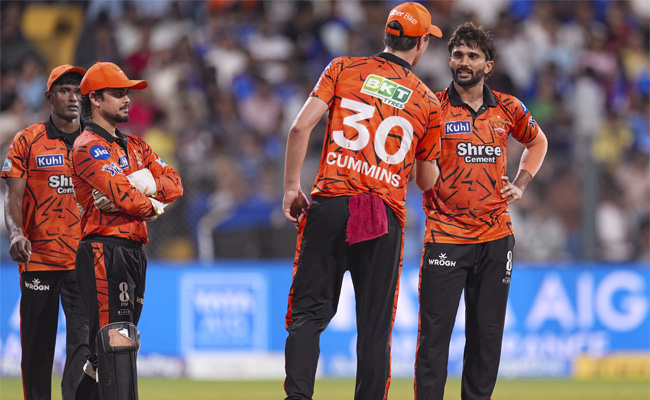
Mumbai (PTI): Ryan Rickelton's whirlwind unbeaten ton was overshadowed by Heinrich Klaasen's unbeaten 65 as Sunrisers Hyderabad defeated Mumbai Indians by six wickets in an IPL match here on Wednesday.
Chasing an imposing 244-run target, Travis Head (76 off 30) and Abhishek Sharma (45 off 24) shared 129 runs for the opening wicket to set the platform for SRH.
Klaasen (65 not out off 30 balls) then displayed his all-round hitting abilities to guide SRH home with the help of Nitish Kumar Reddy (21) and Salil Arora (30 not out off 10) in 18.4 overs.
Earlier, Rickelton's knock powered MI to 243 for five.
MI rode on a 93-run stand between Rickelton (123 not out off 55 balls) and Will Jacks (46 off 22) in 7.1 overs for the opening stand to power the side.
MI skipper Hardik Pandya scored a valuable 31 off 15 balls before being dismissed.
Praful Hinge (2/54), Eshan Malinga (1/29), Sakib Hasan (1/39) and Nitish Kumar Reddy (1/31) were the wicket-takers for SRH.
Brief Scores:
Mumbai Indian: 243 for 5 in 20 overs (Ryan Rickelton 123 not out; Praful Hinge 2/54).
Sunrisers Hyderabad: 249 for 4 in 18.4 overs (Travis Head 76, Heinrich Klaasen 65 not out; AM Ghazanfar 2/51).